Designing the Human AI Operating Model: Clear Ownership and Decision Rights by Consequence
In 2021, Okta completed its acquisition of Auth0 and announced that Auth0 would operate as an independent business unit reporting to Okta’s chief executive officer, establishing a documented boundary for leadership and operating responsibility. That fact does not establish how access decisions, data controls, or workflow redesign should work across the two businesses. In an identity context, the distinction is consequential: suggesting an access change differs materially from approving privileged access. A hypothetical cross-company workflow therefore needs explicit authority for recommendation, approval, execution, pausing, and remediation.
Without named owners, AI-enabled work redesign can produce faster recommendations but slower decisions, inconsistent baselines, and unclear accountability across the Chief Operating Officer, Chief Financial Officer, Chief Human Resources Officer, Chief Information Officer, and legal and risk functions. Routine access changes may be delegated, while privileged access or material control failures require escalation against defined thresholds. The Integration Management Office (IMO) can coordinate and record those decisions without becoming the permanent owner of the work. How can naming workflow owners and governing by consequence unlock accountable AI work redesign across COO, CFO, CHRO, and CIO?
The answer is a consequence-tier decision-rights register that assigns one end-to-end workflow owner, defines routine delegation, and specifies material escalation thresholds. It connects process performance, benefit validation and budget, role redesign and workforce choices, platform, data and security controls, and legal and risk review to explicit decisions rather than titles alone. With that artifact in place, governance becomes a practical mechanism for measurable value, controlled handoffs, and accountable AI-enabled change.

Framing the Human AI Operating Model
AI work redesign cannot sit inside the technology function. The Chief Operating Officer (COO) must own process performance, the Chief Financial Officer (CFO) must validate benefits and budget capacity, the Chief Human Resources Officer (CHRO) must govern role redesign and workforce choices, and the Chief Information Officer (CIO) must control platform, data, and security dependencies. Legal and risk functions must define the boundaries for acceptable use. Deloitte reports that 84% of companies have not redesigned jobs for AI, even as expectations for automation accelerate, exposing the gap between deploying tools and redesigning work around them. Operating model research similarly frames operating model design as central to converting AI investment into business value.
The target is not a large bureaucracy. It is a lightweight but rigorous operating model built around measurable outcomes, a documented baseline, one accountable owner, and a defined path for harvesting benefits. The NIST AI Risk Management Framework supports this discipline by treating governance as an ongoing responsibility across the AI lifecycle, rather than as a one time technical review. A practical operating model therefore records what changes in the workflow, which measure should improve, who can authorize the change, and what evidence will confirm that the benefit has been realized.
The distinction between structural intent and operating decisions matters. Okta announced that it completed its acquisition of Auth0 on May 3, 2021, and that Auth0 would operate as an independent business unit reporting to Okta’s CEO. That documented arrangement establishes a reporting choice, but it does not determine who should recommend an access policy change, approve privileged access, execute the change, pause the workflow, or own remediation when controls fail. Earlier future state operating model design reinforces the need to translate structural choices into explicit operating responsibilities rather than relying on organizational charts.
In a hypothetical cross company identity workflow, an AI tool could recommend access changes based on role, usage, and risk signals; the security product owner could approve routine low risk changes within a defined threshold; the CIO’s security delegate could approve privileged access; an automated control could execute approved changes; and the CIO could pause the workflow when data quality or control conditions deteriorate. The COO would own cycle time and exception rates, the CFO would validate avoided cost or capacity release against the baseline, and the CHRO would decide whether redesigned roles require retraining, reassignment, or hiring. The Integration Management Office (IMO) should coordinate and record those decisions, not become the permanent owner. The resulting consequence tier decision rights register becomes the usable artifact: it makes ownership, delegation, escalation, and benefit harvest paths visible before implementation begins.
Exposing Governance Gaps in AI Work
A privileged access recommendation can fail before any model makes a mistake. An AI enabled identity workflow may suggest removing access after detecting a role change, a product owner may approve the recommendation against an incomplete baseline, and operations may deploy it through an automated tool before security confirms that the user does not support a second tenant. The resulting exposure is not caused by weak model performance alone. It reflects a governance failure in which ownership was unclear, the consequence threshold was undefined, and automation moved faster than validation. The control that would have prevented the sequence is straightforward: any change involving privileged access, cross tenant exposure, or an unverified baseline must pause until the security authority and accountable business executive approve it.
Okta’s acquisition of Auth0 illustrates why organizational design does not resolve this problem by itself. When Okta completed the transaction on May 3, 2021, it stated that Auth0 would operate as an independent business unit reporting to Okta’s chief executive officer. That structure established a boundary, but it did not determine who would approve access policies, fund platform changes, validate benefits, or accept residual risk. The NIST risk framework defines consequence through potential harm and likelihood, giving executives a practical basis for assigning authority: higher consequence decisions require stronger evidence, clearer approval, and faster escalation. Independence can protect accountability, but only decision rights tied to consequences can govern the handoffs between units.
The operating sequence should therefore begin with ownership, not delegation. One workflow owner must remain accountable from recommendation through remediation, while the routine delegate receives authority only within a defined threshold; consequence thresholds must be established before automation expands the delegate’s reach. In the identity example, the Chief Information Officer owns platform, data, and security integrity, the Chief Operating Officer owns process performance, and the Chief Financial Officer validates benefits and budget, while the Chief Human Resources Officer determines whether redesigned roles require retraining, reassignment, or hiring. The Integration Management Office (IMO) coordinates dependencies, records decisions, and exposes unresolved issues, but it does not become the permanent owner of functional outcomes. Stanford’s 2026 AI Index reported that AI specific governance roles grew 17% in 2025, even as knowledge gaps affected 59% of organizations, budget constraints affected 48%, and regulatory uncertainty affected 41%, reinforcing the need to connect formal roles with actual operating decisions.
Without that interface, each function can complete its assigned task while the enterprise absorbs the consequences. The CFO may approve funding without a validated baseline, the CHRO may receive a workforce request before the process design is settled, and legal or risk may enter only after deployment. Earlier go to market governance work reinforces the need to connect executive priorities with daily operating decisions, while total cost analysis shows why unpriced technology and operating costs can erode value. The required artifact is a consequence tier decision rights register that records the workflow owner, routine delegate, approval authority, pause trigger, escalation threshold, remediation owner, and benefit validator for each material AI enabled process. Require that register, the validated baseline, and the escalation paths before permitting the workflow to scale.
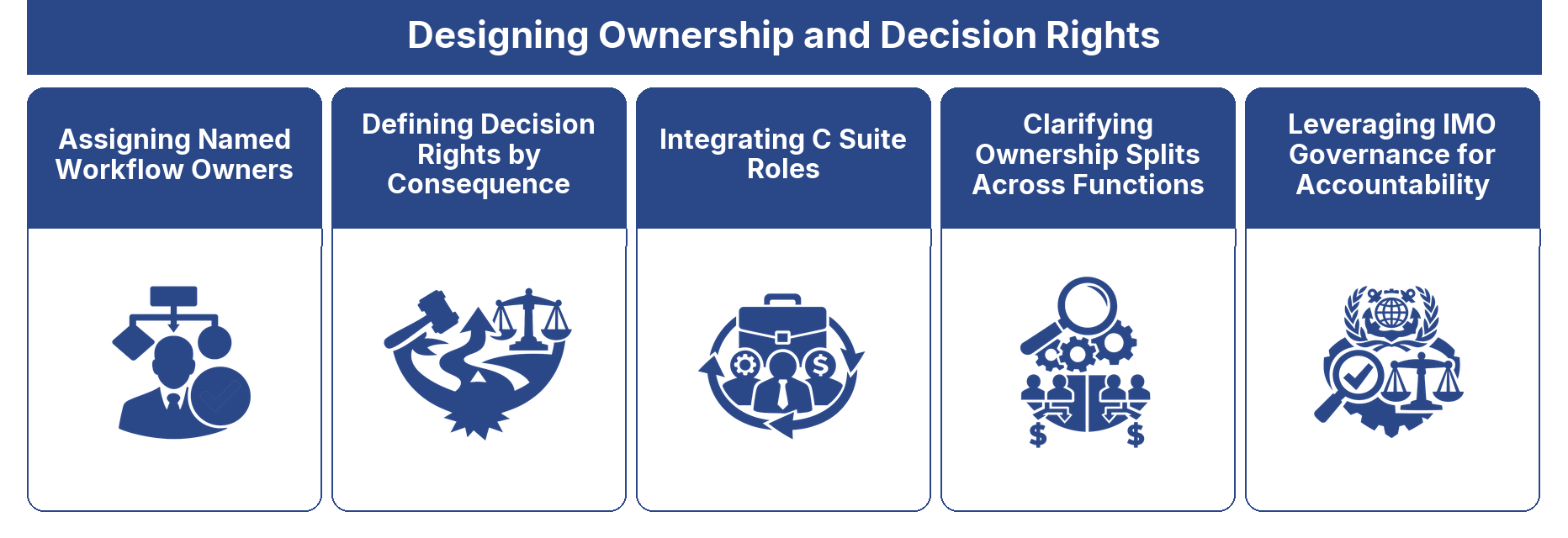
Designing Ownership and Decision Rights
A privileged access request is moving through an AI enabled workflow when the system flags unusual data movement, the security team recommends a pause, the business sponsor insists on continuity, and no one can determine who has authority to decide. The system has detected the risk. Governance has not. The same problem appears in large integrations, where reporting lines may look clear but decision rights remain unresolved.
In 2021, Okta completed its acquisition of Auth0 and announced that Auth0 would operate as an independent business unit. That structure clarified organizational autonomy, but it did not, by itself, determine who could approve, pause, or remediate a consequential workflow. The operating model must do that work.
A usable operating model converts accountability from an aspiration into a record of explicit decisions. The consequential design rule is straightforward: pause authority and remediation ownership must be assigned before execution is delegated. That sequence prevents a security team from stopping a workflow without an accountable business owner, or an operations team from continuing execution after a material control threshold has been breached. Earlier total cost analysis makes the same practical point from a financial perspective: value depends on assigning responsibility for costs, assumptions, and outcomes rather than merely listing them.
The resulting artifact is a consequence tiered decision rights register. Each row identifies the workflow owner, routine delegate, approval authority, pause trigger, escalation threshold, remediation owner, benefit validator, and decision date. The AI governance playbook from the National Institute of Standards and Technology supports this emphasis on accountable governance, while Harvard Business Review research reinforces that authority should accelerate collaboration rather than add another approval layer. Accountable redesign begins when authority is assigned to the workflow and calibrated to the consequence of failure.
Assigning Named Workflow Owners
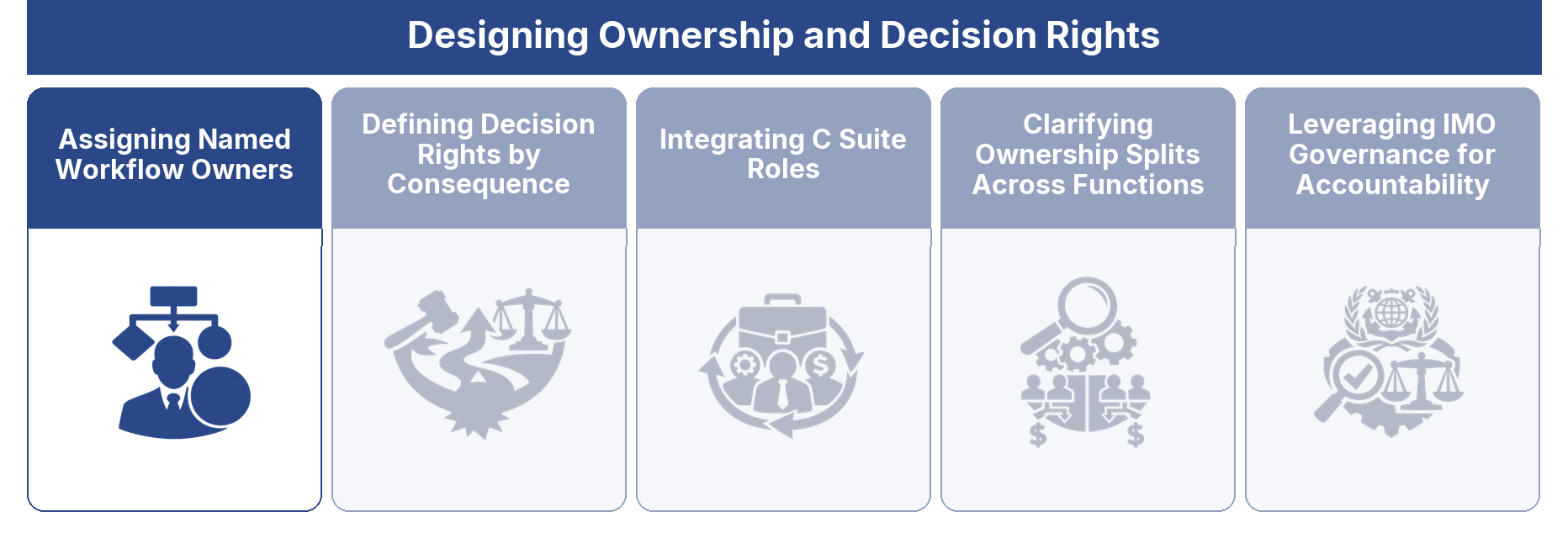
Every material AI enabled workflow needs one named end to end owner, even when execution crosses several functions. That owner is accountable for performance, control design, issue resolution, and the integrity of handoffs, while routine work may be delegated to an operations lead or product manager. A function can own a capability without owning the workflow outcome, which prevents technology, finance, or risk teams from becoming accidental substitutes for business accountability.
In a cross company identity access request, the security operations lead can recommend a change, the business unit leader can approve standard access, and the identity platform team can execute it. The workflow owner remains accountable for the result. If privileged access or unusual data movement triggers a pause, the owner must already be named before the request enters delegation. Without that rule, the system can stop activity but no accountable executive owns the evidence, remediation, or final disposition.
Defining Decision Rights by Consequence
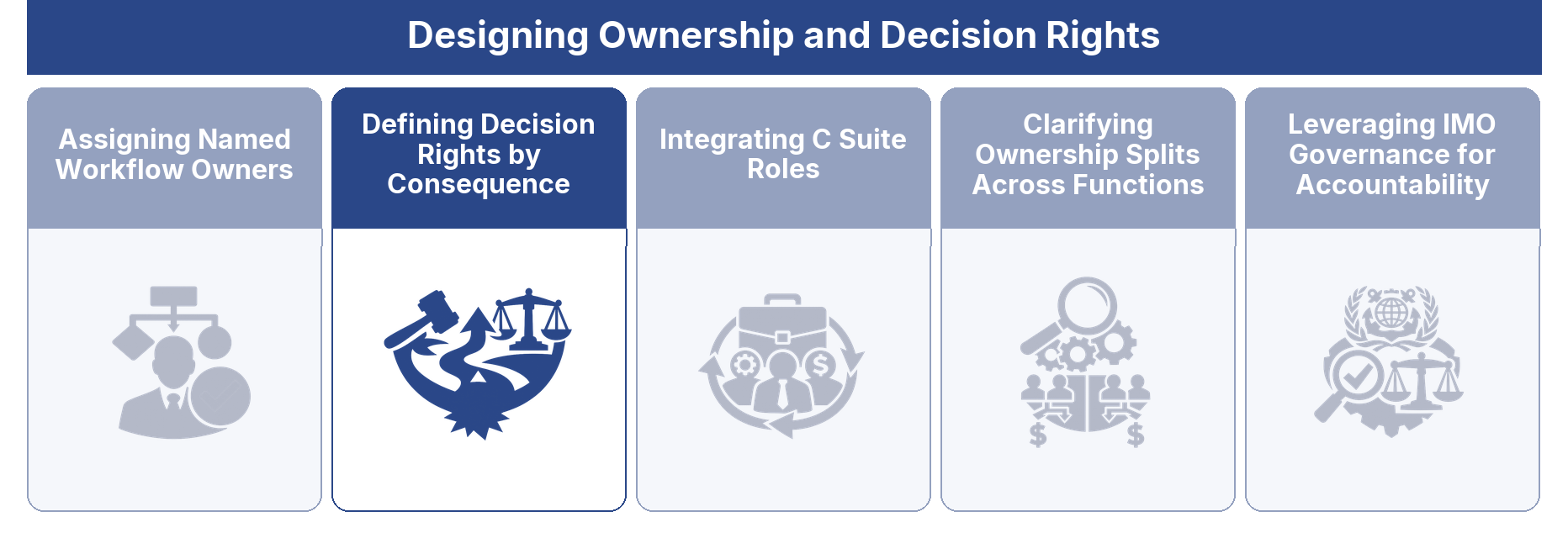
Decision rights should follow consequence, not organizational seniority. Low consequence and reversible decisions can remain with the workflow team, while decisions involving customer data, regulatory exposure, material spend, workforce structure, or strategic commitments require a higher approval threshold. Harvard Business Review’s guidance on matching authority to consequences provides a useful basis for this separation.
The register must define the trigger and the response together. A standard recommendation may proceed, an approval may be withheld pending evidence, and a pause may stop execution without transferring remediation to the team that detected the issue. NIST’s AI governance playbook similarly frames governance as an ongoing discipline of assigning roles, monitoring risk, and responding when conditions change. The threshold changes the outcome: a control breach should first activate pause authority, then route remediation to the workflow owner, rather than allow routine delegation to continue by default.
Integrating C Suite Roles
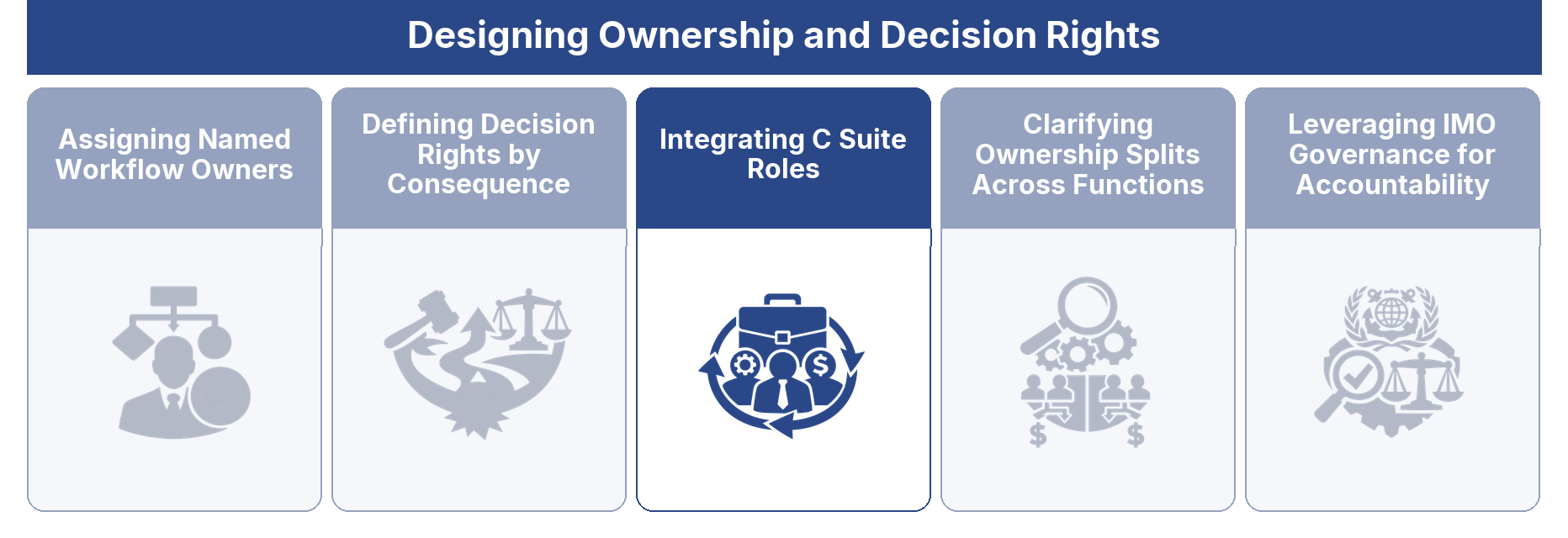
C suite participation works when each executive owns a distinct consequence, not when every executive reviews every decision. In the identity workflow, the operating executive must resolve service disruption, the finance executive must validate any claimed savings or incremental cost, and the technology executive must confirm that the platform can enforce the proposed control. Legal, risk, and human resources become decision participants only where the request creates an obligation, exposure, or workforce implication within their remit.
The conflict becomes visible when one handoff is missing. If the business leader approves access without a finance or risk threshold, the workflow may create unrecorded cost or exposure; if the technology leader can block execution without a remediation owner, the control becomes a permanent bottleneck; if the operating executive owns continuity but not the benefit claim, reported value can enter the case without operational proof. Research on organization and governance levers supports explicit accountability over diffuse executive sponsorship.
Clarifying Ownership Splits Across Functions
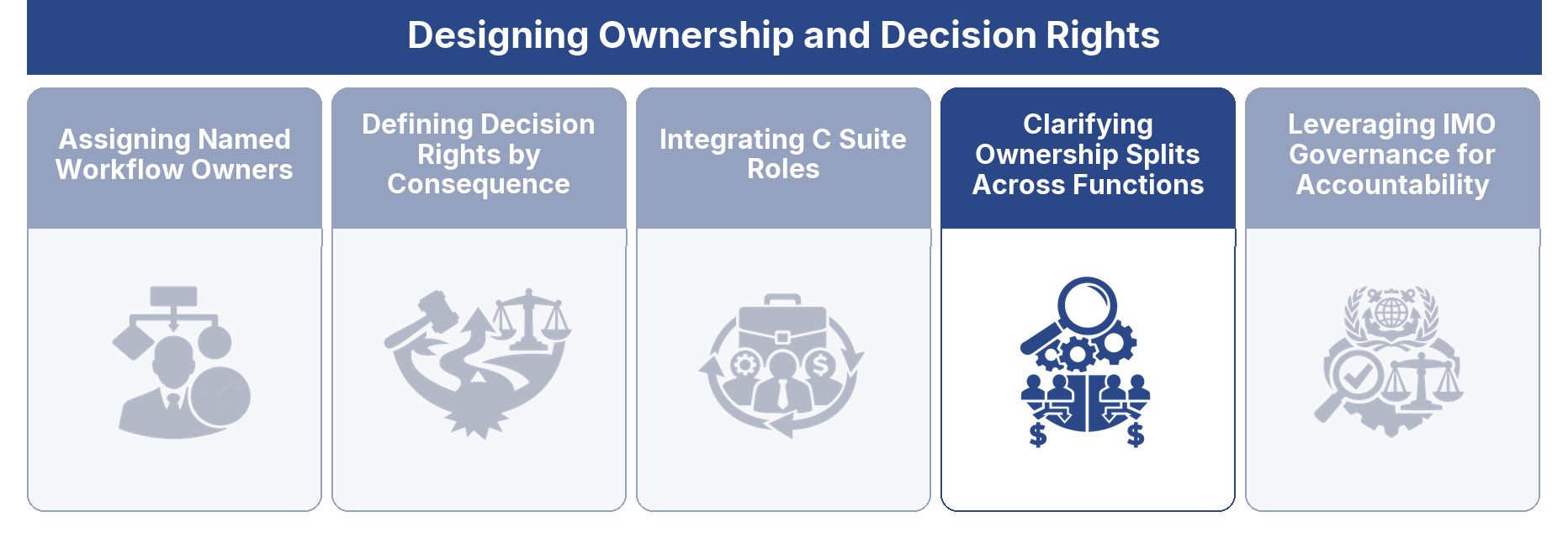
Functional ownership should be divided by decision type while preserving a single workflow owner. In the identity access example, the business sponsor owns the access need, the technology organization owns platform execution, security owns control enforcement, legal and risk own policy interpretation, and finance validates incremental cost or benefit assumptions. None of those responsibilities permits a function to override another outside its defined authority.
The register should distinguish recommend, approve, execute, pause, and remediate. That vocabulary exposes conflicts before they become delays. A security team can pause a privileged access request because a control threshold was breached, but the workflow owner remains responsible for obtaining missing evidence, resolving the issue, and recording the final disposition. Prior integration governance discipline reinforces the importance of separating decision authority from coordination activity. The split is effective only when every pause has a corresponding path to resolution.
Leveraging IMO Governance for Accountability
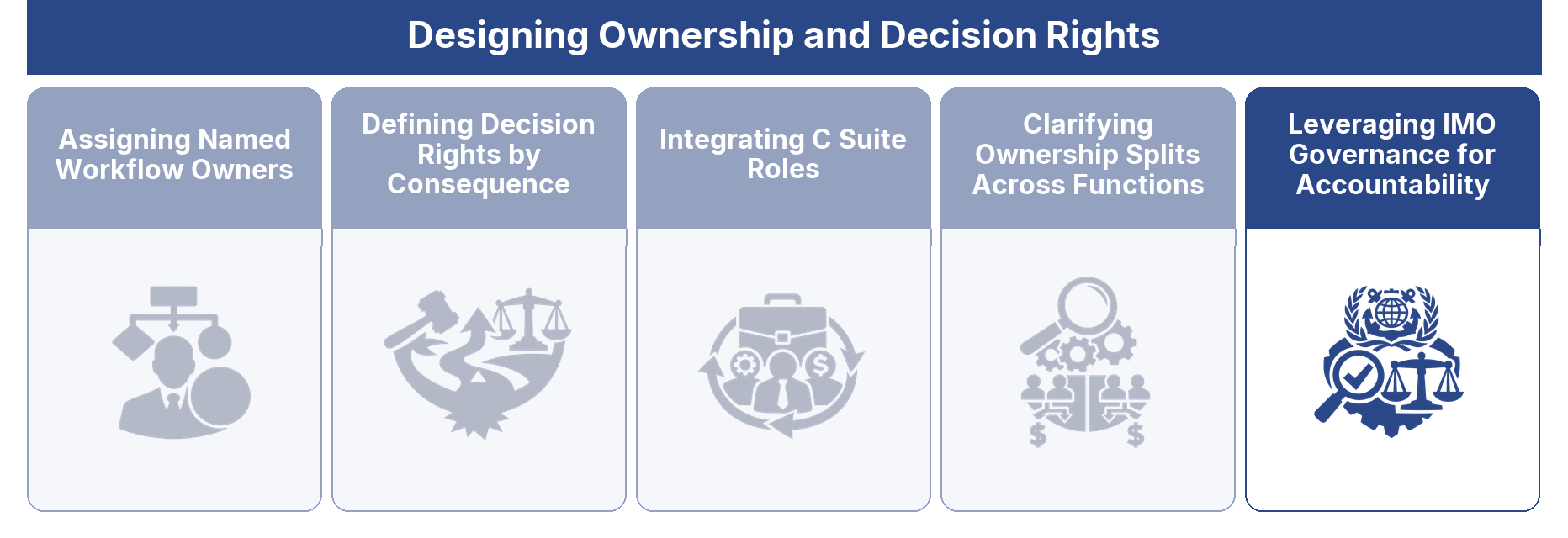
The Integration Management Office (IMO) should maintain the register, convene decisions, track escalations, and record outcomes, but it should not become the permanent owner of business processes. Its value lies in making governance visible and lightweight: one decision log, one escalation path, one owner for each open issue, and phase gates tied to the deal thesis or transformation objective. The IMO can require a decision by a stated date, but the accountable executive must still make or delegate that decision.
The final artifact should show the workflow owner, routine delegate, approval authority, pause trigger, escalation threshold, remediation owner, and benefit validator in one consequence tiered register. Each row should also carry a status, evidence link, decision date, and transition condition for moving from IMO oversight into ongoing operations. This structure prevents the common failure in which an escalation is recorded but no one owns the cure. Approve no workflow for scale until its owner, pause trigger, and remediation authority are recorded.
Synthesizing Governance Outcomes Across IMO
AI value depends less on the sophistication of a model than on the operating discipline surrounding its decisions. When work crosses technology, operations, finance, human resources, and risk, accountability must move from broad sponsorship to explicit authority, with each decision tied to its consequence, evidence standard, and escalation path. A consequence tier decision rights register gives executives that control surface: it clarifies who recommends, who approves, who executes, who can pause the workflow, and who owns remediation. The Integration Management Office (IMO) coordinates and records those decisions, while functional leaders retain durable accountability.
Looking ahead, disciplined practitioners should implement the register against one end to end workflow, establish routine delegation rules, and codify material escalation thresholds before deployment expands. The COO should govern process performance, the CFO should validate benefits and budget exposure, the CHRO should formalize role and workforce choices, the CIO should own platform, data, and security controls, and legal and risk leaders should define non negotiable boundaries. Teams should stand up the governance rhythm, instrument decision and exception logs, and execute a formal review when outcomes, access levels, or regulatory exposure cross the agreed threshold. The practical test is simple: every consequential AI decision should have an identifiable owner before the system acts.

Get new articles by email
Insights on M&A, revenue growth, and business transformation, delivered occasionally.