
Enterprise AI for Organizational Value: Workforce Enablement, Functional Intelligence, and Operational Transformation
In 2017, Intel made a bet on machine intelligence when it acquired Mobileye for about $15.3 billion to accelerate autonomous driving. The thesis paired Intel compute with Mobileye computer vision, mapping data, and automotive relationships. The integration challenge was operating design: Mobileye needed autonomy to keep innovating while Intel needed visibility into data, talent, and commercialization. Stakeholders watched whether an AI capability could become organization wide value, a governance question sharpened when Intel took Mobileye public again.
That tension intensifies in business to business software as a service (B2B SaaS) Mergers and Acquisitions (M&A), where generative AI, machine learning, and analytics sit across product, go to market, finance, and customer success. Data ownership fragments; decision rights blur. Without an Integration Management Office (IMO), governance, training, and workflow redesign remain disconnected. How can organizations unlock organization wide value from Enterprise AI by enabling the workforce, delivering functional intelligence, and orchestrating end to end transformation within a B2B SaaS M&A context?
The answer starts with treating AI as an operating model, not a feature backlog. In SaaS acquisitions, value creation depends on mapping capabilities to business outcomes, establishing data stewardship, and embedding decision support into daily work. Regulatory pressure, private equity expectations, and talent risk raise the cost of fragmented adoption. Disciplined leaders build scalable platforms, metrics, and change programs that convert experimentation into repeatable operational advantage.

Situating Enterprise AI Value
Adobe’s proposed acquisition of Figma for about $20 billion in 2022 showed why artificial intelligence value cannot be evaluated as a product feature question alone. The strategic logic of that deal centered on collaborative design workflows, creator communities, and the enterprise systems surrounding how teams produce digital work, not merely another application inside a portfolio. The same logic applies to AI: the highest value use cases often sit across work patterns, functional decisions, and operating cadence. Treating AI as a feature backlog narrows the ambition before the organization has defined where value creation actually occurs.
The adoption curve is already broad enough to expose the gap between activity and enterprise value. OpenAI reports more than 7 million ChatGPT workplace seats, with ChatGPT Enterprise seats increasing approximately 9x year over year, evidence that usage has moved beyond experimentation into daily work. Deloitte’s enterprise AI research found that productivity and efficiency gains lead realized benefits so far, with 66% of organizations reporting improvement. Yet productivity alone is a shallow value pool if it remains trapped in individual tasks, disconnected from customer operations, finance workflows, engineering prioritization, and go to market decisions.
A practical value model therefore needs three lenses: workforce enablement, functional intelligence, and transformation. Workforce enablement asks whether employees can use AI safely, repeatedly, and measurably in the moments where work actually happens; functional intelligence asks whether teams such as sales, product, finance, legal, and customer success can make faster, better decisions from shared data; transformation asks whether the operating model changes enough to alter cycle times, service quality, cost structure, or competitive advantage. EY captures the risk of fragmented adoption clearly, reporting that while 88% of employees use AI at work, only 28% of organizations are positioned to translate that activity into meaningful business outcomes. Usage is not transformation. It is raw material.
That conversion requires foundations before scale: an explicit operating model, governance prerequisites, and a data roadmap. Prior analysis of B2B SaaS transformation emphasized that a clear vision serves as the organization’s guiding star, and AI raises the cost of ambiguity because models amplify both discipline and disorder. McKinsey’s 2025 research found that AI high performers, defined as organizations seeing significant value and at least 5% earnings before interest and taxes impact, represent only about 6% of respondents. The implication is direct: organizations need data stewardship, decision rights, risk controls, adoption metrics, and change management before deploying AI at enterprise scale. Without those foundations, AI becomes a faster way to reproduce fragmented processes; with them, it becomes an operating system for measurable value creation.
Highlighting Enterprise AI Adoption Barriers
Artificial Intelligence (AI) adoption rarely stalls because the model cannot generate an answer; it stalls because the enterprise cannot supply the context, controls, and ownership required to make that answer usable. Deloitte reports that 66% of organizations have already achieved productivity and efficiency gains from enterprise AI, yet only 42% believe their strategy is highly prepared for adoption across infrastructure, data, risk, and talent, exposing a gap between ambition and operating readiness in enterprise AI preparedness. Data silos, inconsistent definitions, incomplete customer records, and fragmented governance turn AI into a mirror of existing process debt. The result is not transformation; it is faster propagation of inconsistent decisions.
The organizational barrier is equally material. Harvard Business Review describes how fear of replacement, rigid workflows, and entrenched power structures can derail AI initiatives, even when tools are technically capable. In B2B SaaS environments, the friction often appears as a decision rights problem: product owns the roadmap, sales owns the account motion, customer success owns adoption signals, finance owns performance thresholds, and information technology owns the architecture, but no single forum reconciles tradeoffs across functions. Prior analysis of adaptive change management reinforces the same operating lesson: communication, training, and stakeholder engagement determine whether new capabilities become adopted behaviors.
AI also requires a higher standard of data stewardship than traditional analytics because outputs depend on the integrity, lineage, and permissioning of the information flowing through the system. EY’s 2025 Work Reimagined Survey captures the adoption disconnect clearly: while 88% of employees now use AI at work, only 28% of organizations are positioned to translate that activity into meaningful business outcomes, underscoring the need for organizational context and controls. Anthropic’s Economic Index adds a complementary signal, noting that consumer and employee AI adoption reached 40% in 2024 while nine out of ten United States businesses reported not using AI at the firm level, a striking indicator of uneven enterprise deployment. The bottleneck is not curiosity. The bottleneck is institutionalization.
In mergers and acquisitions, that bottleneck becomes more acute because the enterprise must reconcile duplicated systems, overlapping data models, conflicting governance norms, and divergent cultures while still protecting deal momentum. The Dell EMC combination, a $67 billion transaction announced in 2016 to integrate a sprawling enterprise technology portfolio, illustrates the scale of enterprise portfolio integration that can sit beneath a strategic acquisition rationale. In that environment, an Integration Management Office (IMO) becomes a strategic imperative, not an administrative layer, because AI decisions must connect system migration, data harmonization, risk controls, workforce enablement, and synergy realization. A disciplined roadmap converts fragmented experimentation into sequenced value creation, giving leadership a practical path from isolated pilots to integration success.
Operationalizing Enterprise AI Value
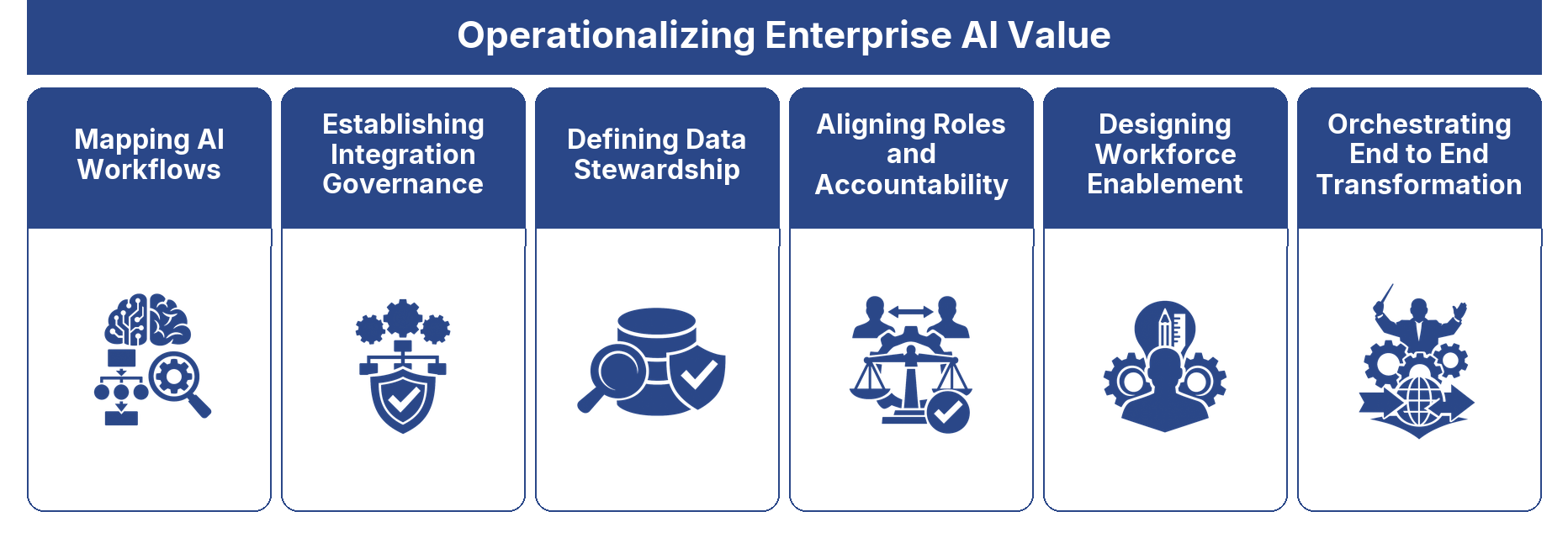
Enterprise Artificial Intelligence (AI) value becomes operational only when leadership treats it as a managed transformation, not a portfolio of tools. The practical sequence is straightforward: map workflows where intelligence changes economics, assign decision rights through the Integration Management Office (IMO), establish trusted data foundations, redesign roles around accountable outcomes, enable the workforce, and phase adoption into critical business processes. OpenAI’s enterprise guidance notes that leveraging AI differs from deploying conventional software because value depends on changing how work actually gets done.
Mapping AI Workflows
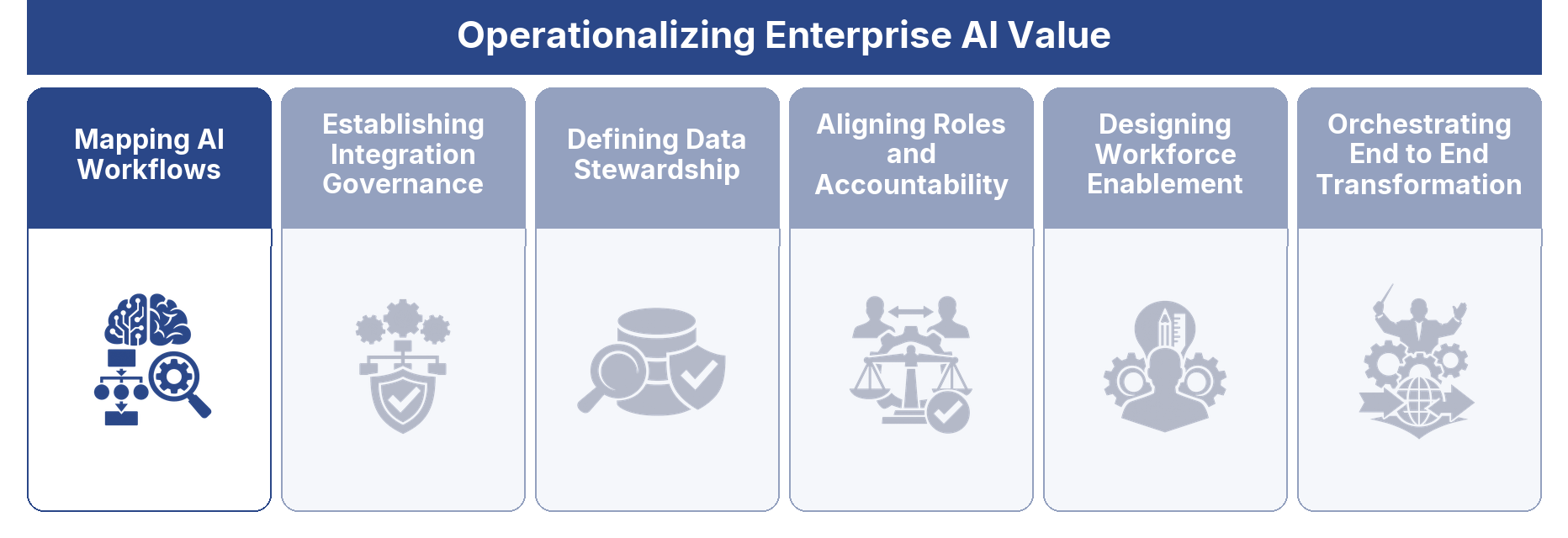
AI workflow mapping should start with value pools, not use cases. Leaders should identify where speed, judgment, personalization, quality control, or exception handling materially affects revenue, margin, risk, or customer retention, then rank those workflows by feasibility and economic impact. McKinsey argues that generative AI in operations must be deployed as digital transformation, not merely as a technology upgrade, which makes process selection the first strategic choice. A customer support workflow, for example, may produce faster returns than a speculative forecasting pilot if it reduces handle time, improves escalation quality, and creates measurable service level gains. Prior analysis of scalable operating processes reinforces the same discipline: operational excellence begins when process design, metrics, and accountability move together.
Establishing Integration Governance
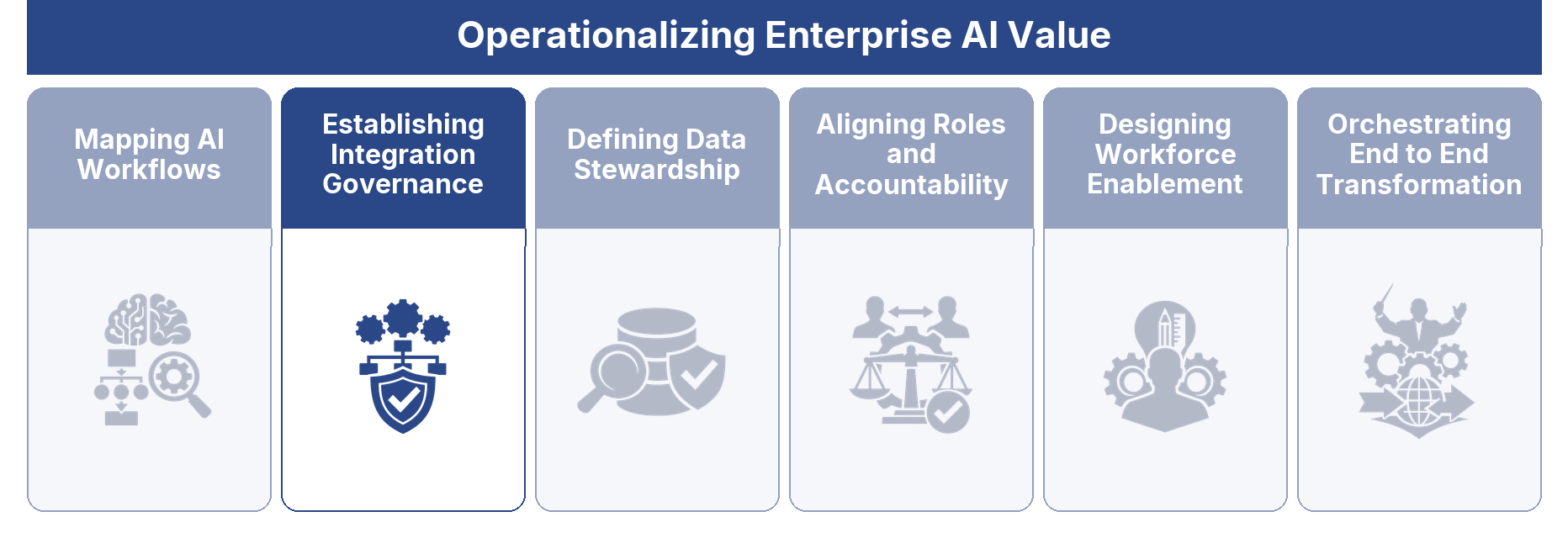
The IMO should become the control tower for AI decisions that cross functions, systems, risk domains, and business owners. Without that anchor, finance may evaluate savings, technology may manage platforms, legal may focus on compliance, and business units may chase local productivity, while no one owns enterprise level value creation. The governance model should define which AI initiatives require executive approval, which data domains need stewardship signoff, which workflows can use automated recommendations, and which decisions require human review. In IBM’s acquisition of Red Hat, the strategic rationale depended on preserving open source culture while scaling hybrid cloud reach, a useful parallel for AI governance because enterprise discipline cannot smother the operating norms that create value. Governance must clarify boundaries, not freeze progress.
Defining Data Stewardship
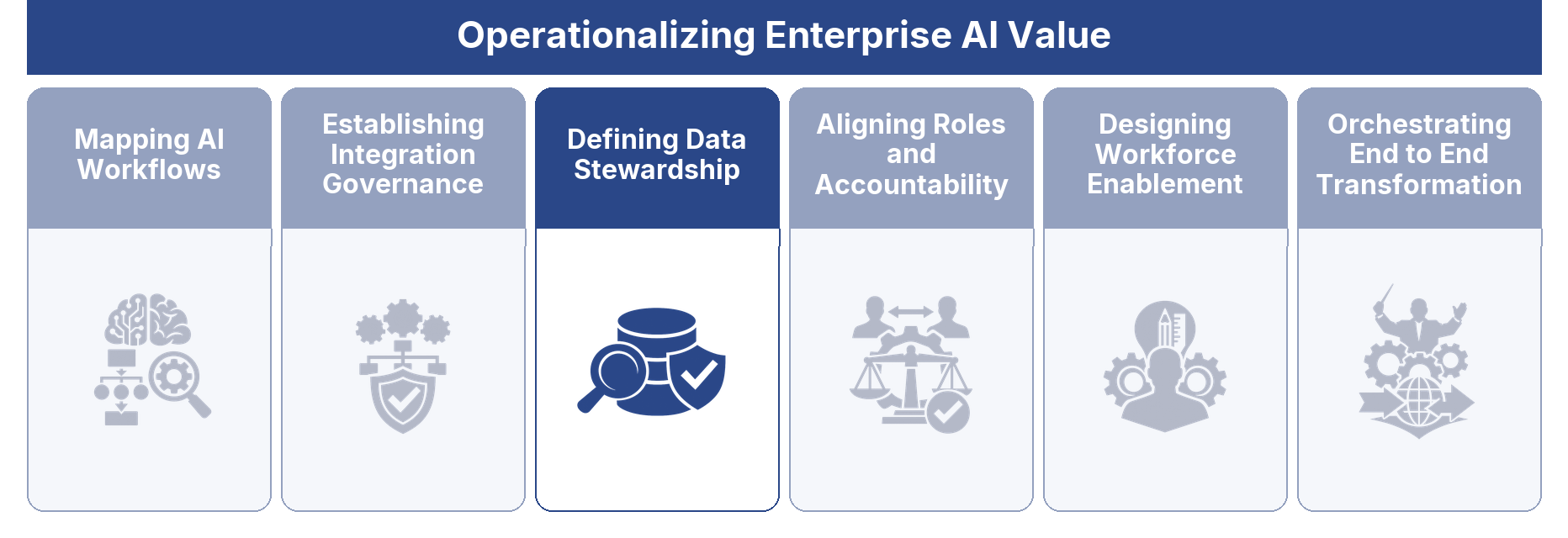
Trusted AI requires more than access to data. It requires clear ownership of definitions, lineage, permissions, quality thresholds, and remediation paths when outputs fail inspection. EY’s 2025 Work Reimagined Survey captures the execution gap: 88% of employees use AI at work, yet only 28% of organizations are positioned to convert that activity into meaningful business outcomes. That gap often reflects weak data architecture, fragmented master data, and unclear stewardship rather than weak model performance. The IMO should force each AI enabled workflow to declare its source systems, data owners, quality controls, and exception protocols before deployment, because an intelligent workflow built on contested data becomes a faster way to scale mistrust.
Aligning Roles and Accountability
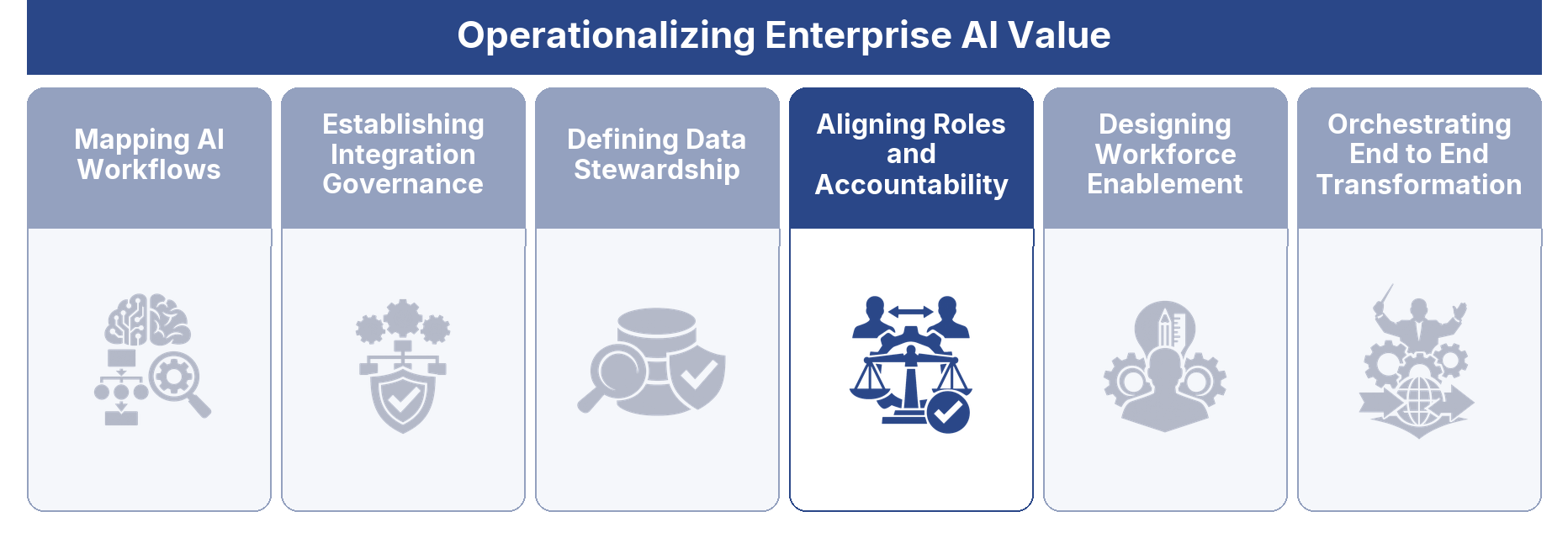
AI operating models fail when accountability remains trapped in pre AI job descriptions. Each workflow needs an accountable business owner, a technology owner, a data steward, a risk reviewer, and frontline users who can identify when recommendations do not match operational reality. OpenAI describes five enterprise value models in which workforce empowerment builds the fluency that makes governance and deeper system integration possible, which places role design near the beginning of the roadmap rather than at the end. In practice, accountability should attach to outcomes such as cycle time reduction, conversion improvement, error rate decline, or working capital release. A role matrix that lacks performance metrics is documentation. It is not governance.
Designing Workforce Enablement
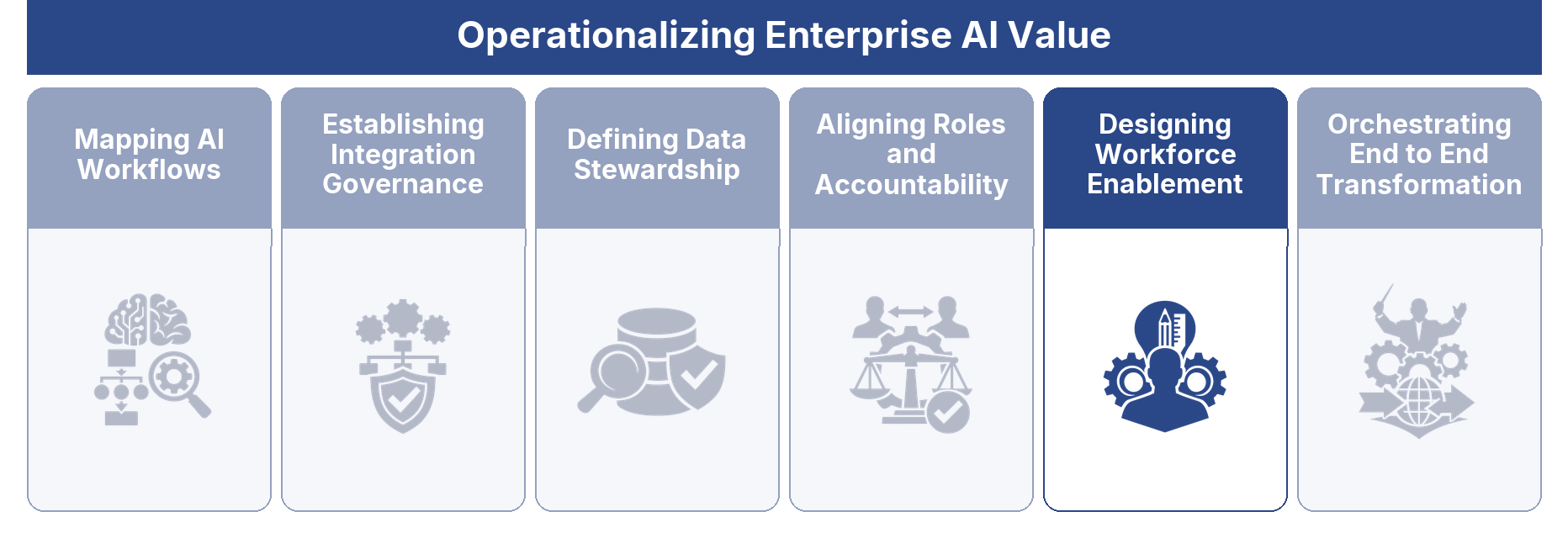
Workforce enablement should be designed as capability building tied to operating metrics, not as a training calendar. Employees need role specific instruction on when to rely on AI, when to challenge outputs, how to escalate exceptions, and how performance will be measured after adoption. MIT Technology Review describes enterprise AI as an operating layer that can improve consistency, throughput, and operational gains when people and systems work together. That makes change management the anchor that keeps synergy plans on track. Training impact should be measured against real performance data, including adoption rates, exception volume, productivity gains, quality scores, and employee confidence, because learning has value only when it changes the work.
Orchestrating End to End Transformation
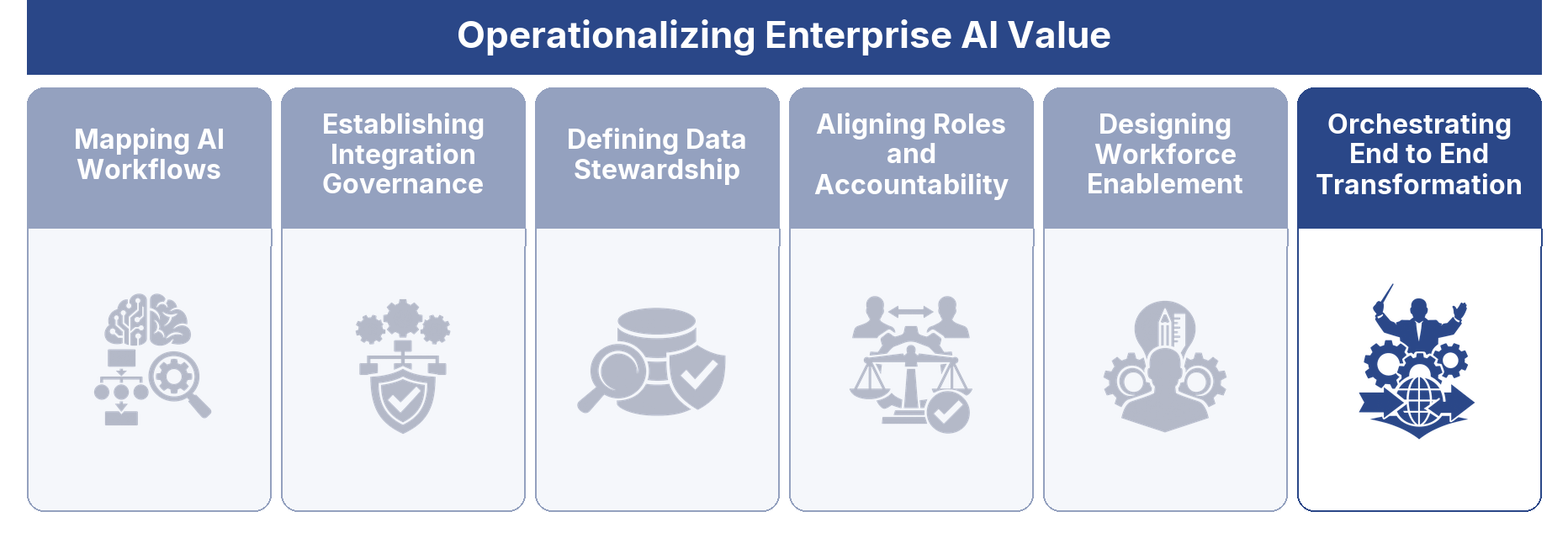
The final step is phasing AI enabled workflows into critical processes through milestone based value delivery. Leadership should avoid both extremes: unfunded experimentation that never scales and large transformation spending that cannot prove value. The better path sequences workflows by readiness, funds integration costs against measurable outcomes, and expands only after data quality, adoption, and business impact meet defined thresholds. HBR’s sponsored analysis emphasizes that AI creates stronger value when organizations embed it into core systems influences that shape products, pricing, customer engagement, and speed to market. Earlier work on integration strategy discipline makes the same operating point in another context: strategic rationale becomes real only when leadership translates it into choices about capabilities, sequencing, and execution ownership. AI value follows that rule exactly.
Operationalizing Enterprise AI Across the Organization
AI value does not emerge from model access alone. It emerges when leadership connects customer outcomes, functional workflows, data readiness, governance, and workforce adoption into one operating system for change. Adobe’s proposed acquisition of Figma underscored the strategic stakes: in technology markets, advantage increasingly depends on how quickly organizations can combine capability, creativity, and control without breaking the culture that makes innovation valuable. The so what for executives is direct. AI must move from experimentation theater to managed transformation, where use cases have owners, operating metrics reveal friction, and adoption becomes a discipline rather than a hope.
Looking ahead, disciplined organizations will establish accountable business owners, design use cases around measurable customer and employee outcomes, instrument operational and financial signals, codify risk controls, and deploy AI into workflows where judgment, context, and accountability already exist. They will also stand up governance that can escalate blocked decisions, sequence investment against readiness, and operationalize change management before enthusiasm outruns execution capacity. The question facing leadership is no longer whether AI will reshape enterprise work, but how quickly the organization can build the management muscle to turn intelligence into durable value creation.
AI value does not emerge from model access alone. It emerges when leadership connects customer outcomes, functional workflows, data readiness, governance, and workforce adoption into one operating system for change. Adobe’s proposed acquisition of Figma underscored the strategic stakes: in technology markets, advantage increasingly depends on how quickly organizations can combine capability, creativity, and control without breaking the culture that makes innovation valuable. The so what for executives is direct. AI must move from experimentation theater to managed transformation, where use cases have owners, operating metrics reveal friction, and adoption becomes a discipline rather than a hope.
Looking ahead, disciplined organizations will establish accountable business owners, design use cases around measurable customer and employee outcomes, instrument operational and financial signals, codify risk controls, and deploy AI into workflows where judgment, context, and accountability already exist. They will also stand up governance that can escalate blocked decisions, sequence investment against readiness, and operationalize change management before enthusiasm outruns execution capacity. The question facing leadership is no longer whether AI will reshape enterprise work, but how quickly the organization can build the management muscle to turn intelligence into durable value creation.

Get new articles by email
Insights on M&A, revenue growth, and business transformation, delivered occasionally.