

Product AI vs Enterprise AI: Framing the Two Classifications for B2B SaaS
In 2025, a global customer relationship management software leader agreed to acquire Informatica for about $8 billion, positioning the transaction around the trusted data foundation behind agentic AI. The price signaled more than a platform expansion; it reflected a strategic imperative to connect customer-facing AI with governed enterprise data. For deal teams, the classification problem appeared before integration began, because AI embedded in products required different ownership, metrics, and release discipline than AI used to improve internal execution. Product, go-to-market, security, finance, and integration stakeholders were all looking at the same technology wave through different operating lenses.
That distinction often collapses during B2B SaaS M&A, when AI roadmaps become a single undifferentiated budget line. Product leaders pursue differentiated customer experiences and retention signals, while enterprise teams pursue governance, automation, workforce enablement, and decision velocity. Without shared language, synergy realization slows, stakeholder alignment weakens, and early return on investment signals become difficult to interpret. How can a thorough understanding of the taxonomy separating Product AI from Enterprise AI improve alignment, GTM, and integration planning in B2B SaaS M&A?
A practical taxonomy creates two parallel value streams: AI that customers buy, use, and experience, and AI that organizations deploy to scale operations. That separation improves investment discipline because each stream carries a distinct audience, value proposition, funding logic, and success metric. It also matters now as regulatory scrutiny, private equity pressure, and integration complexity force acquirers to prove AI value with greater precision. The disciplined operator treats taxonomy as an operating system for prioritization, governance, measurement, and integration success.

Establishing a Two Class AI Taxonomy for B2B SaaS
HubSpot reported that AI adoption among sales teams grew to 43% in 2024, while 87% of salespeople said AI helped them use customer relationship management tools more effectively. That pattern captures the broader B2B SaaS reality: AI no longer sits in a single innovation queue, because it now appears in product roadmaps, sales workflows, support operations, finance controls, and management reporting. The proliferation creates energy, but it also creates budget ambiguity. Without a shared classification, executives compare unlike investments and ask a single return on investment question of initiatives that serve fundamentally different purposes.
The first class is customer facing Product AI, where AI becomes part of the bought experience and can change differentiation, packaging, adoption, and retention. The second class is organization facing Enterprise AI, where AI improves workforce productivity, decision quality, governance, and operating leverage. Andreessen Horowitz describes AI native applications ingesting contextual data across software workflows rather than relying only on static database records, a shift that makes the boundary between feature value and operating capability harder to manage. The practical answer is not to suppress overlap, but to classify the primary value motion before funding, staffing, or measuring the initiative.
The distinction matters because customers experience AI as product value, while enterprises fund AI as transformation capacity. In Product AI, the investment case typically belongs with roadmap priority, pricing architecture, competitive positioning, and go to market (GTM) enablement. In Enterprise AI, the investment case belongs with process redesign, data readiness, governance, change management, and workforce adoption. Prior analysis of pricing and packaging discipline reinforces the commercial implication: when capability becomes differentiated value, packaging decisions must preserve pricing integrity rather than burying AI inside undifferentiated bundles.
The same taxonomy also improves integration planning after mergers and acquisitions, because the Integration Management Office (IMO) can separate AI that must remain visible to customers from AI that should standardize the operating model. Microsoft’s about $26 billion acquisition of LinkedIn in 2016 illustrates the strategic importance of protecting a customer network while still pursuing broader platform value. AI raises that integration challenge because models, data rights, governance controls, and user trust all travel with the value proposition. The Traccia research paper argues that taxonomy based decomposition helps match AI architecture to regulatory and operational requirements, which is precisely why B2B SaaS leaders need a practical classification before the portfolio becomes a maze of disconnected experiments.
Complicating Alignment Across Product and Enterprise AI
Artificial Intelligence (AI) initiatives fracture when product and enterprise teams use the same vocabulary to mean different things. Product teams naturally optimize for release velocity, customer facing differentiation, and adoption signals, especially in a market where Andreessen Horowitz observes that 10x is the new 3x for breakout AI software growth. Enterprise programs, by contrast, require longer planning horizons, governance controls, data stewardship, security review, and stakeholder alignment across legal, finance, sales, support, and operations. Without a shared taxonomy, these motions do not compound; they collide.
The distinction matters because AI value increasingly depends on operating context, not just model capability. Harvard Business Review describes a General Motors design case in which an AI generated component was 40% lighter and 20% stronger, yet failed to reach production because the supply chain and manufacturing system could not support it. That pattern translates directly to B2B SaaS: a product team can ship an impressive feature while the enterprise lacks the data rights, workflow readiness, trust controls, or commercial packaging to scale it. The product may work, but the system cannot absorb it.
Mergers and Acquisitions (M&A) intensify the alignment problem because the combined entity inherits two product roadmaps, two operating models, two data architectures, and two versions of customer truth. Salesforce’s acquisition of Slack for about $27.7 billion illustrates the strategic ambition behind this pattern: collaboration, customer data, and workflow intelligence needed to reinforce a broader platform thesis, not sit as disconnected product capability. In integrations of this shape, the recurring failure mode is misaligned workstreams and undefined ownership across product, go to market, information technology, finance, human resources, and data governance. Prior analysis of integration planning and execution reinforces the same operating lesson: synergy realization depends on coordinated execution, not post close optimism.
Metrics create the final complication. MIT Sloan Management Review research with Boston Consulting Group, based on a global survey of 3,043 respondents, highlights the need to understand how key performance indicators interact across connected business activities. When AI programs lack clear audiences, product managers may measure usage, enterprise leaders may measure productivity, and finance leaders may wait for hard return on investment before approving scale funding. ACM Computing Surveys adds that distribution shift complicates alignment, meaning systems that perform well in one environment may degrade when deployed into another. Ambiguous metrics therefore obscure early ROI signals, delay prioritization, and make the five part taxonomy that follows a strategic imperative rather than a labeling exercise.
Defining a Practical Taxonomy Driven AI Framework
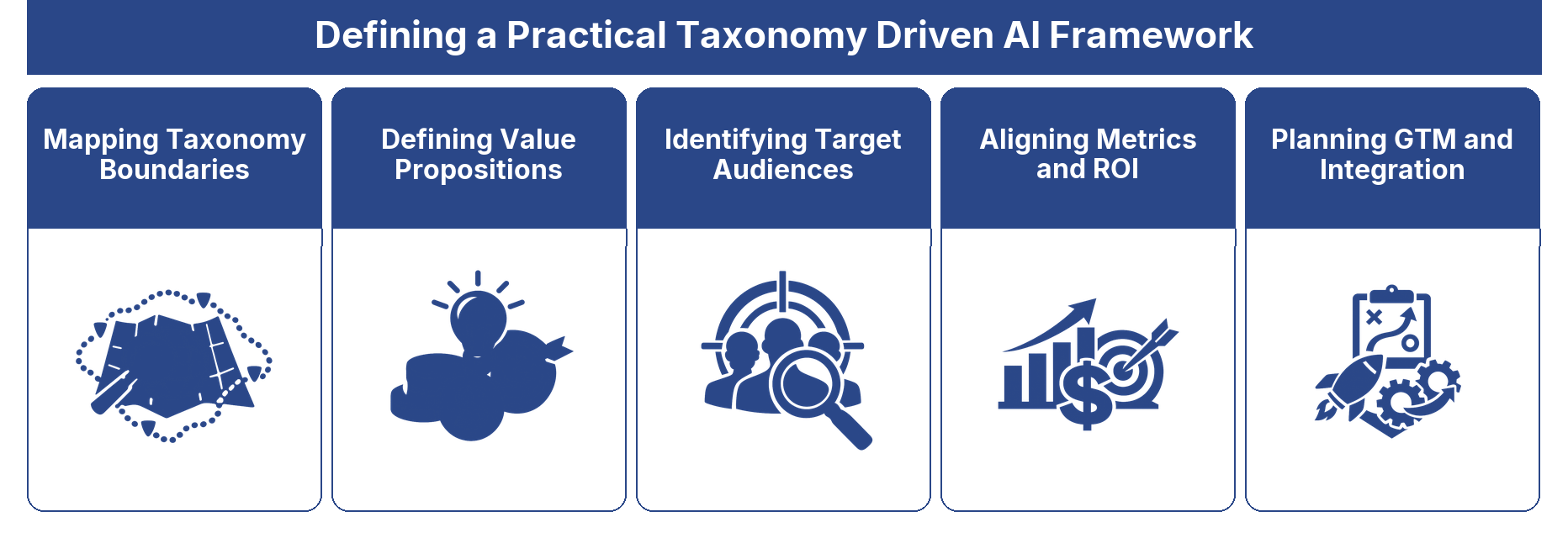
A practical taxonomy starts with one management premise: Product Artificial Intelligence (AI) and Enterprise AI are parallel value streams, not competing labels. Product AI creates customer facing differentiation through features, workflows, agents, and embedded intelligence inside the software platform; Enterprise AI improves the operating model through automation, analytics, decision support, and productivity gains inside the company. The distinction matters during Mergers and Acquisitions (M&A), because integration teams that collapse both streams into one backlog usually blur ownership, dilute capital allocation, and slow the path from thesis to measurable value creation.
Mapping Taxonomy Boundaries
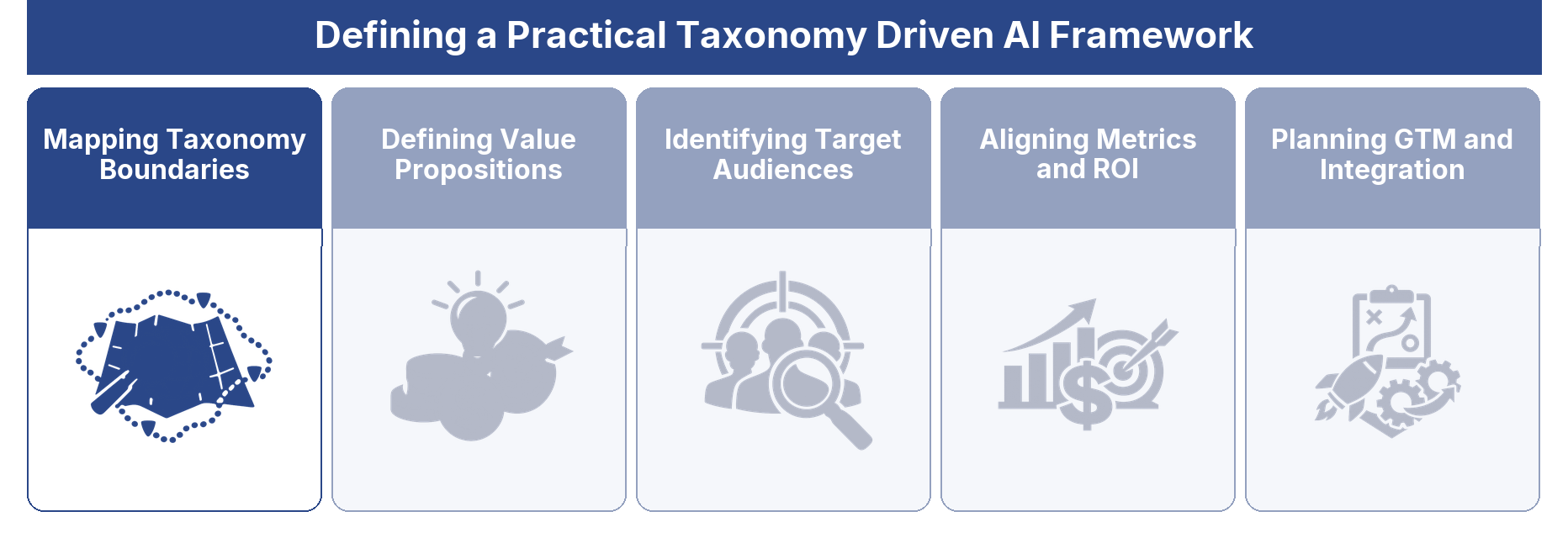
Classification should begin with boundaries, because unclear boundaries turn every AI idea into a priority. The first screen asks whether the initiative changes the customer product experience or the enterprise operating model, then tags each use case by workflow, data dependency, risk exposure, and strategic objective. A 2026 arXiv assessment of AI development methods selected six frameworks for comparison, reinforcing the broader point that AI execution improves when teams move from prompts and experiments to structured process taxonomies. In an acquisition context, IBM’s acquisition of Red Hat for about $34 billion offers a useful operating analogy: preserving Red Hat’s independence helped protect the open source model while IBM pursued an open hybrid cloud future. AI taxonomy should apply the same discipline, separating what must be integrated from what must be protected.
Defining Value Propositions
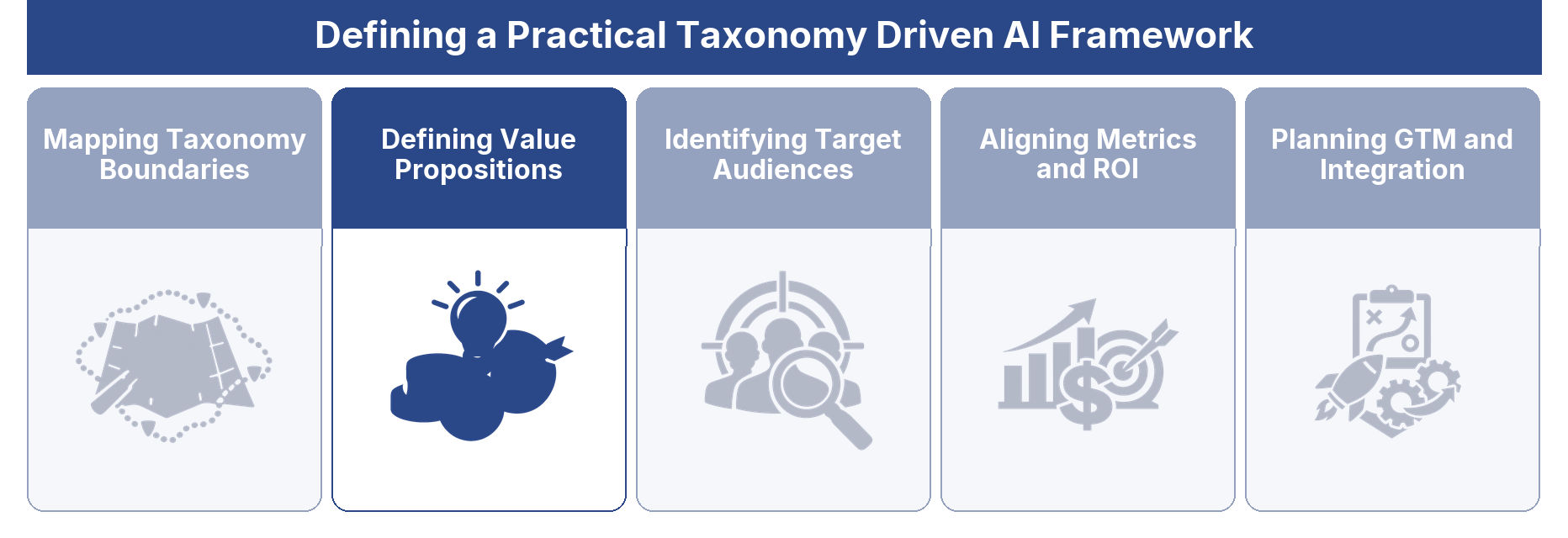
Once classification is clear, each AI stream needs a distinct value proposition. Product AI should answer how the offering improves customer outcomes: faster task completion, better recommendations, lower error rates, richer analytics, or new monetizable capabilities. Enterprise AI should answer how the organization performs better: shorter cycle times, reduced manual work, improved forecasting, cleaner compliance, or better management visibility. NIST’s AI Use Taxonomy emphasizes human goals and outcomes, a useful standard because both streams ultimately succeed only when a defined audience experiences a measurable improvement. Prior work on technology evaluation discipline framed the same logic: strategic fit, feasibility, market impact, and return on investment must filter promising ideas before leadership funds scale.
Identifying Target Audiences
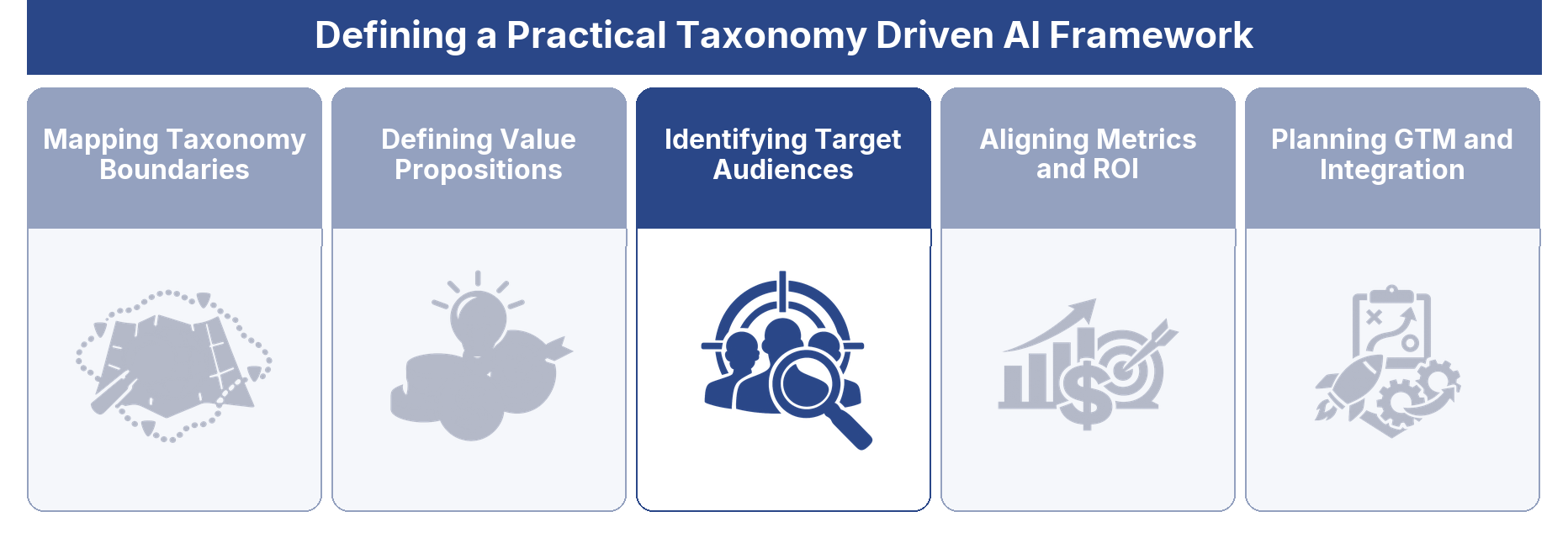
Audience mapping prevents AI strategy from becoming a technology inventory. Product AI serves buyers, users, administrators, developers, partners, and customer success teams, each with different adoption barriers and proof points. Enterprise AI serves employees, managers, executives, finance teams, legal teams, sales operations, engineering operations, and the Integration Management Office (IMO), each with different workflow constraints and governance needs. The ACM review of explainable AI notes that the field has expanded so quickly that annual publications now exceed several hundreds, which illustrates why leaders need audience specific classification rather than generic AI enthusiasm. For B2B SaaS companies, the practical implication is direct: a support agent copilot, a product recommendation engine, and an internal revenue forecast assistant may share model infrastructure, but they require different adoption motions, controls, and success owners.
Aligning Metrics and ROI
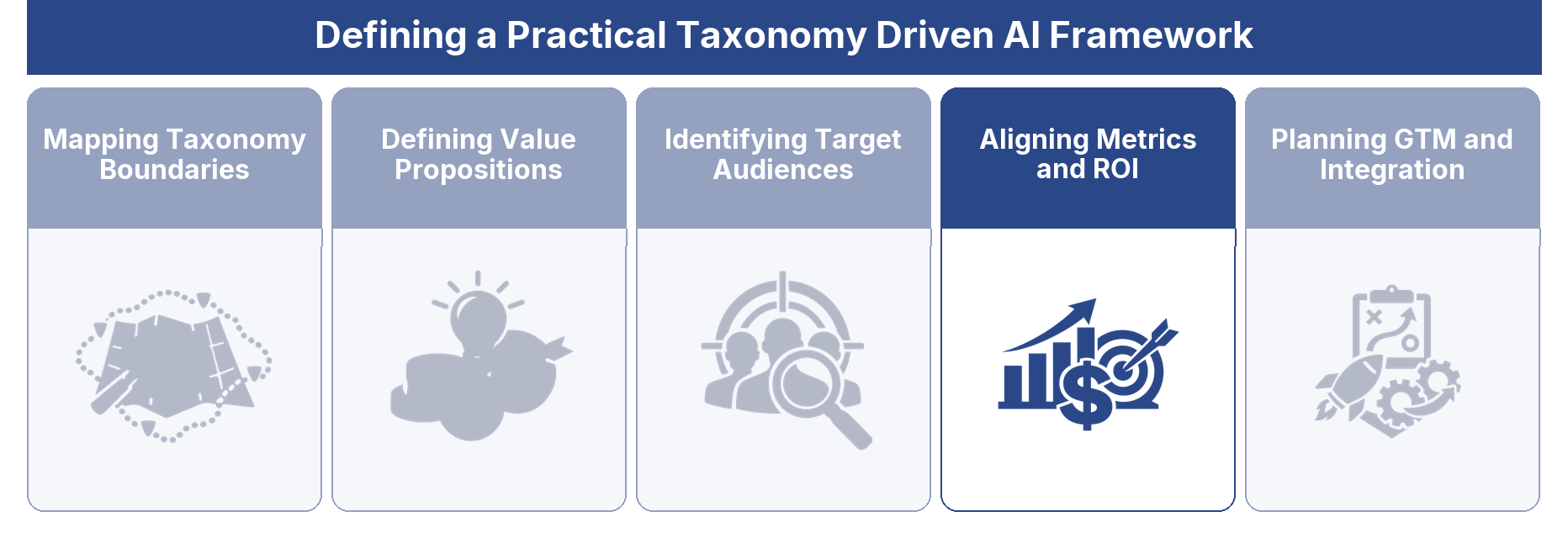
Metrics should follow the value stream, not the technology. Product AI needs commercial and customer metrics such as feature adoption, expansion revenue, conversion lift, retention impact, support deflection, usage frequency, and net revenue retention contribution. Enterprise AI needs operating metrics such as hours removed, cycle time compression, forecast accuracy, ticket resolution speed, compliance throughput, and cost to serve reduction. The NIST trustworthy AI taxonomy links evaluation to efficiency, effectiveness, and user satisfaction, which gives executives a practical triad for comparing unlike initiatives without pretending that every AI use case belongs on the same scorecard. This is also where financial discipline matters: prior analysis of total cost of acquisition highlights how speed and deal pressure can undermine analytical rigor, especially when integration costs, data readiness, and capability gaps sit outside the headline valuation.
Planning GTM and Integration
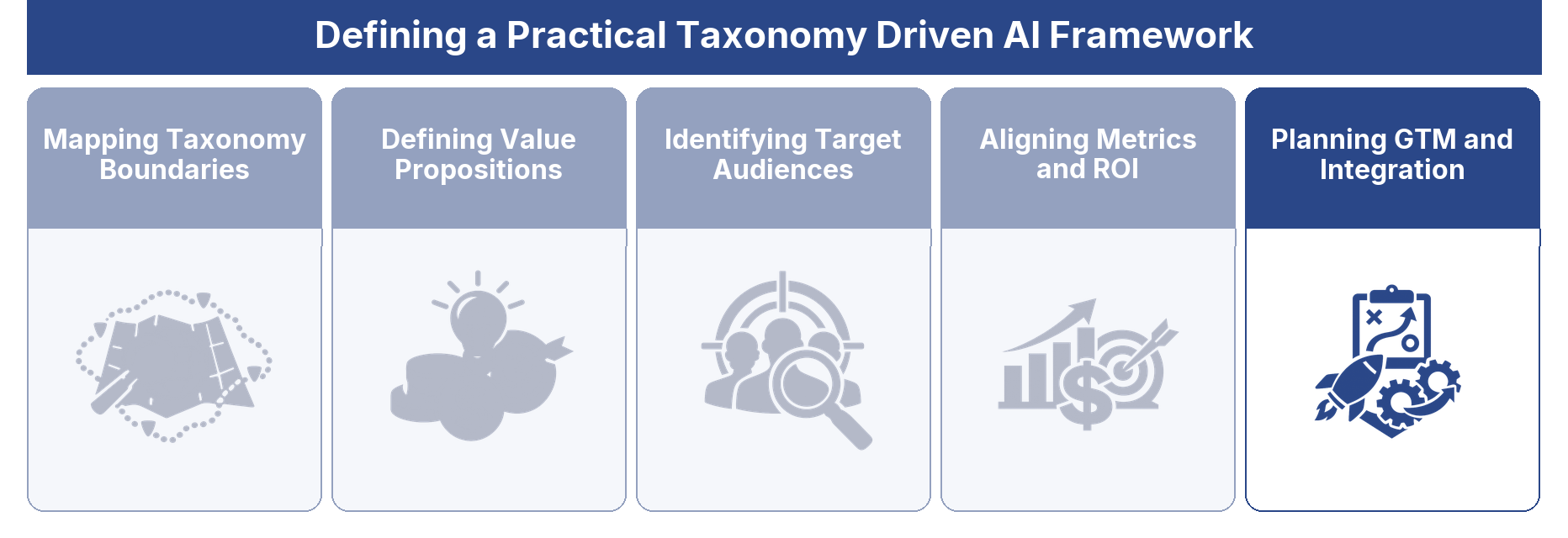
The final step connects taxonomy to execution, because Product AI and Enterprise AI require different launch paths. Product AI needs go to market (GTM) planning: packaging, pricing, sales enablement, customer education, proof of value design, support readiness, and roadmap integration. Enterprise AI needs transformation planning: process redesign, data access, controls, change management, workforce adoption, and IMO governance. Salesforce’s acquisition of Tableau for about $15.7 billion shows the product side logic clearly, adding self service analytics to the platform through an all stock transaction; Oracle’s acquisition of NetSuite for about $9.3 billion illustrates the enterprise platform logic, extending cloud enterprise resource planning while protecting service continuity for customers. The taxonomy gives leaders a sequencing mechanism: deliver fast customer value where Product AI strengthens competitive advantage, while building scalable enterprise transformation where internal AI compounds operational excellence after close.
That sequencing becomes especially important when talent, roles, and accountability shift during integration. Prior work on competency framework design underscores the need to define behaviors and standards by role, which applies directly to AI product managers, data scientists, solution engineers, functional process owners, and integration leaders. Without that clarity, governance becomes a committee exercise. With it, Product AI and Enterprise AI become managed portfolios, each tied to strategy, stakeholders, investment logic, and synergy realization.
Synthesizing Taxonomy Driven Value Across Functions
AI programs create value when language, ownership, and measurement match the work being done. Product AI improves the customer facing offering, changes the roadmap, and alters the commercial promise. Enterprise AI improves the operating model, reshapes internal workflows, and raises productivity. Treating both as one generic initiative obscures accountability, diffuses investment discipline, and turns stakeholder alignment into a vocabulary debate rather than a value creation agenda.
With the framework established, B2B SaaS leaders can establish separate value streams, charter accountable owners, and instrument distinct metrics for customer impact, operational efficiency, risk, and adoption. Management teams can then sequence investments by strategic priority, govern shared platforms without collapsing the taxonomy, and embed AI decisions into product planning, go to market execution, finance reviews, and operating cadences. The practical shift is simple but consequential: classify the work before funding the work. The organizations that operationalize this distinction fastest will not merely run cleaner AI portfolios; they will build a stronger basis for competitive advantage.
AI programs create value when language, ownership, and measurement match the work being done. Product AI improves the customer-facing offering, changes the roadmap, and alters the commercial promise. Enterprise AI improves the operating model, reshapes internal workflows, and raises productivity. Treating both as one generic initiative obscures accountability, diffuses investment discipline, and turns stakeholder alignment into a vocabulary debate rather than a value creation agenda.
With the framework established, B2B SaaS leaders can establish separate value streams, charter accountable owners, and instrument distinct metrics for customer impact, operational efficiency, risk, and adoption. Management teams can then sequence investments by strategic priority, govern shared platforms without collapsing the taxonomy, and embed AI decisions into product planning, go-to-market execution, finance reviews, and operating cadences. The practical shift is simple but consequential: classify the work before funding the work. The organizations that operationalize this distinction fastest will not merely run cleaner AI portfolios; they will build a stronger basis for competitive advantage.

Get new articles by email
Insights on M&A, revenue growth, and business transformation, delivered occasionally.