Integrating Product and Engineering: Roadmaps, Architecture, and Delivery Across the Combined Tech Stack
In 2021, Salesforce, a leading B2B software company, completed the Slack acquisition by Salesforce for about $27.7 billion to anchor its collaboration layer across Customer 360. The deal preserved Slack as a largely autonomous unit while wrapping it into Salesforce’s platform to protect Slack’s collaboration culture. In the ensuing months, product and engineering roadmaps began to converge on a shared value proposition, yet data models and APIs remained friction points. Cross-functional teams faced the challenge of reconciling security controls, data flows, and delivery cadences across two organizations while preserving Day One value, integration governance discipline.
Friction surfaces emerge from dual portfolios, divergent data strategies, and competing delivery cadences. Without reconciliation, duplicated investments, inconsistent interfaces, and stalled decision rights erode the value thesis. Executives increasingly confront the question of how to reconcile these elements without derailing momentum. How can product roadmaps and engineering architecture be harmonized across a merged organization to sustain a coherent product strategy and reliable delivery Cadence?
The IMO-led framework translates corporate strategy into concrete product and engineering criteria, sets a shared target state, and codifies governance around interfaces, data standards, and decision rights. It emphasizes delivery cadence alignment that synchronize cross-functional work across teams. These elements together enable Day One readiness and steady value realization across the merged tech stack. The path to sustained value realization begins with disciplined governance that aligns roadmaps, architecture, and delivery across the merged tech stack.

Contextualizing Post-Merger Product & Engineering Integration
Post-merger product and engineering integration hinges on unifying roadmaps and architecture across the combined tech stack. The Integration Management Office (IMO) serves as the central governance hub, coordinating cross-functional alignment across product, engineering, and commercial functions. Cadence, accountability, and clearly defined decision rights are prerequisites for value delivery; Day One readiness translates strategy into auditable milestones that sustain momentum through the transition. A high-profile example is the 2019 IBM acquisition of Red Hat, where Red Hat was allowed to operate with substantial autonomy to protect its open-source community and product strategy. This governance model, defining interfaces, preserving strategic intent, and enabling rapid decision making, illustrates how post-close integration can avoid early frictions that sap momentum.
External research reinforces the case for disciplined IMO-led integration. LeanIX notes that nearly 90 percent of enterprise architectures participate in PMI, with data integration and IT landscape harmonization among the most common use cases, underscoring the imperative to align tech stacks early LeanIX 2021 M&A Report findings. The Post-Merger Integration framework from Boston Consulting Group highlights how a thoughtfully designed operating model and governance can unlock synergies and build new capabilities, often translating into measurable value uplift; in fact, some clients report value capture improvements in the mid-single digits, up to about 9 percent BCG PMI framework. At the same time, the discipline must acknowledge the complexity uncovered by deal data: roughly six in ten 2019 mergers and acquisitions were scope deals, signaling substantial integration challenges in technology stacks and data flows that require disciplined planning LeanIX notes. In risk terms, governance and cybersecurity stay tightly coupled with operational plans, as illustrated by the cost of data breaches where average losses run into millions of euros per incident, highlighting the value of robust Day One readiness and ongoing control IBM Cost of a Data Breach €3.9 million; [Nortal discussion]. Broader business guidance also emphasizes early synergy planning and a product integration blueprint, framing a practical path for product and engineering leaders to follow after signing Forbes Council post on product integration roadmaps.
The route from strong governance to delivered value rests on a disciplined repertoire of actions that tie roadmaps, architecture, and delivery together. In practice, Day One readiness is the anchor: a well-defined operating vision, auditable functional requirements, and a synchronized transition across departments set the foundation for deeper integration. This approach is reflected in industry analysis analyses that emphasize blueprinting the future state, the centrality of integration strategy, and the pursuit of integration excellence as enduring capabilities [blueprinting the future state; integration strategy; integration excellence]. Across the field, the IMO emerges as the leverage point that turns a merger into momentum, enabling the merged entity to deliver on customer continuity and accelerated value realization. The real test is sustaining cadence and clarity of ownership as the organization migrates from transition to steady-state delivery.
Internal industry analysis references for context and continuity: blueprinting the future state, integration strategy, and integration excellence. These anchor points anchor the broader logic that cross-functional governance, early Day One readiness, and disciplined cadence convert post-merger complexity into a durable competitive advantage.
Navigating Divergent Roadmaps and Architectures
Navigating divergent roadmaps and architectures becomes a strategic obstacle when multiple portfolios harbor overlapping capabilities and conflicting priorities. In large-scale integrations, distinct lines of business often operate on different technology stacks, generating data fragmentation and fragile interfaces that slow decision making. The Dell-EMC integration provides a stark illustration: a 2016 merger valued at about $67 billion wrestled with a sprawling portfolio and hundreds of interfaces that needed harmonization across seven functional towers. The IBM-Red Hat integration offers a parallel lesson, where preserving an open culture while converging platforms demanded disciplined governance and architecture choices. Dependency management and rapid decision making proved essential yet highly challenging when the operating landscape is fragmentary and customer experience must be preserved through transition.
Seven adaptive roadmaps stacked into one portfolio translate strategy into synchronized timelines across cyber-physical domains, translating architecture into actionable delivery cadences. This approach aligns hardware and software trajectories with the business calendar, reducing churn and surfacing tradeoffs early. External data reinforce the point: Deloitte’s outlook highlights that 51.6 percent of manufacturers now maintain a formal corporate AI strategy, while the share of operating budgets devoted to technology climbs from 23 percent in 2023 to 30 percent in 2024, and global AI spending is forecast to grow at a 29 percent compound annual growth rate through 2028. In governance terms, Gartner finds that 94 percent of CIOs anticipate major changes in the next 24 months, yet only 48 percent of digital initiatives meet or exceed targets. For delivery speed, Shopify reports that implementations average 20 percent faster when an enterprise architecture roadmap is funded and executed, underscoring how funding cadence and architecture governance matter for Day One readiness. Seven adaptive roadmaps in one portfolio formal corporate AI strategy technology budgets rising to 30% global AI spending 29% CAGR Gartner CIO survey context 20% faster Shopify implementations
From a synthesis perspective, the pattern is clear: divergence can be tamed through a shared architecture language, common data standards, and a formal governance rhythm that makes interdependencies visible rather than surprising. Prior analyses emphasize that a disciplined, portfolio-level discipline, not ad hoc project-by-project work, drives speed and coherence in post-close programs. The imperative of governance and a mapped Day One plan recurs across the literature as the real lever for value capture. Executives should consider adopting a structured planning discipline for post-merger integration, the cornerstone of which is a disciplined IMO governance rhythm; see [structured planning for post-merger integration], [integration management office imperative], and [blueprinting the future state] for deeper treatment. structured planning for post-merger integration integration management office imperative blueprinting the future state
Aligning Roadmaps, Architecture, and Delivery Across the Combined Tech Stack
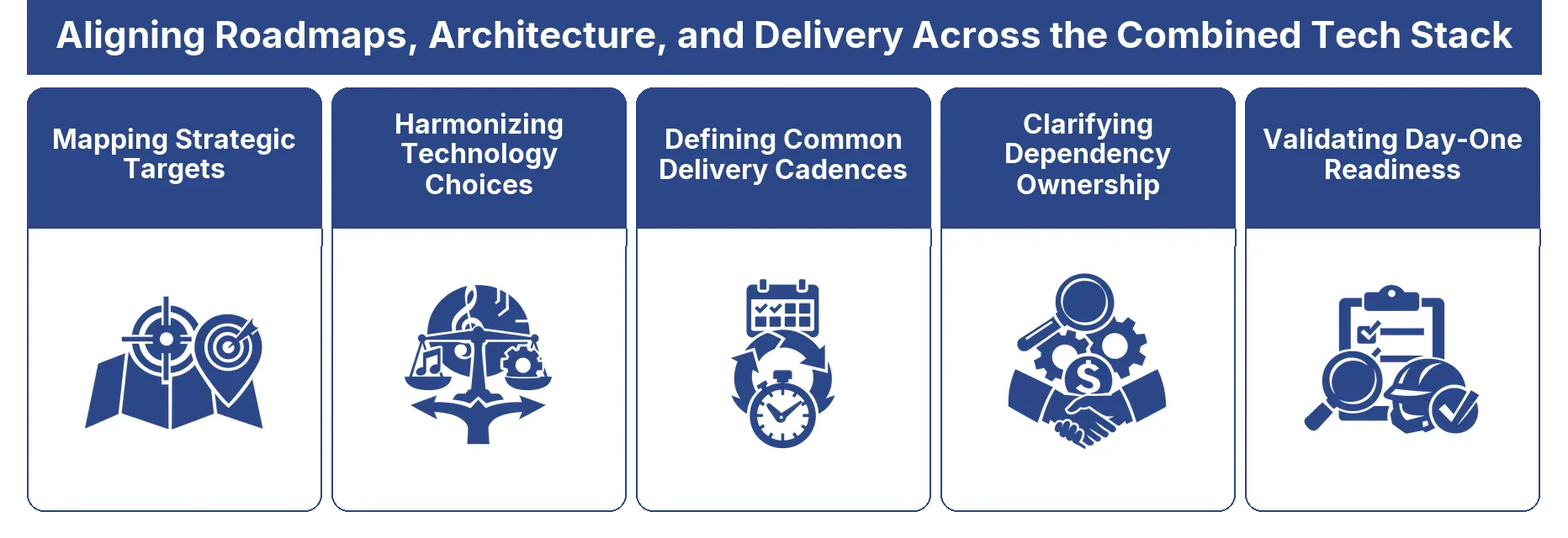
Aligning roadmaps, architecture, and delivery across the combined tech stack turns a merger thesis into an operating model that sustains value realization after close. A disciplined framework connects strategic targets to architecture decisions, establishes common delivery cadences, and clarifies ownership of dependencies while treating Day One readiness as a measurable milestone. The construct rests on five pillars: Mapping Strategic Targets, Harmonizing Technology Choices, Defining Common Delivery Cadences, Clarifying Dependency Ownership, and Validating Day-One Readiness. Earlier industry analysis analyses emphasize governance scaffolds that orchestrate cross-functional planning; see blueprinting the future state and the Integration Management Office imperative. External research on adaptive roadmaps and strategy-aligned planning reinforces the payoff from tightly coupled roadmaps, architecture, and delivery cadences even as complexity grows; the evidence points to faster time to value and higher throughput when health work is budgeted within the plan. See the pairing of structured post-merger planning with architecture discipline.
Mapping Strategic Targets
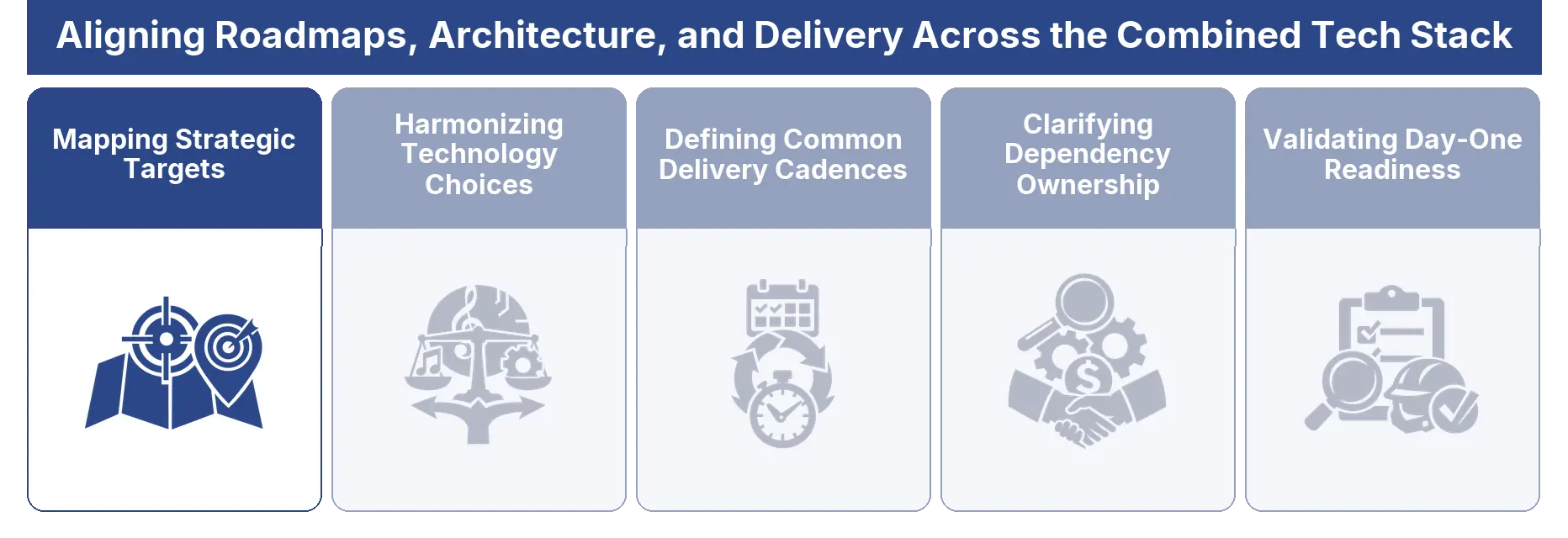
Translating the merger thesis into a concise program objective set spans product capabilities, data flows, and platform readiness. Day One deliverables and the architectural prerequisites anchor the roadmap, ensuring actions translate into durable value. Explicit cross-functional ownership, governed by the Integration Management Office cadence, makes decisions visible and traceable. A small, explicit blueprint drives a 90- to 120-day execution window rather than a big-bang plan. External evidence shows that when targets align with architecture, 34% faster time to market is common, and smart roadmaps budget 20-30% of engineering capacity for technical health. The first principle is to anchor the target map to a practical Day One plan, with projects and milestones owned across Finance, IT, and lines of business; see blueprinting the future state for a concrete reference point. The Dell-EMC integration program architecture illustrates how portfolio alignment to shared platforms and data pathways accelerates value capture. <a href=”https://www.dell.com/en-us/dt/corporate/newsroom/announcements/2016/09/20160907-01.htm”>Dell-EMC integration program architecture</a>
Harmonizing Technology Choices
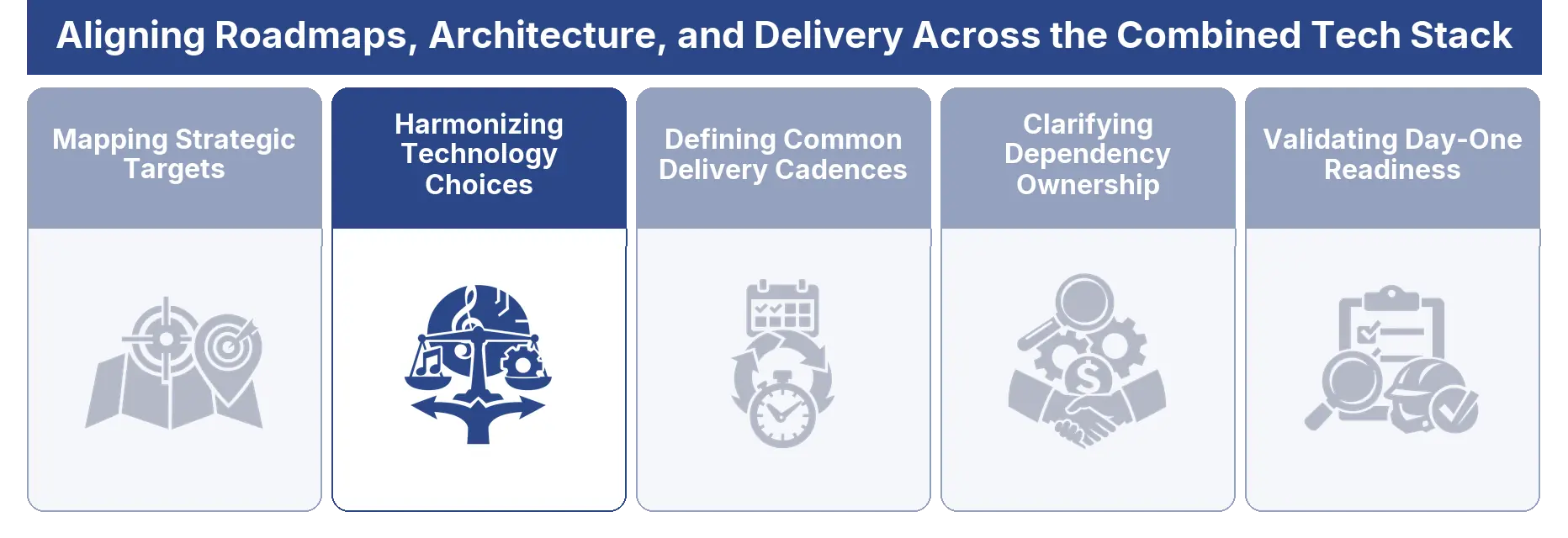
Harmonizing technology choices requires selecting shared platforms, data models, and security regimes that traverse the merged entity. The IBM-Red Hat integration is frequently cited as a landmark example of preserving an open, innovative culture while consolidating a common backbone; the governance model enabled rapid interoperability across teams and regions. <a href=”https://www.redhat.com/en/about/press-releases/ibm-closes-landmark-acquisition-red-hat-34-billion-defines-open-hybrid-cloud-future”>IBM-Red Hat integration</a> A core implication is convergence around a core cloud and data backbone with interoperable APIs that support both speed and resilience. The architecture blueprint should be a living document that guides legacy retrofit work and Day One enablement; when architecture decisions propagate into delivery, data quality improves and duplication declines. This pattern is reinforced by broader roadmapping literature that links architecture alignment with faster delivery and better risk management; the engineering roadmap literature connects context, platform upgrades, and reliability work. <a href=”https://www.notion.com/use-case/project-management/engineering-roadmap”>Engineering roadmap: How connected context helps product teams</a> The practical takeaway is to codify decisions into a portal of truth that teams across the merged organization can rely on for cross-functional work.
Defining Common Delivery Cadences
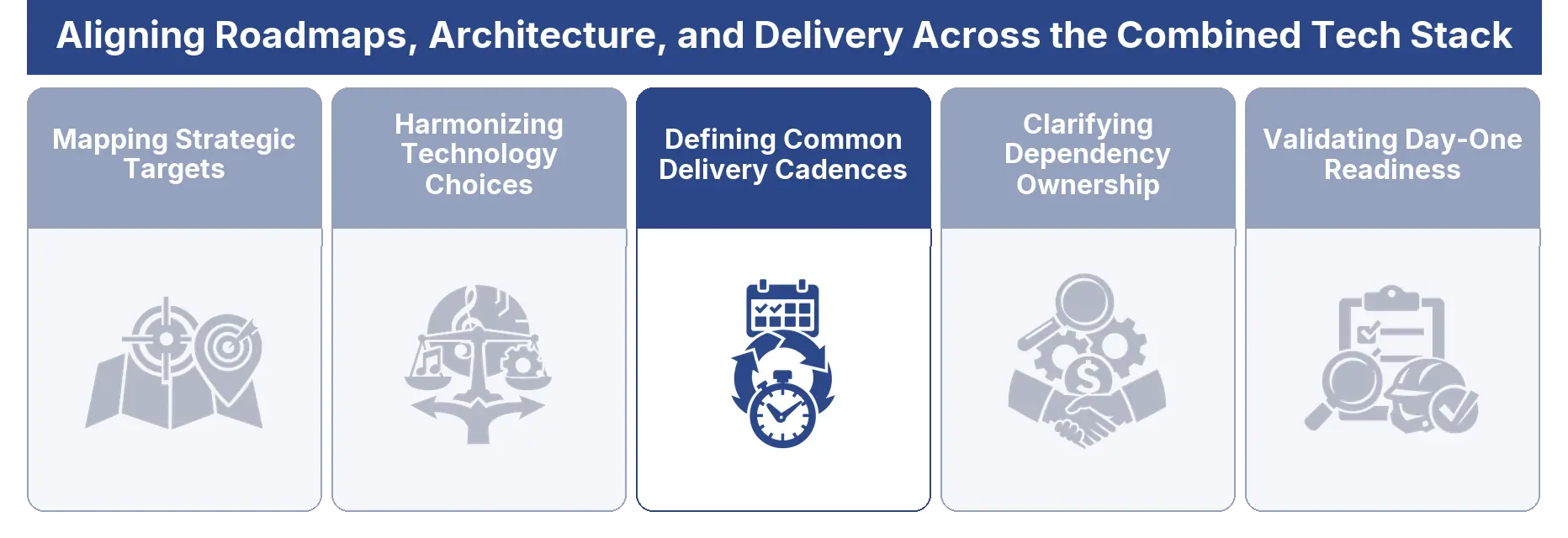
Defining common delivery cadences creates the rhythm necessary for cross-functional execution. Cadences emerge from an IMO-driven cadence that links weekly status, risk, and dependency reviews to broader quarterly milestones; this discipline is especially valuable in multi-entity integrations where misaligned cycles derail synergy realization. A case in point is the Salesforce-Slack transaction, where disciplined cadence anchored joint roadmap decisions and business-to-product alignment. <a href=”https://investor.salesforce.com/news/news-details/2021/Salesforce-Completes-Acquisition-of-Slack/default.aspx”>Salesforce completes Slack acquisition</a> Cadence governance should be visible in shared roadmaps, dashboards, and risk registers, and the discipline must enforce clarity on where dependencies live and who owns them. The adaptive roadmaps perspective highlights governance across stages while software sprints continue. <a href=”https://gocious.com/blog/7-adaptive-roadmaps-to-align-hardware-and-software-integration”>7 Adaptive Roadmaps to Align Hardware and Software Integration</a>
Clarifying Dependency Ownership
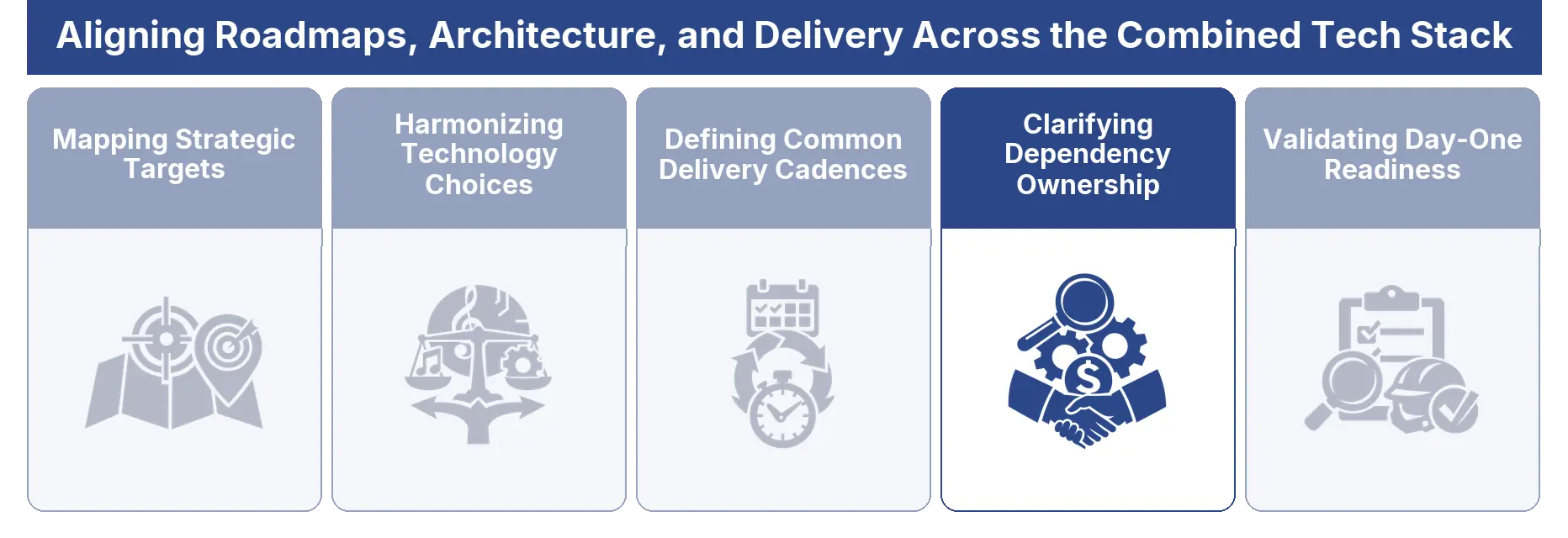
Dependency ownership assigns accountability for shared components, APIs, data models, and platform services. A clearly defined ownership model prevents duplication and ensures reliability across the merged entity; the Oracle-NetSuite integration illustrates the risk of ambiguous ownership for cloud ERP and financial data flows across regions. <a href=”https://www.oracle.com/corporate/pressrelease/oracle-buys-netsuite-072816.html”>Oracle’s acquisition of NetSuite</a> An explicit RACI combined with an integrated data model helps ensure that strategic outcomes do not stall due to conflicting requirements or unclear accountability. The IMO should establish a cross-functional dependency matrix mapping ownership to critical data and workflow intersections, and ensure it evolves as the platform matures.
Validating Day-One Readiness
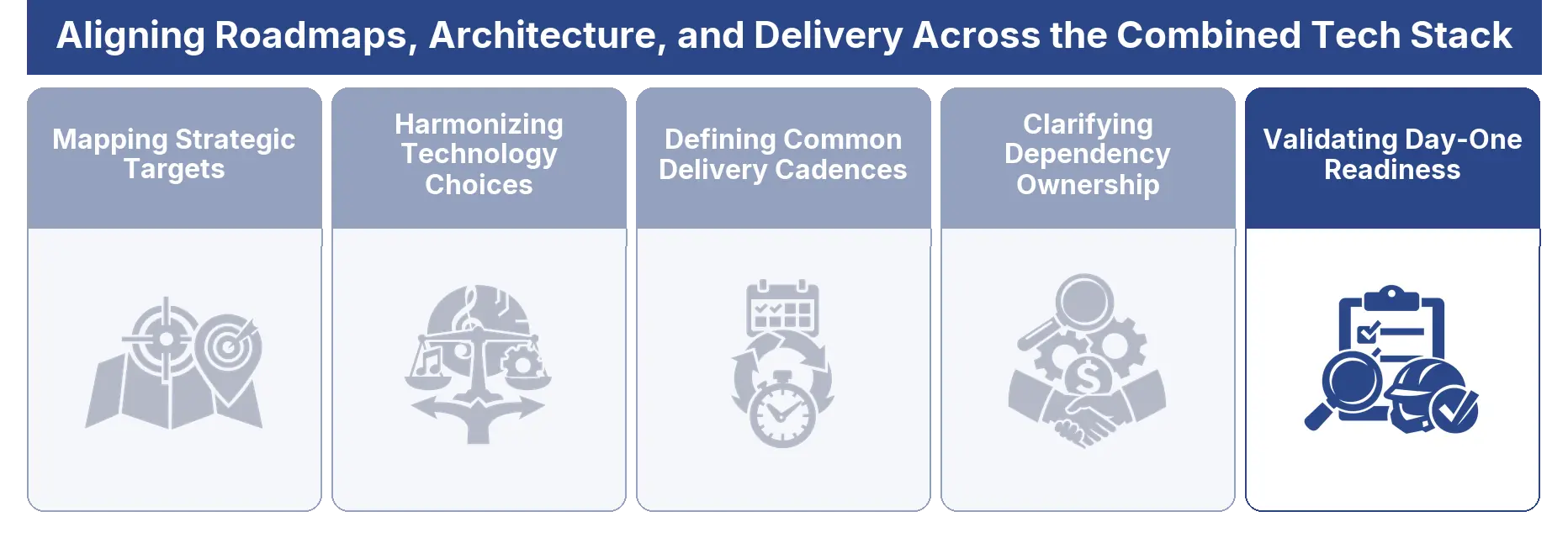
Day-One readiness translates strategy into operational capability at the moment of close. Concrete planning around data continuity, user access, security posture, and process alignment across functions is essential. The Salesforce-Slack case underscores the importance of rapid operationalization of the collaboration layer to support business workflows from day one. <a href=”https://investor.salesforce.com/news/news-details/2021/Salesforce-Completes-Acquisition-of-Slack/default.aspx”>Salesforce completes Slack acquisition</a> Industry evidence aligns with a disciplined approach: roadmaps balancing near-term delivery with platform health increase execution confidence, and a portion of engineering capacity should be reserved for technical debt and health work. The disciplined approach makes Day One the baseline, not a one-off milestone; it rests on a well-defined target map, standardized technology choices, and synchronized delivery cycles.
Synthesizing Cross-Stack Alignment Across the Combined Tech Stack
The synthesis shows that post-merger value hinges on unifying roadmaps and architecture across the combined tech stack. When product and engineering roadmaps diverge and architectural choices fail to converge, valuable overlap devolves into competing priorities and delayed delivery. The executive thesis is realized only when roadmaps, architecture, and delivery are aligned, turning strategy into a repeatable operating model. The integration discipline becomes concrete through a published blueprint for ma success that translates strategic intent into sequencing and governance; further, the necessity of comprehensive Total Cost of Ownership Analysis (TCOA) anchors the diligence in value realization rather than hindsight. Together these elements reduce friction and lift cross-functional velocity. the blueprint for ma success provides the reference for that governance, while necessity of comprehensive TCOA analysis anchors the finance and risk lens.
On Monday morning, disciplined practitioners will keep a single integrated roadmap and architecture blueprint as the source of truth for product and engineering decisions. An Integration Management Office (IMO) governance model will synchronize milestones, assign clear ownership, and establish a common delivery cadence that reduces handoffs. Cross-functional squads will operate against standardized interfaces, data contracts, and a unified backlog aligned with a shared value realization plan, enabling faster, more predictable releases. With governance in place, the merged organization prevents drift and ensures each feature increment advances the joint strategic objectives.

Get new articles by email
Insights on M&A, revenue growth, and business transformation, delivered occasionally.