Strategic Alignment Across M&A: From Corporate Strategy to Integration Strategy
In 2019, Salesforce’s acquisition of Tableau closed for about $15.7 billion in an all-stock deal. The aim was to fold Tableau’s self-service analytics into a broader customer platform while preserving the product and community that made the franchise valuable. Public observers noted the work required to reconcile overlapping analytics portfolios and align two large go-to-market organizations. The result underscored a need for disciplined, stage-gated integration planning.
Within the same deal landscape, an anonymized mid-market tech transaction demonstrates that post-close friction can erode value when governance and decision rights remain ambiguous. That anonymized deal was valued at about $2.8 billion. Deal teams move with speed, but cross-functional functions finance, operations, technology, and talent arrive with different vocabularies and incentives. How can a clear line of sight from corporate strategy through acquisition strategy to integration strategy be established to unlock value through cross-functional alignment?
Day One readiness and a formal Integration Management Office (IMO) become the practical bridge between strategy and execution, turning high-level intent into auditable operating requirements. A disciplined framework, the blueprint for MA success, connects governance, culture, and capabilities to a milestone-driven integration roadmap. Earlier analysis of total cost of acquisition analysis framed the diligence decisions that determine post-close investments and governance rights. That framework sets the trajectory for the rest of the discussion, aligning governance, leadership accountability, milestone cadence, and measurable value.

Anchoring Strategic Intent in Corporate and Acquisition Contexts
Anchoring strategic intent begins with clearly defined corporate strategy that sets portfolio priorities, identifies capability gaps, and pins down long term value drivers. Those elements determine the deal criteria, sequencing, and required pace of execution. Acquisition strategy should translate those priorities into precise target profiles, rigorous due diligence lenses, and deal execution expectations that reinforce the corporate thesis. Without a formal bridge between strategy and execution, the deal program and the integration program drift apart, leaving value unrealized in the handoffs. Alignment of corporate strategy and acquisitions yields more durable value, a claim supported by syntheses that describe alignment as the essential precondition for durable value. See the synthesis on aligning corporate strategy and acquisitions for a practical framing of this principle. alignment of corporate strategy and acquisitions
Absent the bridge, strategy and execution drift into separate tracks, amplifying the risk that the intended business model fails to materialize post-close. An anonymized $2.8 billion deal illustrates this drift: close occurred, yet eighteen months later a $1.2 billion impairment reveals misaligned integration priorities and delayed capture of realized value. This underscores the need to treat diligence and integration planning as a single, continuous thread rather than sequential steps. The discipline of linking diligence to value realization is reinforced in industry analysis’ discussions of Total Cost of Acquisition analysis and its role in anchoring diligence to the strategic thesis. Total Cost of Acquisition analysis provides the framework for testing whether post-close investments match the original strategic rationale and value targets. A closely related concept is the notion of synergy realization milestones, which anchors expectations for when and how integration activities translate into measurable value. synergy realization milestones
Bridging strategy and execution requires a formal, IMO driven program that translates intent into capability, governance, and cadence. The bridge gains strength from thesis, screening, and integration discipline that align target selection with the corporate thesis and lock in accountability for delivery. External perspectives reinforce this architecture: a thesis-driven approach to M&A, rigorous target screening, and integrated governance are central themes in Umbrex’s framing of M&A in corporate strategy, while the emphasis on stakeholder alignment and internal controls for integration is a core thread in practical M&A playbooks. thesis, screening, and integration Align Stakeholders and Establish Internal Controls for Integration Internal citations to prior analyses on integration discipline and comprehensive TCoA continue to anchor the argument as the bridge becomes operational. integration discipline Total Cost of Acquisition
Navigating Cross-Functional Alignment Gaps in M&A
Navigating cross-functional alignment gaps in Mergers and Acquisitions remains a systemic risk as deals scale beyond a single function. Cross-functional teams bring competing priorities, vocabularies, and risk appetites that challenge a single integration story. Governance tends to be fragmented, with unclear ownership of post-close activities and uncertain decision rights across the Integration Management Office (IMO). Deal timelines pressure speed over rigor, heightening the risk that value hypotheses are not fully tested or operationalized before close. A 23% rise in global M&A deal values underscores the need for governance that translates strategy into action across functions, not merely a high-level thesis.
Real-world deals illuminate the tension between ambition and operating reality. The IBM-Red Hat transaction demonstrates that autonomy for acquired platforms can preserve the capabilities that justified the deal, a governance choice that protects value while enabling rapid scale, as reflected in the decision to run Red Hat as an operationally independent unit. The IBM-Red Hat combination further shows that preservation of culture, open-source in this case, can be a deliberate governance outcome rather than a side effect. Disney-Pixar provides a parallel example: protecting creative culture and brand during integration can be central to sustaining long-term value rather than pursuing immediate convergence. In each case, the path chosen, autonomy, cultural preservation, or brand protection, shaped post-close execution and, ultimately, value realization. These patterns are not accidental; they illustrate how governance choices interact with strategy to determine what remains nimble and what remains intact as the organization moves to execution. See Intel-Mobileye operating autonomy, Red Hat governance independence, and Disney-Pixar cultural protection for examples.
To counter alignment gaps, governance must be codified and anchored in a charter that clarifies scope, responsibilities, and cadence. A governance charter enables faster decisions and better cross-functional alignment by removing ambiguity about who owns what and when. An IMO functions as the centralized command center coordinating cross-functional work, mapping teams, and ensuring accountability without introducing bureaucratic bloat. Practical alignment requires mapping interdependencies and creating cross-functional roadmaps that translate strategic priorities into concrete, resourced actions across finance, operations, and technology. The framework for translating strategy into an IMO-driven integration playbook rests on five elements that tie intent to execution: mapping intent to integration objectives, clarifying roles and decision rights, aligning capabilities with value drivers, defining value metrics and cadence, and operationalizing change communications and knowledge transfer. These elements guide governance through charter-driven alignment, cross-functional collaboration, and dependency management. For practitioners, this means equipping the IMO with a clear charter, accountable owners, and synchronized roadmaps that reflect both strategic ambition and operational reality. Recent analyses emphasize the need for scalable governance that connects what the enterprise aims to achieve with how each function delivers it. See for example bridging integration planning and navigating the human side for governance implications, and Total Cost of Acquisition analysis to anchor financial discipline in the playbook. The broader literature on integration governance reinforces the case for a formal IMO framework and charter-driven alignment, while Navima’s synthesis on aligning corporate strategy and acquisitions highlights the foundational principles needed to unlock value from cross-functional integration. The practical takeaway is clear: governance must be more than a committee structure; it must be the operating system that links strategy to accountable execution.
Translating Strategy Into an IMO-Driven Integration Playbook
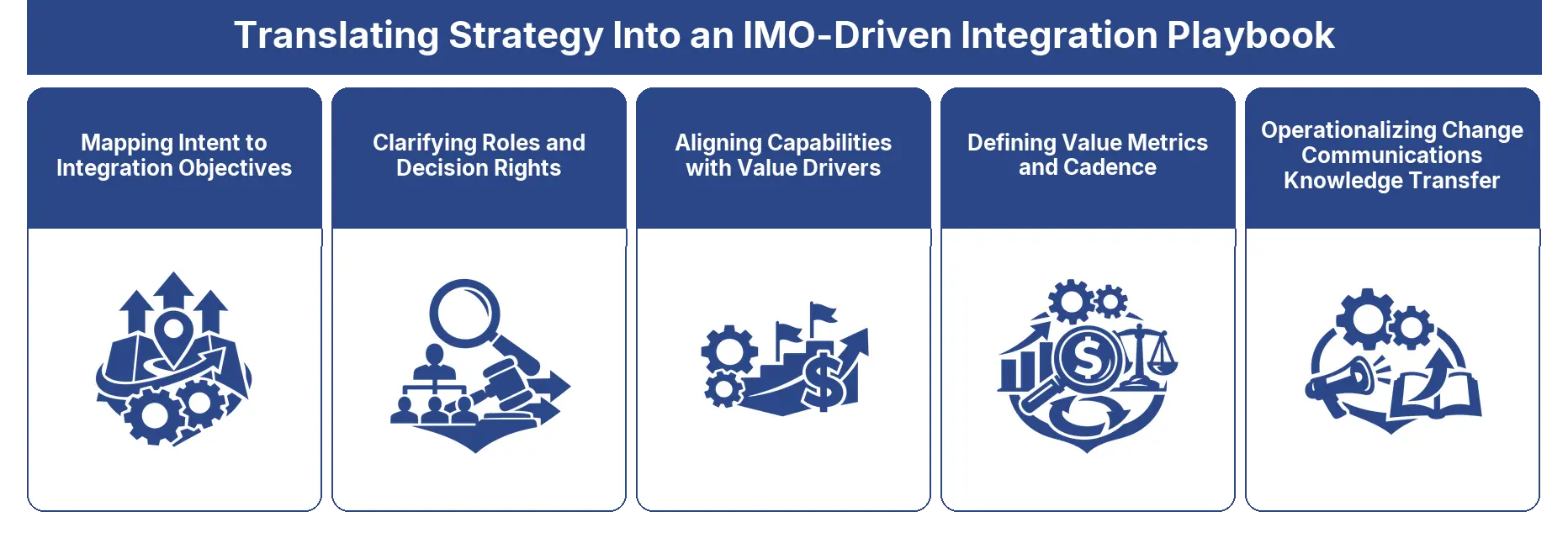
Translating strategic intent into an IMO-driven integration playbook requires a disciplined bridge from a deal thesis to a value-driven program. The Integration Management Office (IMO) acts as the operating system for integration, aligning leadership, governance, and delivery tempo across all work streams. The objective is to render strategy executable through a clear set of objectives, milestones, and ownership that survive the frictions that frequently accompany a close. Governance research underscores that a formal IMO, charter alignment, and early planning stabilize post-close execution. EY emphasizes that the IMO should support work streams, validate charters against guiding deal principles, and lock in Day One readiness; the central coordination body role is reinforced by Stratrix, which describes the IMO as the hub that manages timelines, tracks synergies, and keeps momentum across dozens of workstreams, not just a single track. This disciplined, centralized approach guards against value erosion in megadeals. See Bridging governance to execution, Mastering post-merger integration, and the blueprint for M&A success for deeper context.
Mapping Intent to Integration Objectives
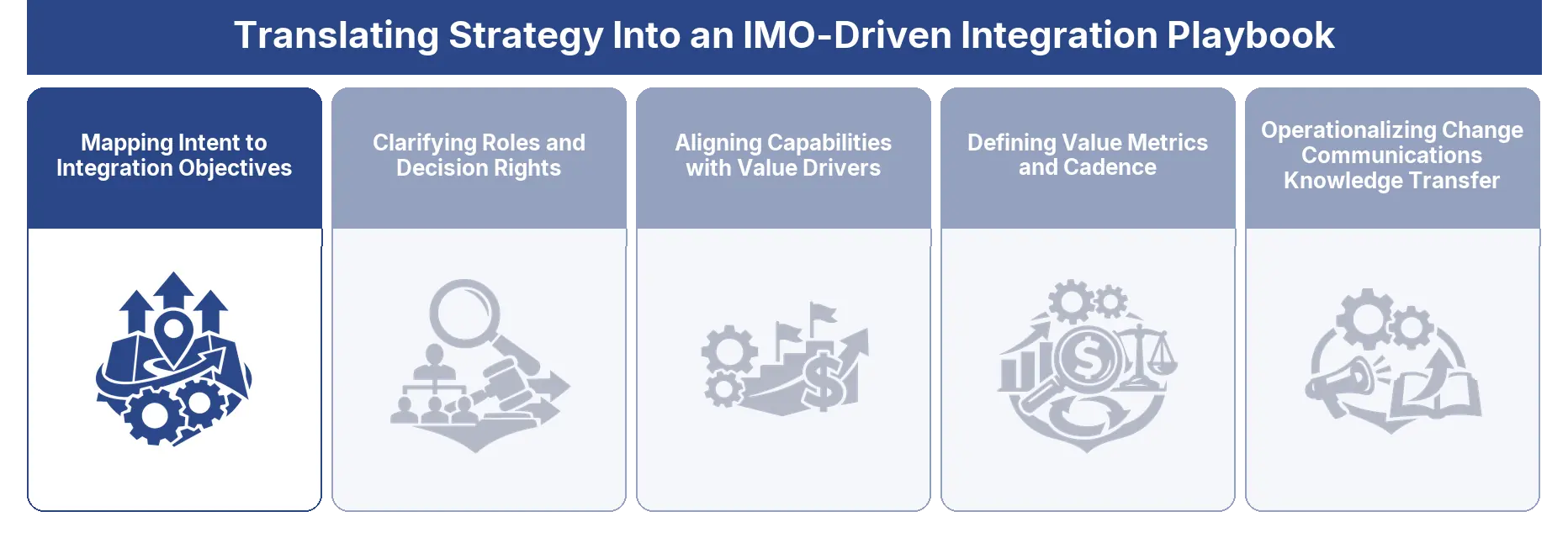
Strategic intent must be translated into a concrete integration objective tree that links each synergy type to a measurable milestone, owner, and decision gate. The IMO should establish a four-quadrant value map, cost synergies, revenue synergies, capability acquisitions, and market access, and translate these into a calendar of milestones with explicit Day One requirements. A well-structured objective set prevents drift when the deal closes and operating realities emerge. EY’s guidance on guiding principles and charter alignment anchors this translation, while a real-world illustration shows how maintaining autonomous operability for creative assets while aligning on shared capabilities preserves value without sacrificing execution discipline. The integration strategy framework reinforces how intent becomes action, reducing ambiguity and accelerating value realization. For broader context, see the blueprint for M&A success.
Clarifying Roles and Decision Rights
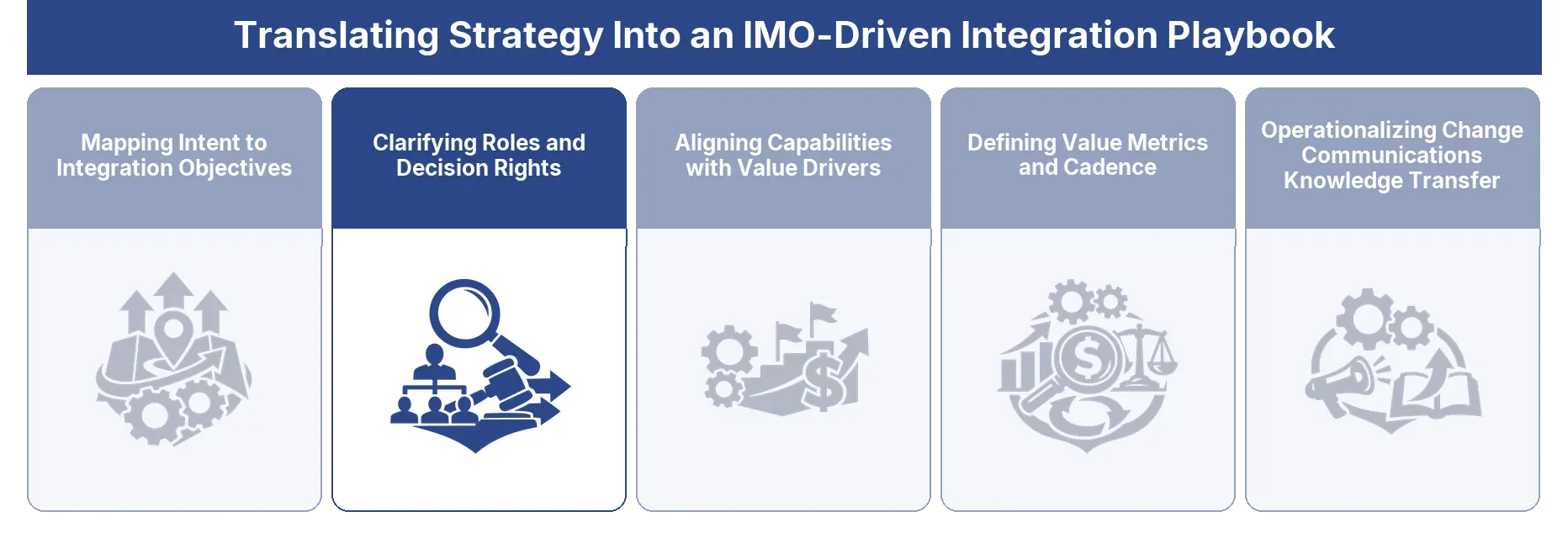
Clear roles and decision rights are non-negotiable in complex integrations. The IMO should codify a formal decision rights framework, supported by a RACI model that designates sequence owners for critical decisions, budget, milestones, scope changes, and Day One readiness. Charter documents must explicitly map decisions to the appropriate governance layer, from work-stream leads to the IMO, and up to executive sponsors. EY’s nine steps to setting up an M&A integration program emphasize that the IMO validates charters against guiding deal principles and confirms Day One readiness, anchoring accountability. The central coordination function described by Stratrix reinforces the need for conflict resolution mechanisms and a cadence that sustains momentum across dozens of workstreams. Internal governance perspectives also provide practical steps for bridging governance and execution. See internal discussions in Bridging the Gap: Effective Integration Planning and Execution in M&A and Mastering post-merger integration for additional depth.
Aligning Capabilities with Value Drivers
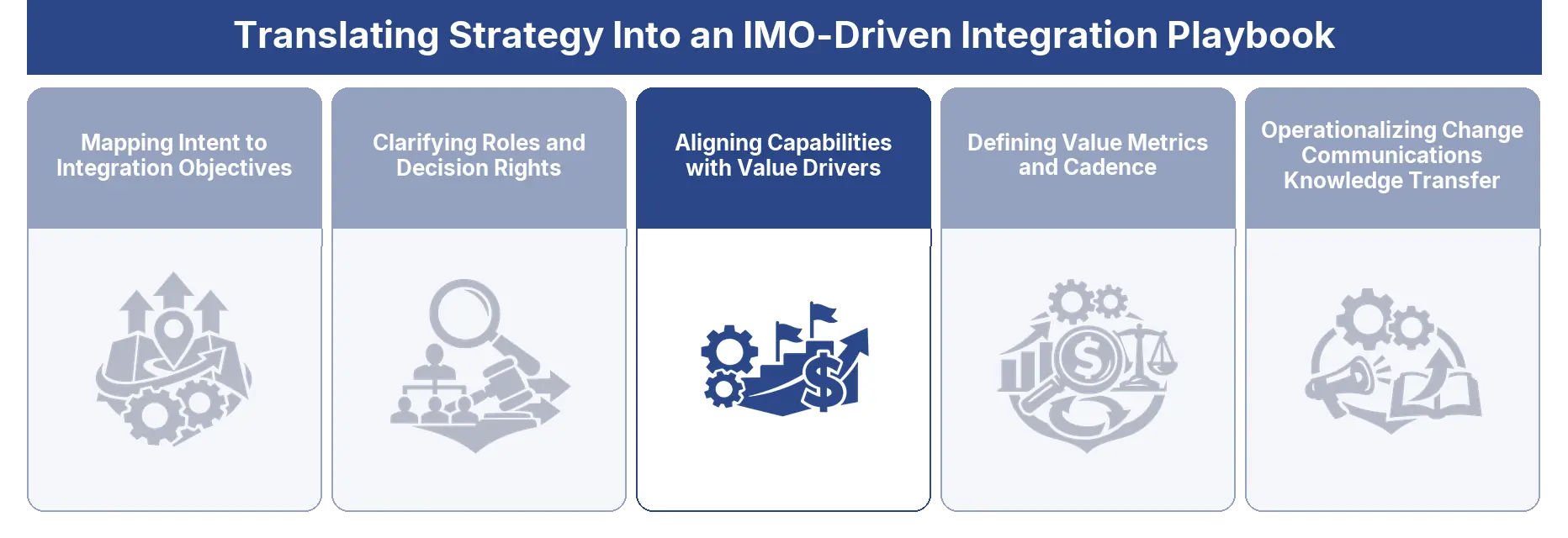
Capabilities must be explicitly tied to value drivers and the integration archetype chosen. The IMO should map which assets, processes, and platforms deliver which synergies and determine the required level of integration for each asset: full, partial, or holding. The strategy and execution alignment must accommodate potential divestitures under a best-owner lens, ensuring ownership matches long-term value creation. Public analyses stress that total value realization hinges on disciplined architecture of synergy delivery, with meaningful progress often achieved early in integration. For a practical synthesis of this logic, see the integration strategy framework. This structure aligns with prior industry analysis on mapping capabilities to post-merger value realization.
Defining Value Metrics and Cadence
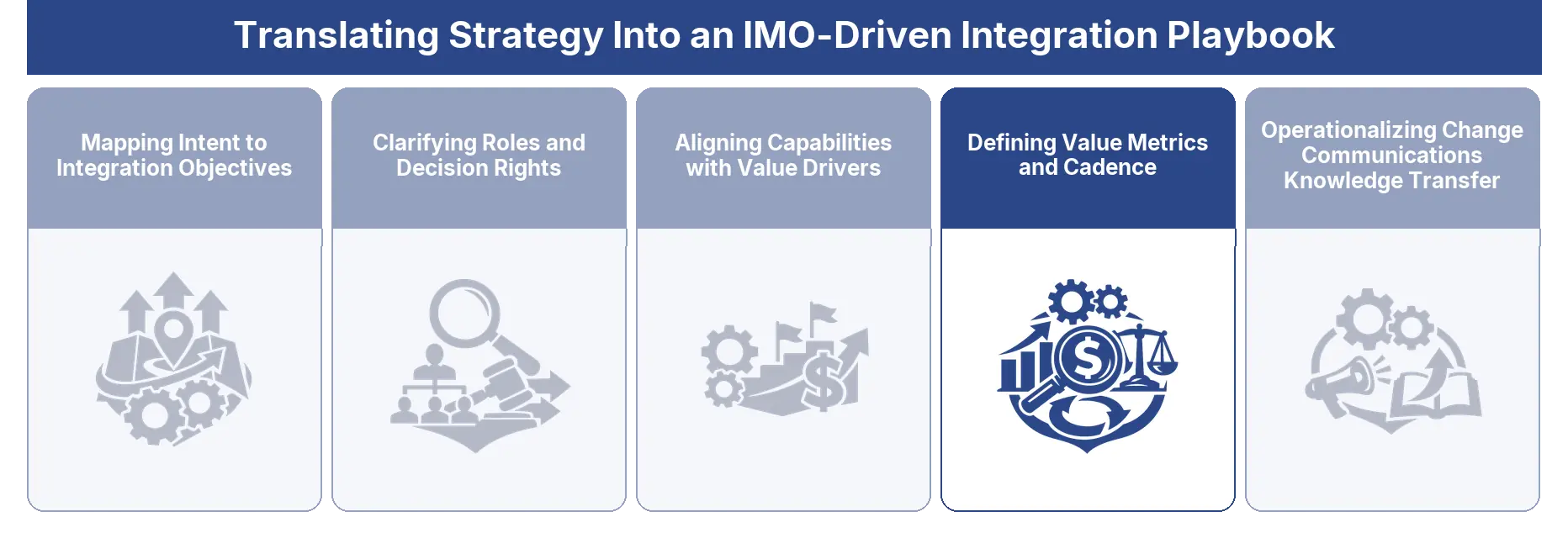
Value metrics must be defined at the outset and tracked through a disciplined cadence. The IMO should establish a dashboard of leading and lagging indicators across cost savings, revenue uplift, customer retention, and operational resilience, with a cadence that matches decision rights and milestones. Industry benchmarks show why governance cadence matters: early integration effort correlates with higher probability of achieving target synergies, while lack of formal tracking translates into value erosion. Stratrix notes that 83% of mergers failed to boost shareholder value, underscoring the need for governance discipline; data migration costs, accounting for roughly 40% of tech integration, demand attention in the planning phase. Quick wins in the first 90 days, procurement consolidation and headcount overlap elimination, can capture 15, 20% of total synergies, followed by 35, 45% in the next 3, 6 months as processes consolidate and platforms align. See the architecture and schedule behind these outcomes in The Anatomy of a M&A Integration Strategy, and Day One alignment guidance in Nine steps to setting up an M&A integration program.
Operationalizing Change Communications Knowledge Transfer
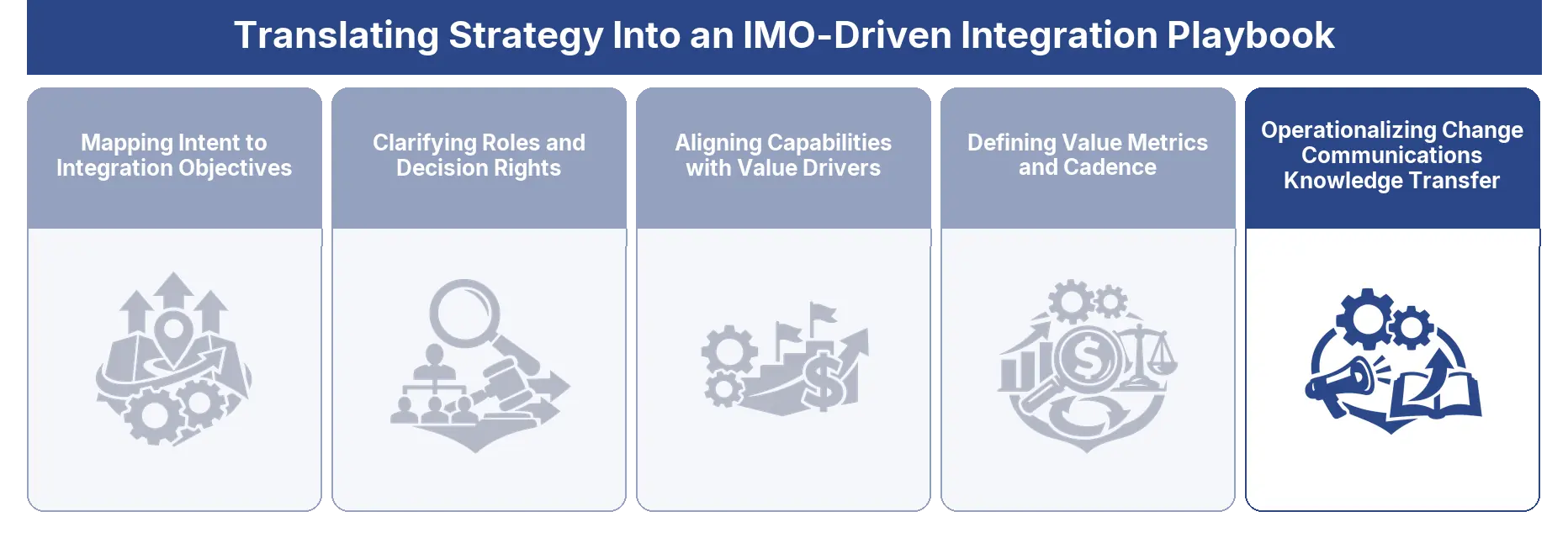
Change management and knowledge transfer are the glue that holds the integration together. The IMO should institutionalize a robust communications cadence, a knowledge transfer plan, and a change management playbook that ensures frontline teams understand new operating principles and customers experience continuity. External experience points to culture preservation as a strategic objective, as in Disney-Pixar, where cultural distinctiveness was safeguarded alongside operational unification. The literature also highlights that governance alone is insufficient without a structured change program engaging stakeholders across the organization. The IMO’s cadence should include regular stakeholder updates, a learning system for tacit knowledge transfer, and incentives aligned with the evolving future state. See governance and oversight best practices in M&A Integration Best Practices for Successful Integrations and playbook-inspired change mechanisms in The Blueprint for M&A Success. Internal references bridge governance and execution in Bridging the Gap and Mastering Post-Merger Integration.
Synthesizing Strategic and Integration Trajectories Through the IMO
Strategic alignment across M&A begins with a clearly articulated corporate strategy that sets portfolio priorities, defines capability gaps, and pins down long term value drivers. From that base, the deal thesis must be translated into an IMO driven integration plan whose governance, milestones, and funding choices are tightly linked to strategic objectives. Cross functional alignment gaps remain a systemic risk as deals scale beyond a single function, underscoring the need for early explicit alignment across operating models; integration discipline in M&A. The Value Catalyst framework ties this alignment to the realization of synergies by connecting vision, culture, and execution, ensuring ambition translates into action rather than rhetoric.
Practitioners operationalize this bridge by codifying a Day One readiness plan that defines an auditable operating vision, concrete functional requirements, and synchronized transitions across departments. The bridge requires explicit governance with an Integration Management Office and a disciplined cadence for monitoring early milestones. Resource decisions must align with the total cost of acquisition analysis, ensuring the plan captures integration related costs and reserves for transformation. With a robust framework in place, organizations can accelerate value realization, reallocate scarce resources to high impact synergies, and maintain flexibility as realities shift.
Momentum hinges on disciplined execution. With the framework in place, Monday morning actions become unambiguous and value realization accelerates.

Get new articles by email
Insights on M&A, revenue growth, and business transformation, delivered occasionally.