
You Signed the Deal. Now What? Activating the Between Close Window to Create Early Value
In 2024, Cisco closed its roughly $28 billion acquisition of Splunk, in a deal described publicly as Cisco Completes Acquisition of Splunk. The plan set out to fuse Cisco networking with Splunk security and observability data while keeping the Splunk product teams and customer relationships stable through the transition. Integration decisions were sequenced to protect continuity rather than consolidate everything at once, preserving Day One readiness and reducing disruption. That between close approach turned the signing moment into a test of disciplined execution, shaping the outcome of the entire value thesis.
Even with a landmark deal, the between close phase risks scope drift and misaligned expectations. Data migrations and policy alignment often race ahead on parallel tracks, eroding Day One readiness. Without a deliberate, four week plan led by an Integration Management Office, momentum can fade and value can slip away. How can you surface quick wins and align Day One readiness in the four week between close window to create early value?
Treating the between close period as a structured value sprint reframes post signing work as a tightly scoped program. A four week playbook coordinates cross functional efforts across IT environment control, data and policy alignment, talent and org design, and governance, Earlier work on integration discipline, delivering a concrete Day One readiness blueprint. This approach accelerates a lean Integration Management Office and creates a repeatable pattern for future acquisitions. Two guiding insights, comprehensive TCO analysis in M&A, offer tested lenses for shaping this discipline.

Establishing the Between Close Context for Early Value Realization
Establishing a Between Close context for early value realization treats the four weeks after signing as a strategic sprint. The goal is to translate the target operating model into Day One actions that unlock immediate, measurable progress rather than wait for months of planning. Cross functional clarity is essential for scope, risk, and quick win opportunities to be understood by IT, finance, operations, and commercial teams alike. A lightweight governance rhythm keeps momentum without adding friction, while a shared risk and issue log captures learnings and surfaces decisions in real time. Early wins should be designed to demonstrate impact quickly, reinforcing the deal thesis while preserving optionality for longer term roadmaps. See how Day One readiness frameworks can guide this shift, for example through a documented early action plan aligned to the framework that governs Day One outcomes. Day One readiness framework
External evidence underscores why this sprint matters. Sign to close dynamics have shifted, with the window widening by more than 30 percent over the past decade, signaling the need for disciplined pre close and post close execution to protect value. Leaders should maintain visible leadership continuity and explicit interim decision rights during this interval, incorporating guardrails that keep the integration on track rather than drifting into post close delays. Momentum in the early post close period hinges on turning plans into executable steps within a compressed time frame, not waiting for a lengthy roadmap. A real public example that illustrates the value of maintaining operational continuity during transition is the Cisco Splunk integration, where the acquired unit continued operating with substantial autonomy to preserve product momentum and customer trust while pursuing value upside. Cisco Splunk acquisition approach In parallel, public analyses emphasize that the sign to close window should be treated as an active intervention period with clear guardrails and accountability to avoid erosion of the original thesis. sign to close window widening active intervention window during sign to close momentum across the deal lifecycle
Synthesis and practical framing point executives toward a repeatable operating pattern. The four week sprint should be supported by a disciplined yet lightweight governance approach that distributes accountability across the IMO and functional leaders, while a single risk/issue log surfaces constraints and decisions in one place. The aim is to connect the four weeks directly to Day One outcomes and to link activities to concrete value milestones as described in established guidance on integration discipline and value realization. For context, see the blueprint for MA success as a reference for translating strategy into execution, and the Day One readiness framework as a practical blueprint for converting plans into action. the blueprint for MA success Day One readiness framework comprehensive TCO analysis
Navigating Between Close Uncertainties to Protect Day One Readiness
Between signing and close, three principal risk vectors merit attentive management: scope drift, interdependent workstreams, and governance gaps. Scope drift emerges when carved out and retained operations shift in definition or boundaries, reshaping the future operating model just as the integration begins. Dependencies across IT, HR, finance, and commercial functions proliferate, and friction mounts when parallel workstreams race ahead without aligned owners and cadence. Governance gaps compound these risks, allowing issues to escalate unchecked and elevating the probability that Day One readiness becomes a casualty of delay. An IMO like early governance layer is essential to surface compounding issues before they derail the plan, ensuring that the Day One operating vision remains intact and auditable across the deal’s critical contacts. The Day One readiness framework emphasizes this pre close alignment, translating a merged entity’s future state into a coherent, actionable transition plan Day One readiness framework and it sits at the heart of the blueprint for MA success blueprint for MA success.
External research reinforces the importance of surfacing and addressing tension before the close. The value proposition in private market transactions increasingly hinges on capturing value prior to Day One; carve outs and pre close access to management are leverage points for early savings protect and create value between signing and close. From a governance stance, integrating value creation into the pre close phase is not a bonus but a necessity Maximizing value creation: Sign to close. In markets like the U.K., the sign to close window has lengthened, with 2022 showing about 165 days on average between announcement and closing, a trend driven by heightened regulatory scrutiny and diligence complexity 165 days between announcement and closing. Real world diligence hazards also underline the risk of hidden liabilities surfacing after LOI; a vendor liability uncovered during QoE diligence can materially erode deal value and stall Day One readiness undisclosed vendor liability. In parallel, a disciplined pre close information package, such as a detailed information request list, helps sets expectations and reduces ambiguity at close detailed information request list. Taken together, these findings argue for a structured, pre close governance cadence that links the four week sprint to concrete Day One outcomes.
The framework for this context is the Four Week IMO Driven Value Sprint, which, when referenced, comprises five elements: Defining Day One Scope, Mapping Critical Dependencies, Prioritizing Quick Wins, Aligning Cross Functional Commitments, and Establishing Decision Gates and Issue Tracking. This framing keeps the sprint tightly connected to Day One execution, ensuring risks are surfaced early and that dependencies do not metastasize into operational disruption. The sprint’s cadence translates strategic intent into operational stability by anchoring cross functional commitments in formal ownership, a transparent milestone map, and auditable issue tracking protocols. The outcome is a tighter linkage between near term readiness actions and post close performance, with IT, HR, finance, and commercial teams advancing in concert rather than at cross purposes. In practice, the emphasis on early governance and disciplined pre close work reduces unknowns that would otherwise impede Day One execution and create tangible, trackable momentum after close.
Implementing the Four Week IMO Driven Value Sprint
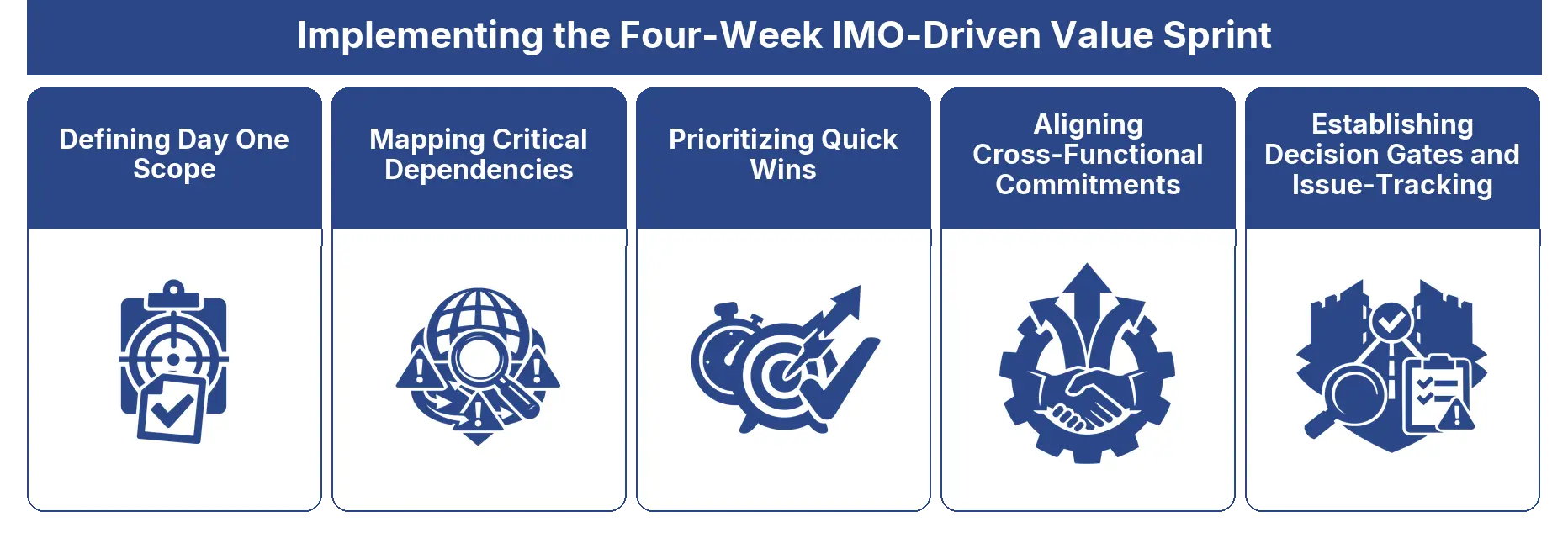
Implementing the Four Week IMO Driven Value Sprint translates Day One readiness into a compact, executable cadence. Day One scope is defined to reflect the target operating model and strategic priorities, ensuring the intended value is protected from the outset. The sprint surfaces critical dependencies across IT, security, HR, finance, and product, enabling a coordinated, cross functional approach that reduces post close disruption. Quick wins are prioritized by impact and feasibility to demonstrate momentum before close, while decision gates and auditable issue tracking cadences keep actions accountable. The result is a tight linkage between pre close actions and post close performance, anchored by disciplined IMO governance.
Defining Day One Scope
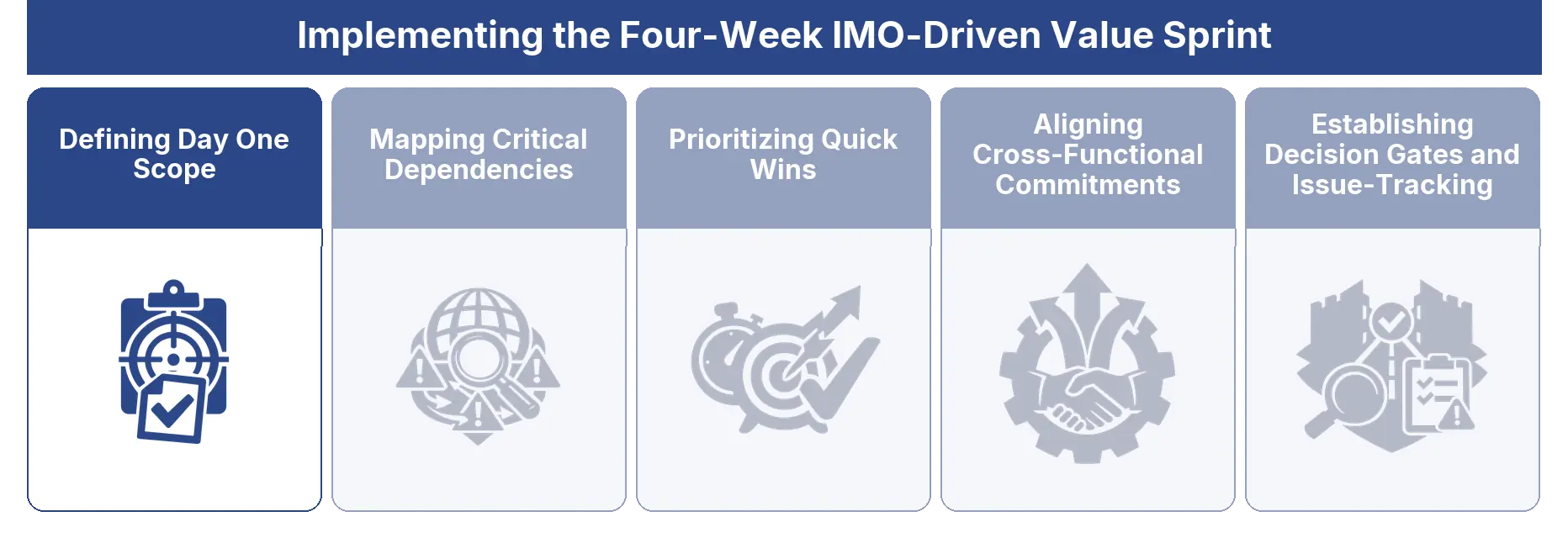
Day One scope centers on the minimum viable operating envelope necessary to support the combined entity at close while aligning to the target operating model. It includes the essential IT services, security baselines, HR policies, financial controls, and product continuity required to sustain customers and employees on Day One. Scope decisions should cascade from the strategic priorities and the intended value thesis, ensuring that efforts are not diluted by nice to have activities. In practice, Day One scope benefits from a clear, agreed TOM and a concrete set of gating criteria that separate essential from optional work. The approach mirrors what has been observed in large scale integrations, where prescriptive scope helps preserve network effects and maintain execution discipline, as illustrated in the IBM Red Hat integration, where Red Hat was kept operationally independent to protect its open source community and momentum. Executives should consider linking Day One readiness to the blueprint for MA success, which highlights coordinating across functions to preserve strategic fit. See the Carnegie Miller synthesis on MA execution for a deeper frame of reference. The four week sprint also requires anchoring the scope to an IMO driven governance rhythm, a pattern aligned with prior GTM wide transformations and described in Scaling revenue growth framework.
Mapping Critical Dependencies
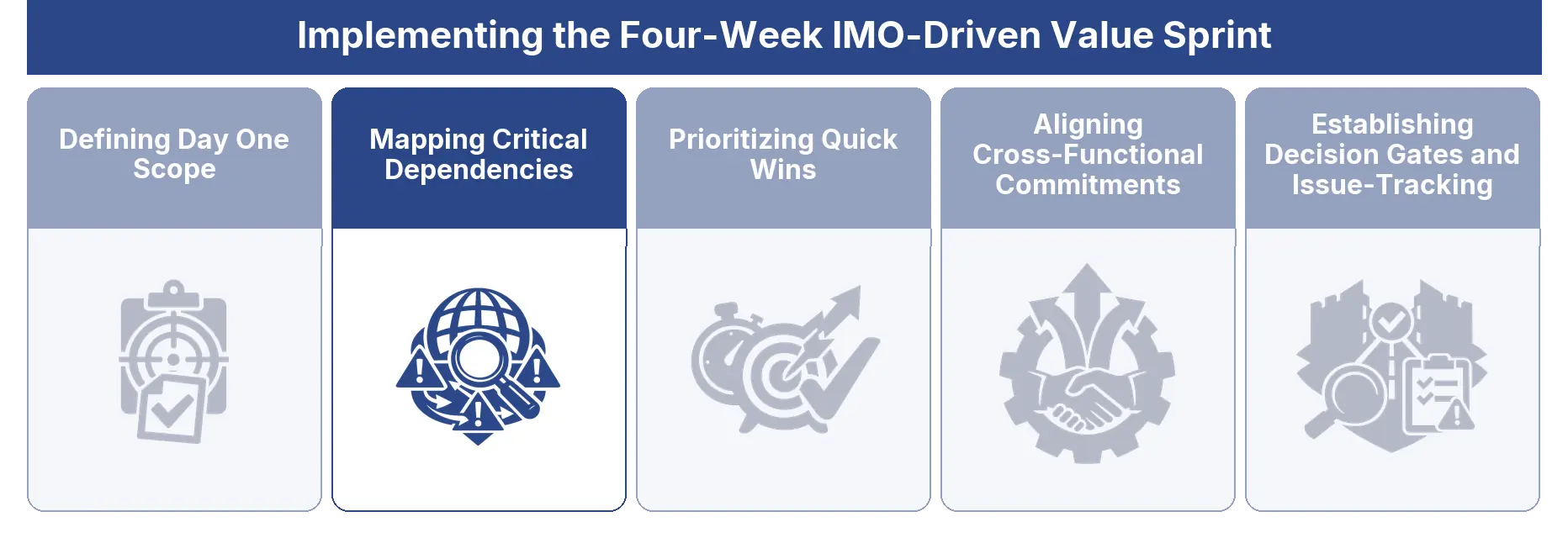
Critical dependencies must be surfaced across IT, security, HR, finance, and product, with clear owners and escalation paths. A rapid dependency map helps identify interlocks that could derail Day One readiness if left unaddressed. This work often reveals hard walled interfaces between legacy systems and the post close architecture, forcing early conversations about data lineage, access governance, and policy alignment. Realistic dependency sequencing reduces the risk of value leakage once the deal closes, especially in complex tech integrations. The Salesforce Tableau integration case demonstrates how cross functional dependencies in data and analytics surfaces must be aligned to avoid silos after close. See the post merger discipline described in the MA literature and linked governance patterns. For context, the anatomy of a deal value creation underscores the importance of early dependency clarity across the lifecycle. The dependency mapping discipline is also described in depth in the First 100 Days literature, which emphasizes rapid problem identification and issue tracking cadence as part of onboarding the combined IT and business teams. Internal references to the blueprint for MA success and mastering post merger integration provide practical anchors for this work.
Prioritizing Quick Wins
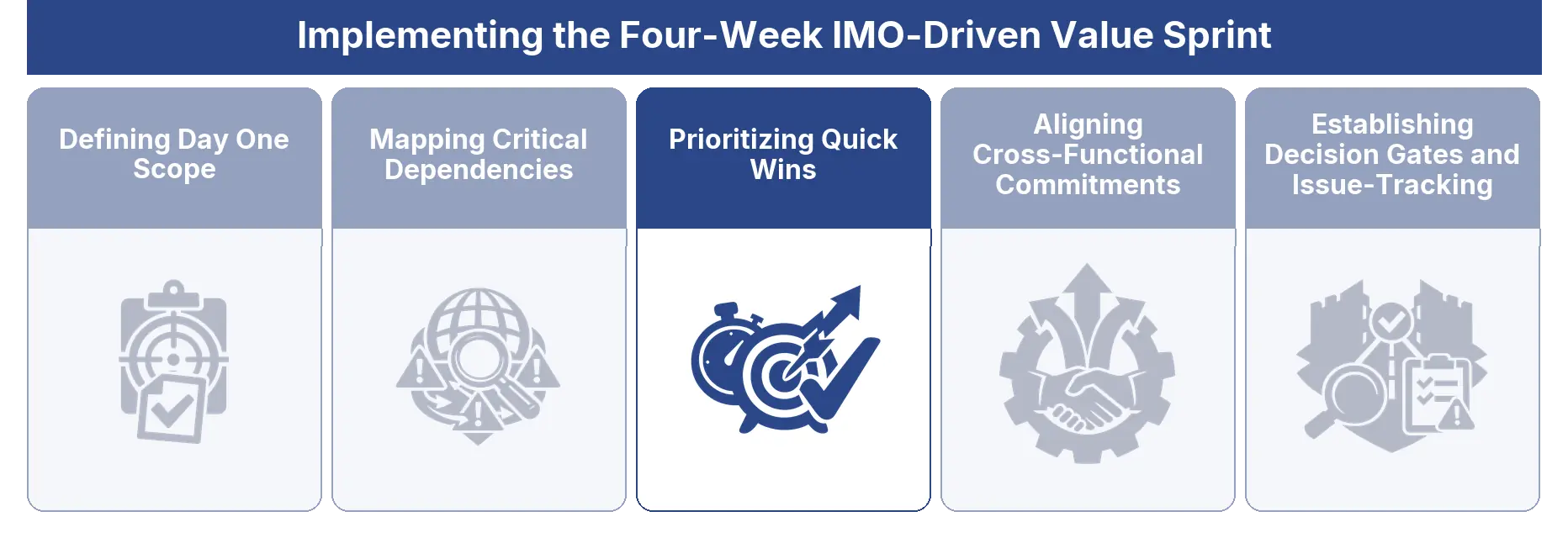
Quick wins should combine high impact with high feasibility, delivering tangible value within the first 28 days and establishing credible momentum before close. Examples include consolidating overlapping IT services, harmonizing basic HR policies for the most critical roles, and locking in policy controls that reduce risk exposure. Frame early wins around customer impact, employee reassurance, and near term cost takeout that does not compromise long term value creation. The deal lifecycle literature points to value creation accruing through fast, credible demonstrations of progress, and the anatomy of a deal value creation framework provides concrete guidance on prioritizing these wins. First mover wins can be anchored to a concrete data initiative or a standardized operating play that accelerates integration milestones. The aim is to build proof points the executive team can observe in 4 weeks, supported by the IMO cadence and issue tracking logs. The approach resonates with the four week sprints used in contemporary private equity value creation playbooks and is reinforced by public case studies from tech integrations.
Aligning Cross Functional Commitments
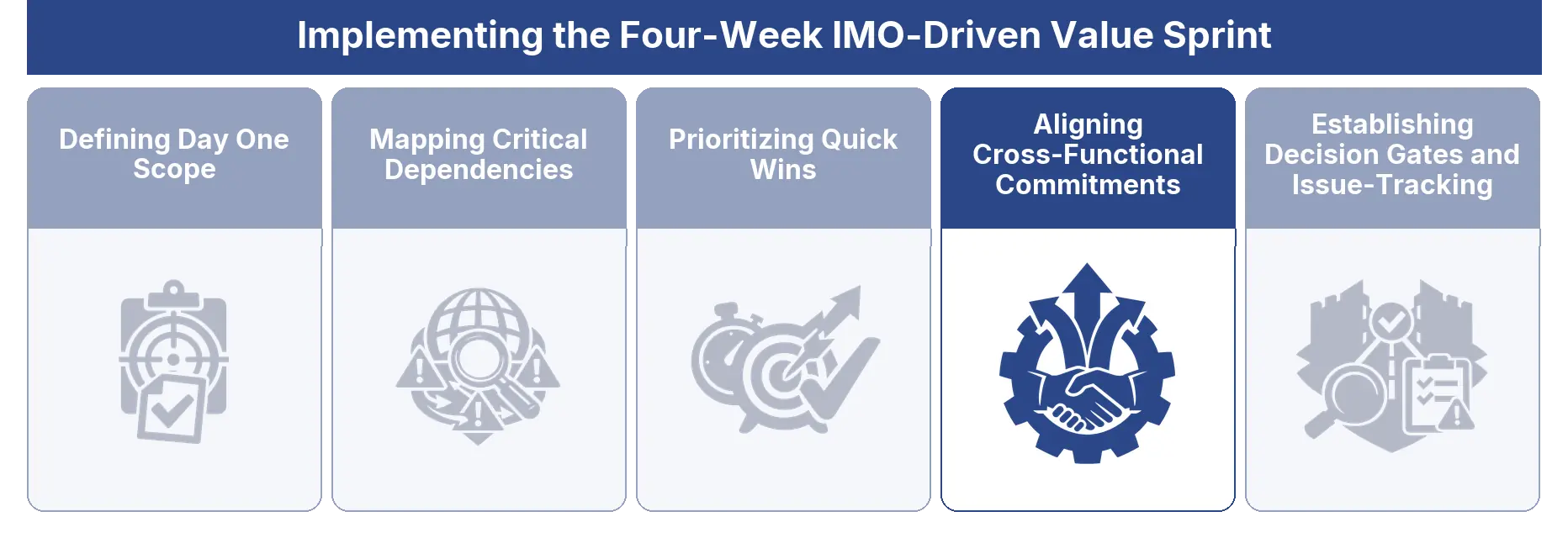
Cross functional commitments require a shared cadence that translates into synchronized actions across IT, HR, finance, security, and product. Establishing a rapid decision gates framework ensures decisions are made at the right level and on the right timeline, preventing drift between functional plans. A disciplined commitment cadence provides accountability for senior sponsors and functional leaders, with explicit ownership and deadlines. Aligning commitments also means agreeing on common data definitions, reporting cadence, and governance rituals so that the IMO can coordinate end to end execution and avoid value leakage. Real world experience emphasizes that early governance and cross functional alignment reduce post close frictions and accelerate value realization, particularly when accompanied by a visible progress cadence and transparent issue resolution processes. The Salesforce Tableau integration experience offers a concrete example of cross functional alignment across data and analytics surfaces, while the Dell EMC integration highlights the complexity of coordinating multi domain workstreams across a large enterprise.
Establishing Decision Gates and Issue Tracking
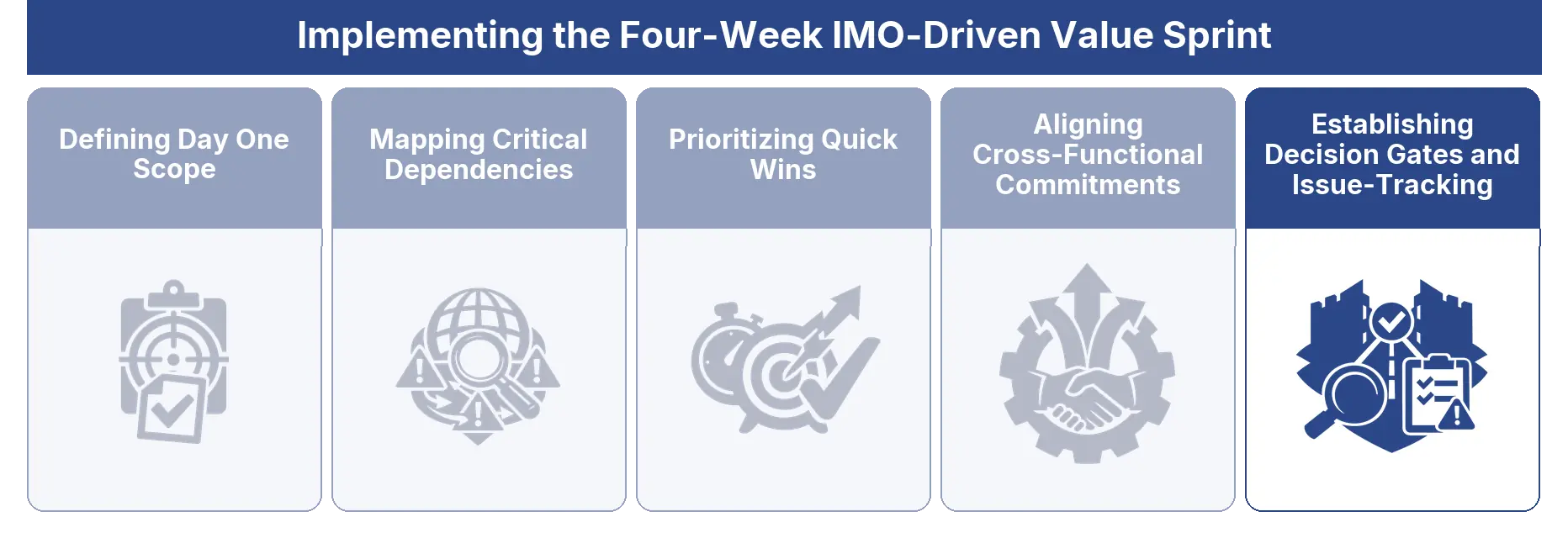
Decision gates formalize the points at which leadership reviews and approves next wave actions, while auditable issue tracking cadences provide transparency into bottlenecks and risk. The decision gates should reflect critical milestones tied to the target operating model, data governance, and risk controls, with light escalation paths and predefined rollback criteria where necessary. A disciplined issue tracking cadence surfaces blockers early, enabling the IMO to reallocate resources or adjust sequencing rather than allow drift. Industry practice shows that clear gates and rigorous issue tracking materially increase the probability of achieving Day One readiness and maintaining momentum into the post close phase. The framework is reinforced by the MA value literature and by practical implementations in MA readiness playbooks available in public sources. The overall cadence should be supported by an explicit governance charter and a transparent log of actions and owners that the executive sponsor reviews weekly.
Consolidating Early Value Across the Between Close Window
The weeks between signing and close are not a waiting room; they are the first sprint of the deal. Treated that way, the window converts deal design into motion, and three failure modes come into focus early: scope drift, tangled workstreams, and the quiet governance gaps where value leaks. The Four Week IMO Driven Value Sprint answers each by making governance an operating capability rather than a binder of policies, aligning leaders, fixing decision rights, and tying incentives to milestones that customers and employees can feel. Cost belongs in that calculus from the outset, which is why total cost of acquisition analysis sits at the center of the sprint rather than at its edges.
Start narrow and move. Name the sprint owner, publish a single governance charter, and stand up one cross functional cadence that holds scope, dependencies, and risk in a single view. Synchronize the interdependent workstreams against a milestone plan, close the governance gaps with a lean decision rights matrix, and let a shared issue log surface blockers before they harden. The reward compounds: a repeatable pattern that carries the next acquisition, grounded in integration discipline and priced honestly through total cost of acquisition analysis. The measure of success is simple and unforgiving, whether strategy became executable action inside four weeks.

Get new articles by email
Insights on M&A, revenue growth, and business transformation, delivered occasionally.