Integrating Go-to-Market: Aligning Sales, Marketing and Customer Success under the IMO
In 2016, Oracle acquired NetSuite for about $9.3 billion to accelerate its cloud ERP footprint. NetSuite kept its own brand and selling motion as a distinct business unit, while Oracle’s enterprise sales force carried an overlapping applications portfolio into many of the same accounts. From a GTM perspective, the decision tested whether a corporate-wide revenue machine could respect distinct sales motions while still driving unified customer value. Industry observers noted channel overlap and segment boundaries as early sticking points, even as deal teams pursued Day One readiness, a pattern described in the integration discipline framework. That tension echoes concerns raised in the Total Cost of Acquisition.
Legacy processes, data silos, and fragmented systems create friction when GTM motions merge under the IMO. Ambiguity about ownership and decision rights slows alignment just as the IMO accelerates integration planning. That tension risks inconsistent customer experiences and diluted value realization if left unaddressed. How can Go-to-Market functions be harmonized under the IMO to deliver a unified revenue motion across the combined entity?
The thesis identifies a four-part operational approach that reconciles GTM under the IMO by aligning end-to-end customer journeys with the combined value proposition, ensuring a coherent revenue motion across touchpoints. This framing matters given rising regulatory scrutiny, private equity dynamics, and the demand for disciplined governance across complex integrations. The discussion that follows translates these ideas into practical actions designed to deliver Day-One readiness and sustained revenue velocity.

Establishing Baseline for GTM Alignment
Post‑deal reality requires cross‑functional GTM alignment under the Integration Management Office, translating the deal thesis into a single, coherent revenue motion across Sales, Marketing and Customer Success. Without this alignment, customer journeys fracture at critical handoffs, leading to inconsistent messaging and friction through renewal. Public deals illustrate the pattern: in the IBM, Red Hat transaction, governance preserved the open-source franchise by maintaining Red Hat as an operationally independent unit; in the Salesforce, Slack combination, the collaboration layer was embedded within Customer 360 to ensure a seamless experience across the platform. Day One readiness becomes the baseline for momentum, not a one‑off milestone. The IMO acts as the central conductor, coordinating the integrated GTM into a unified operating rhythm that spans planning, execution and ongoing refinement, anchored by clear ownership. This approach echoes organizational design and coverage, with a data‑driven GTM engine further guiding disciplined execution.
Governance cadence is foundational to sustaining alignment across the merged GTM. Establishing a disciplined rhythm, weekly IMO status updates, monthly governance reviews, and Day One readiness checks, translates strategy into action and enables rapid course corrections. Evidence from GTM practice highlights the business case for alignment: organizations with strong GTM alignment see about 32% higher year‑over‑year growth. The alignment imperative also shows up in outcomes such as higher win rates; studies indicate up to 38% improvement when cross‑functional collaboration is strong and well choreographed. Yet signals from practitioners reveal ongoing challenges: 96% report alignment challenges across functions, and 80% of key commercial activities lack contributions from at least one function, creating drag and eroding velocity.
From a practical vantage point, the baseline hinges on mapping unified journeys, harmonizing data across the revenue motion, and codifying cross‑functional ownership through explicit roles and accountabilities. The governance cadence must be reinforced by a disciplined IMO inventory and tracking discipline, ensuring Day One readiness translates into sustained velocity. Real‑world patterns show why this matters: when governance cadence is explicit about inputs and decision rights, the post‑close organization preserves core capabilities while gradually integrating processes and systems. For practitioners seeking to deepen the baseline with proven patterns, prior work on organizational design and coverage highlights how clarity in roles supports scalable transformation, while the data‑driven GTM engine emphasizes technology as an enabler of strategic outcomes. Finally, alignment is not a one‑time exercise but a continuing discipline that anchors the GTM engine in a coherent set of customer experiences and revenue motions, reinforced by the GTM transformation in B2B SaaS view of disciplined, accountable change.
Navigating Cross-Functional GTM Tensions
Navigating cross-functional GTM tensions begins with recognizing that legacy processes create friction when blending two organizations’ GTM cultures. Marketing, sales, and customer success often run on different cadences, incentives, and escalation paths, which makes a unified revenue thesis hard to sustain during integration. Data silos and fragmented systems suppress a single, trusted view of the customer, forcing teams to act on partial signals rather than a coherent truth. Ownership ambiguity further slows decision-making and undermines accountability when critical bets cross function boundaries. In practice, the IMO must reclaim tempo by codifying a charter, clarifying escalation paths, and instituting joint cadences that keep Day One objectives front and center. A high-profile example illustrates the point: when IBM acquired Red Hat for about $34 billion, Red Hat was kept operationally independent to preserve the open-source ecosystem that made the acquisition strategically valuable. IBM-Red Hat integration
External research consistently shows that GTM alignment is not optional; it correlates with meaningful revenue outcomes. Demandbase highlights that organizations with strong GTM alignment see about 32% higher year-over-year growth. The same source notes that alignment can yield a [67% uplift in close rates], underscoring how disciplined handoffs and shared priorities accelerate momentum across the funnel. Yet, misalignment persists in many deals, a reality echoed by practitioners who emphasize the toll of data fragmentation and fragmented systems on conversion velocity. When cross-functional contributions falter, [80% missing cross-functional contributions] and [47% report strong handoffs] become meaningful gaps in execution, a drag that undermines trust and customer outcomes. These findings are reinforced by GTM guides that frame alignment as a revenue-improvement discipline, not a one-off project. GTM alignment essential to GTM success and the broader literature on alignment stress the need for a cohesive data backbone and shared metrics. [80% missing cross-functional contributions], [47% report strong handoffs]
Synthesis and implications draw a straight line from governance to execution. The first priority is to establish a single source of truth for the customer, backed by a unified data layer that feeds marketing, sales, and service orchestration. This is complemented by a clearly defined ownership model that mirrors a RACI-like approach, so accountability for GTM outcomes is explicit across Marketing, Sales, and Customer Success. For practitioners, aligning the organization starts with clarifying roles and responsibilities and then layering in cadence and decision rights through a formal governance charter. The GTM engine framework offers a practical blueprint for doing this in practice, with explicit attention to organizational design, coverage, and accountability. See GTM engine organizational design for a concrete pattern, and consider adopting a RACI accountability framework to avoid ambiguity in handoffs. GTM engine organizational design and RACI accountability framework. When larger deals are considered, the blueprint for M&A integration provides a disciplined template for chartering cross-functional work and preserving deal thesis value through Day One and beyond. blueprint for M&A integration
Orchestrating an Integrated GTM Framework
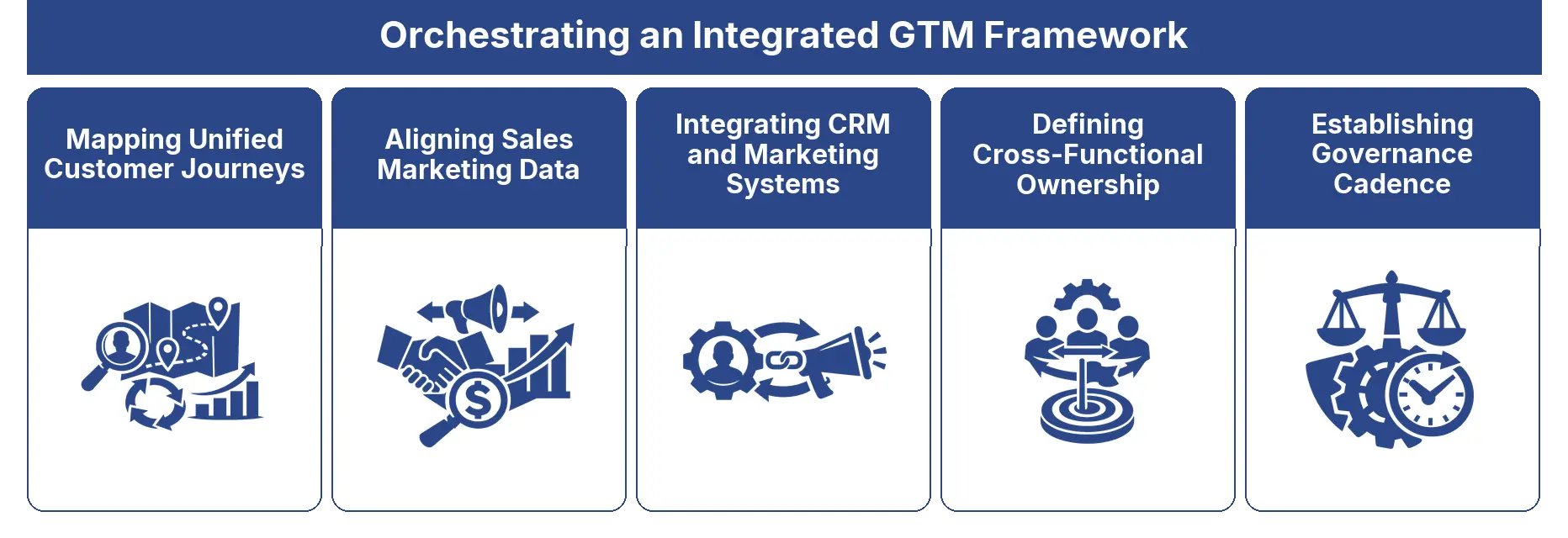
The GTM Alignment Framework unifies sales, marketing and customer success under the Integration Management Office (IMO) into an end-to-end, buyer-centric engine that translates strategy into repeatable execution across the revenue cycle. It solves the friction created by silos and inconsistent data by defining five interlocking elements: mapping unified customer journeys, aligning sales marketing data, integrating CRM and marketing systems, defining cross-functional ownership, and establishing governance cadence. The result is clearer handoffs, consistent data, shared accountability, and durable value realization from first engagement through ongoing value capture.
Practitioners operationalize the framework by turning those five elements into disciplined practice. Handoff templates become standard, data architecture becomes a single source of truth, ownership is codified with clear decision rights, and governance cadence becomes a durable rhythm of reviews and learning. That momentum primes the organization to begin turning journeys into coordinated engagement from the very first touchpoint.
Mapping Unified Customer Journeys
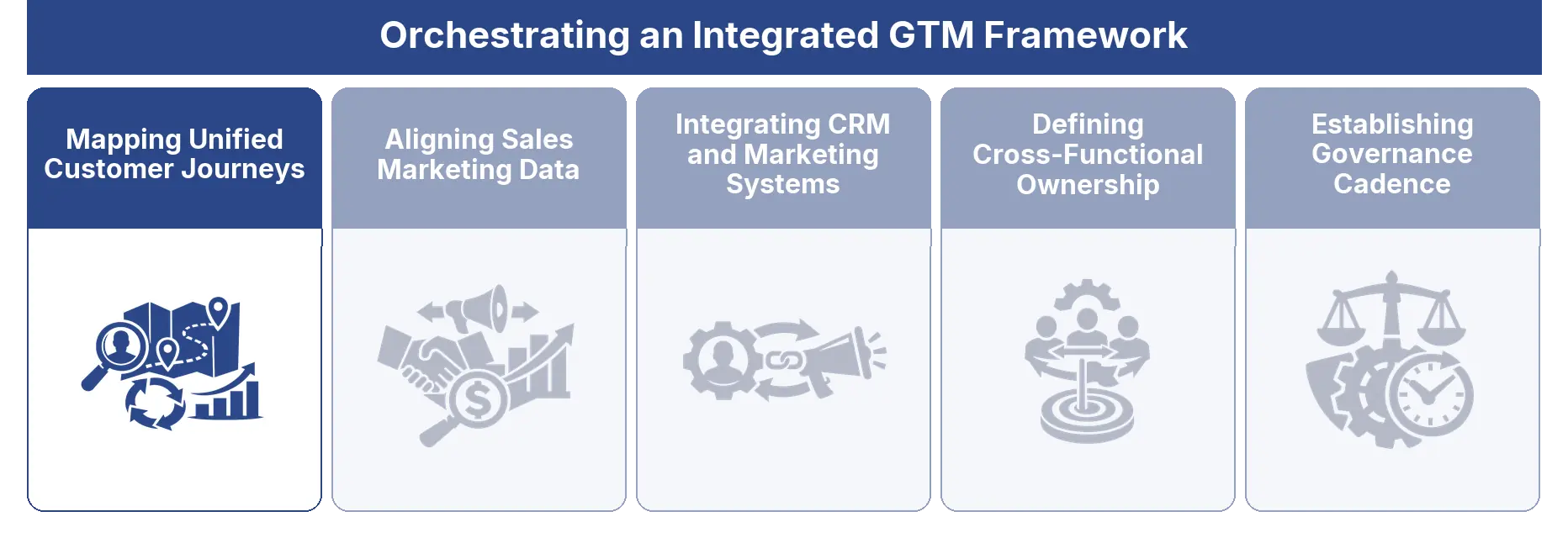
Mapping the unified customer journey anchors the integrated GTM framework in reality rather than siloed playbooks. It requires tracing the buyer from awareness through consideration to purchase and renewal across marketing channels, sales motions, and service moments. When this map exists, handoffs become predictable and incentives align with buyer outcomes rather than channel ownership. Public deal history illustrates the pattern: Salesforce’s 2019 Tableau acquisition preserved a distinct analytics franchise while aligning it to the platform selling motion, safeguarding the buyer’s journey across a dense ecosystem; similarly, Salesforce’s 2021 Slack acquisition anchored collaboration across the Customer 360 to unify workflows. GTM engineering describes this as cross-functional orchestration rather than a single team’s remit. Executives should codify stage owners, inputs, and success metrics into a living map, and reference prior GTM transformation thinking for execution patterns. Imperative for GTM transformation, GTM Engine organizational design, blueprint for M&A integration
Aligning Sales Marketing Data
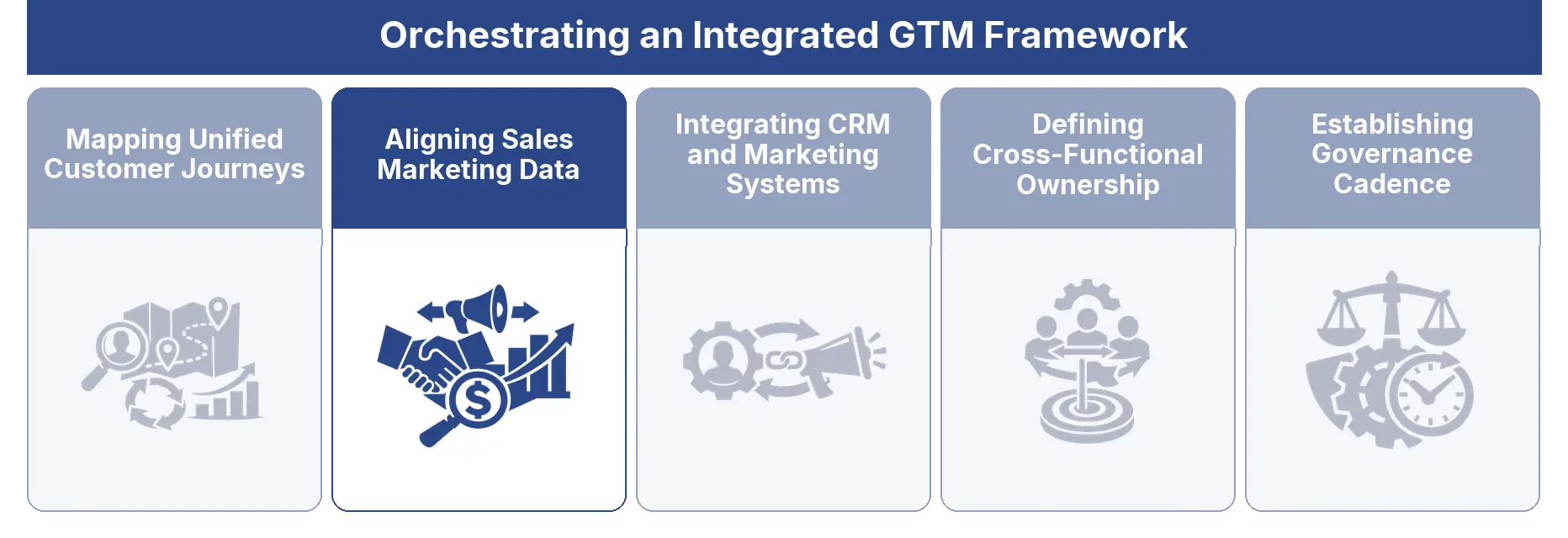
Aligning data across the GTM stack eliminates friction and accelerates decision making. GTM operations, the layer that coordinates demand generation with sales capacity and ensures customer success does not inherit chaos post-sale, provides the practical mechanism for this orchestration. External research reinforces the point: GTM alignment efforts yield measurable gains in velocity and conversion, while data quality directly affects outcomes; a widely cited CRM data quality finding notes that a substantial share of CRM data is incomplete or stale, degrading downstream motions. Additional industry surveys highlight that a substantial portion of field leadership identifies lack of alignment as a top challenge, underscoring the persistent gap between marketing signals and sales action. With a solid data backbone, messaging and targeting can adapt to real buyer intent rather than relying on disconnected signal sets. This is the environment in which integrated GTM models, as described in GTM strategy guides, begin to realize their value.
Integrating CRM and Marketing Systems
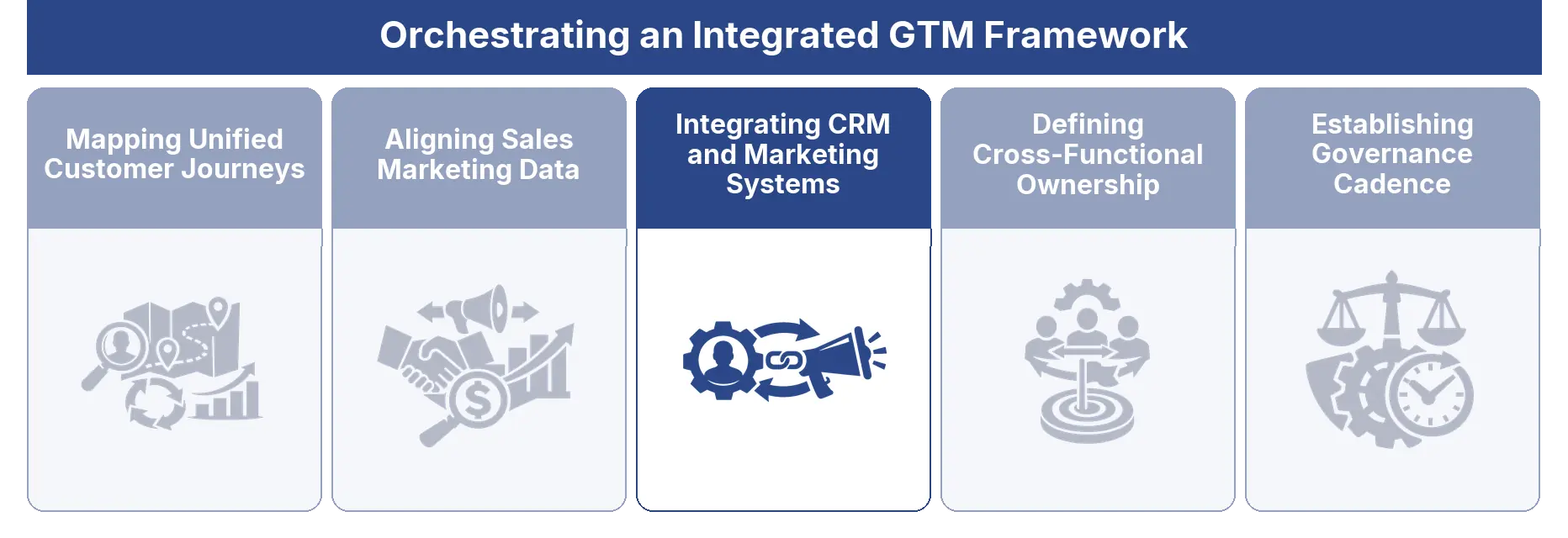
The technical backbone of an integrated GTM is the seamless link between CRM and marketing platforms. Real-world outcomes hinge on preserving service continuity while combining data streams, which supports faster, more accurate forecasting and more cohesive buyer experiences. A high-profile illustration is the Oracle-NetSuite integration, where value was reinforced by maintaining NetSuite’s distinct selling motion while aligning lead flow and content at points of buyer engagement. Another example is the Salesforce-Slack transaction, which explicitly connected collaboration workflows to the broader CRM and analytics fabric, enabling cross-functional workflows from first touch to close. In practice, the aim is to reduce handoffs and latency while preserving the integrity of each system’s strengths, a principle supported by cross-functional GTM thinking and implementation playbooks.
Defining Cross-Functional Ownership
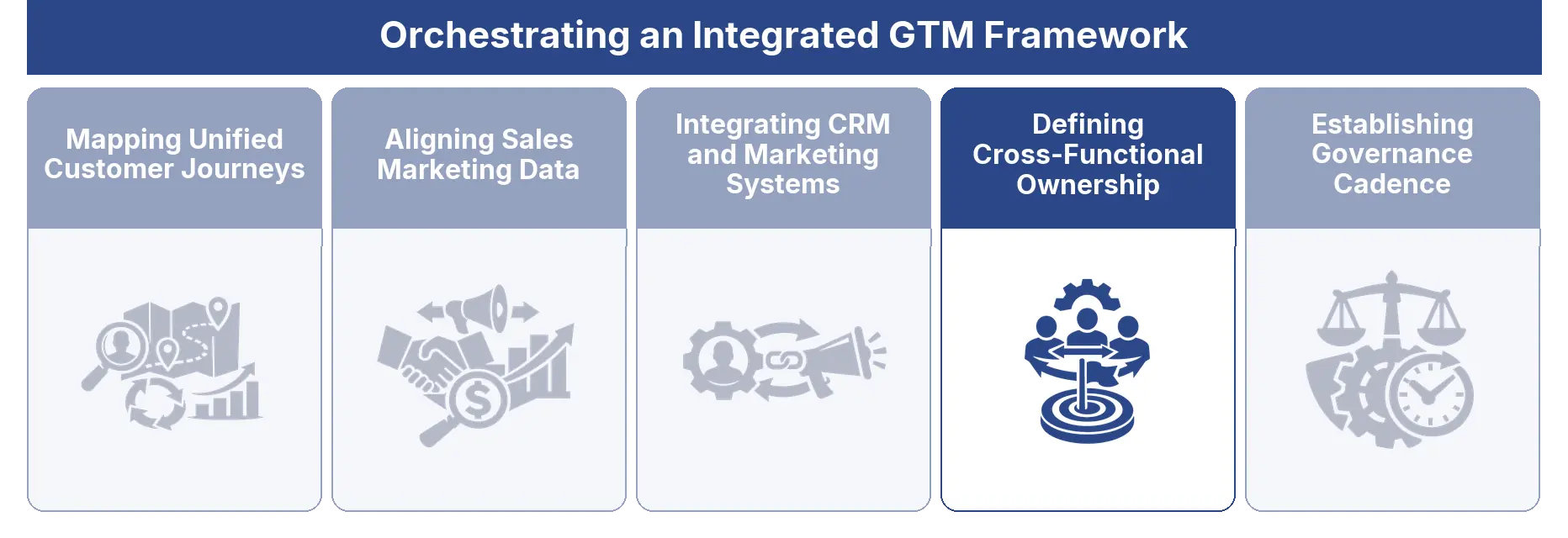
Clear ownership across marketing, sales, and customer success is the linchpin of a credible GTM architecture. A disciplined IMO, driven cadence helps translate the strategic thesis into day-to-day execution, with agreed steers and escalation paths that prevent drift between plans and results. Governance structures, including steering committees and executive sponsorship, standardize how work is prioritized and how performance is tracked across work streams. In practice, the most effective arrangements strike a balance between centralized oversight and local autonomy, enabling rapid decision making without eroding accountability. This governance mindset resonates with established GTM operating principles that emphasize end-to-end ownership and disciplined handoffs, reducing the risk of misaligned incentives and fractured execution.
Establishing Governance Cadence
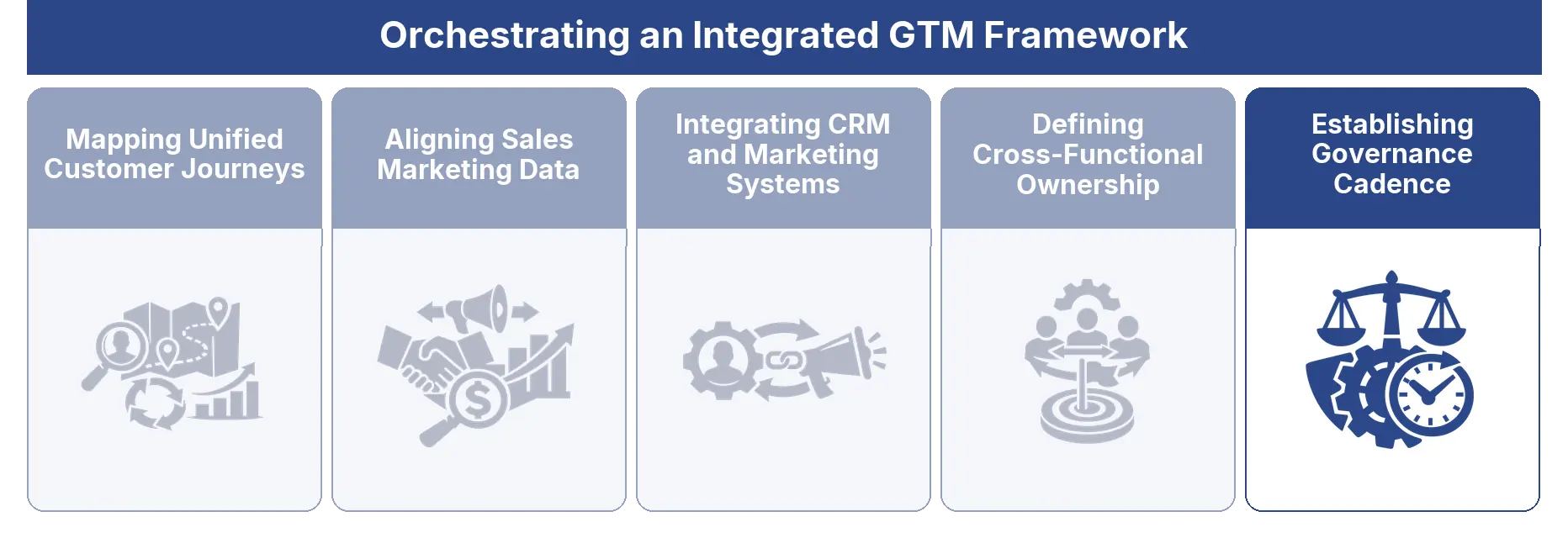
A durable GTM cadence links strategic priorities with daily actions through structured reviews, decision rights, and cross-functional transparency. Regularly scheduled governance forums keep initiatives tethered to the revenue thesis, while escalation paths maintain agility in the face of changing buyer behavior or market conditions. The architecture of this cadence, clear roles, documented decisions, and measurable milestones, forms the backbone of an integrated GTM engine. Executives should implement a cadence that mirrors the four-phased IMO lifecycle and layers Day One readiness, integration planning, and ongoing value capture into a single, standardized rhythm. The result is a repeatable, accountable system for driving integration harmony across marketing, sales, and customer success.
Synthesizing GTM Integration Across the Series
Post deal reality demands a single revenue motion governed by the Integration Management Office, not parallel GTM playbooks. The central insight is that aligning Sales, Marketing and Customer Success into an end to end frame reduces friction and accelerates value realization. Standardized handoffs cut miscommunication and delays; an end to end data architecture supports scale; mapping unified customer journeys anchors the framework in buyer behavior rather than siloed funnels. Market and customer analysis informs ICPs and personas, while a buyer centric sales process keeps engagement true to how buyers buy. The result is a cohesive GTM engine that translates deal thesis into revenue lift.
With the framework in place, the NorthStar strategy is embedded into the IMO backlog, joint cadences established, and standardized templates deployed. The Monday morning play is simple: publish a unified customer journey, assign cross functional ownership, and lock in data governance to validate the motion. A single governance rhythm and shared CRM align with the four phase lifecycle, driving scale and faster value capture. The blueprint for M&A success shows how governance turns ambition into execution, while comprehensive TCOA analysis informs the cost discipline that underpins the value thesis. Monday morning action becomes the habit of the disciplined.

Get new articles by email
Insights on M&A, revenue growth, and business transformation, delivered occasionally.