
Product AI and Commercial Offerings: Unlocking Customer Value
In 2024, global networking and security platform Cisco completed its roughly $28 billion acquisition of Splunk, combining networking infrastructure with security and observability data. The deal logic was compelling: richer telemetry, broader enterprise relevance, and a larger platform for customers managing complex digital environments. The hard work shifted quickly from technical adjacency to commercial translation. Product teams needed to define AI enabled use cases, sales teams needed proof of value, and customers needed outcomes that justified budget priority.
That tension now sits at the center of many B2B SaaS integrations. AI capabilities can impress in demos while failing to become differentiated offerings that customers buy, renew, and expand with confidence. In M&A settings, the risk compounds because product roadmaps, pricing architecture, customer messaging, and sales incentives must converge before market momentum dissipates. How can Product AI be packaged into differentiated commercial offerings that deliver measurable customer value and align with go to market motions?
Product AI creates value when it moves beyond feature novelty and becomes a priced, measurable answer to customer pain. Integration leaders and commercial executives need to connect AI use cases to buyer segments, define return on investment in operational terms, and equip go to market teams with packaging that reflects perceived value. Regulatory scrutiny, tighter capital markets, and higher customer expectations make disciplined monetization a strategic imperative. The organizations that win will preserve product continuity, protect customer relationships, and turn AI capability into commercial clarity before competitors define the category for them.

Grounding Product AI in Customer Value
Artificial intelligence (AI) features create commercial value only when buyers can translate them into operational outcomes. Forrester has warned that the GTM opportunity sits less in broad efficiency claims than in measurable customer outcomes, which means product teams should express capability in the language of speed, accuracy, cost reduction, risk mitigation, and revenue expansion. A claims automation feature, for example, should not enter the market as “AI enabled workflow intelligence”; it should enter as fewer manual reviews, shorter cycle times, better exception handling, and clearer audit trails for the buyer persona accountable for those metrics. Prior work on customer insights discipline reinforces the same point: segmentation and journey evidence should shape strategic decisions, not decorate them after the product narrative has already hardened.
The gap remains wide. BCG research found that only 22% of companies have advanced beyond proof of concept with AI, and only 4% are creating substantial value, a sobering benchmark for executives who assume technical deployment equals market adoption. The stronger commercial pattern starts with the buyer journey, identifies the decision criteria at each stage, and then maps AI features to the moments where perceived risk, switching cost, or time to value constrains conversion. MIT Sloan Management Review describes using AI agents to simulate interviews with persona specific customers and test alternative value propositions, a useful discipline when product teams need sharper evidence about which outcomes buyers actually value.
Pricing and packaging should then follow the economics of the outcome, not the novelty of the algorithm. BCG notes that providers often capture 25% to 30% of the value their solutions create, and one cited example capped fees at no more than 25% of customer value created, which provides a practical guardrail for value based pricing. Tiered offers can separate low risk entry use cases from premium automation, while modular add ons allow buyers to expand once governance, data quality, and return on investment become visible. Trust matters here. Buyers will pay more readily when the offering explains data usage, control rights, model oversight, and escalation paths with the same clarity as the feature set.
In Mergers and Acquisitions (M&A), the same value story must survive diligence, integration planning, and commercial relaunch. ServiceNow’s acquisition of Moveworks for about $2.85 billion illustrates the strategic logic of extending agentic AI into front line employee experiences, but the value depends on whether roadmap continuity, packaging architecture, and sales enablement converge around buyer outcomes after close. Product leaders should protect the core roadmap, keep customer facing promises stable, and use onboarding to produce early wins that sales teams can quantify. The five part framework that follows, Mapping Customer Value, Selecting High ROI Use Cases, Quantifying ROI Metrics, Aligning GTM Motions, and Packaging AI Features Strategically, turns that discipline into an operating system for commercial execution.
Highlighting GTM Frictions and ROI Gaps
Commercial friction often begins before the first sales conversation, when artificial intelligence (AI) capabilities are described as features rather than customer outcomes. A model that drafts summaries, scores accounts, or predicts churn may be technically impressive, but the buyer hears a budget request unless the seller connects that capability to revenue lift, cost avoidance, cycle time compression, or risk reduction. Research from McKinsey found that better analytics can recover up to 20% of lost ROI, which underscores a basic commercial truth: value must be measured before it can be defended. Without that mapping, pricing defaults to cost plus logic, packaging becomes one size fits all, and differentiation weakens precisely when buyers need stronger economic confidence.
The same pattern appears in return on investment (ROI) discussions, where inconsistent measurement creates room for skepticism. Product teams may track feature adoption, marketing may track campaign engagement, sales may track pipeline influence, and customer success may track retention signals, yet none of those measures alone proves value realization. AI offerings require use case level economics, including payback period, total cost of ownership (TCO), and net present value (NPV), segmented by buyer profile and deployment context. That discipline resembles a revenue instrument panel: isolated dials create activity, while a connected dashboard reveals whether the commercial engine is accelerating. Prior work on the data driven GTM engine framed the tech stack audit in similar terms, mapping tools to strategic objectives and exposing redundancies, gaps, and data flow breaks that inhibit commercial execution.
Go to market (GTM) alignment frequently lags product development because the operating cadence rewards release velocity more than buyer comprehension. Product messaging emphasizes capability, marketing campaigns translate that capability into broad themes, and sales teams improvise value narratives under deal pressure. OpenAI’s GTM operations role description highlights the need to diagnose pipeline creation gaps by product, segment, region, and deal size, a practical reminder that friction is rarely generic. It appears in specific handoffs. It compounds through inconsistent qualification, uneven enablement, unclear pricing logic, and misaligned proof points, slowing adoption while competitors present a cleaner path from problem to quantified outcome.
Data readiness creates the final gap between promise and realized value. AI products depend on accessible, governed, integrated data, yet many customers encounter fragmented systems, privacy constraints, unclear ownership, and implementation dependencies that were not surfaced during the buying process. The $13.7 billion Amazon acquisition of Whole Foods showed how a strategic rationale can connect digital capability, logistics infrastructure, and physical customer access, but most AI vendors face a narrower and more fragile version of that same challenge: the value proposition only holds when the operating system can absorb the capability. Cross functional governance therefore becomes a commercial necessity, not an internal coordination exercise, because product, legal, data, marketing, sales, and customer success must maintain one buyer focused narrative from promise through post implementation monitoring.
Structuring a Product AI GTM Framework
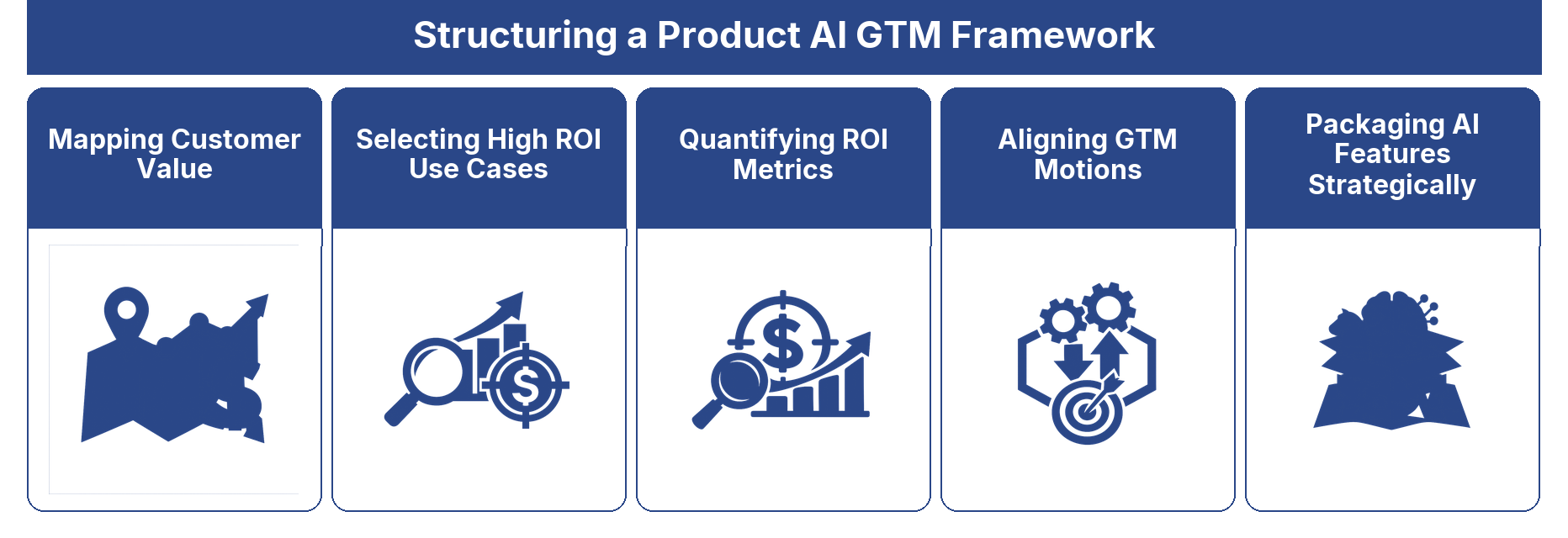
A durable commercial framework for artificial intelligence (AI) offerings starts with a simple discipline: product decisions, revenue motions, and customer proof points must share the same economic logic. HubSpot reports that 86% have seen positive outcomes from incorporating AI into go to market (GTM) strategies, but positive activity does not automatically become value creation. The stronger pattern links five decisions in sequence: customer value, use case priority, Return on Investment (ROI) measurement, GTM execution, and packaging design.
Mapping Customer Value
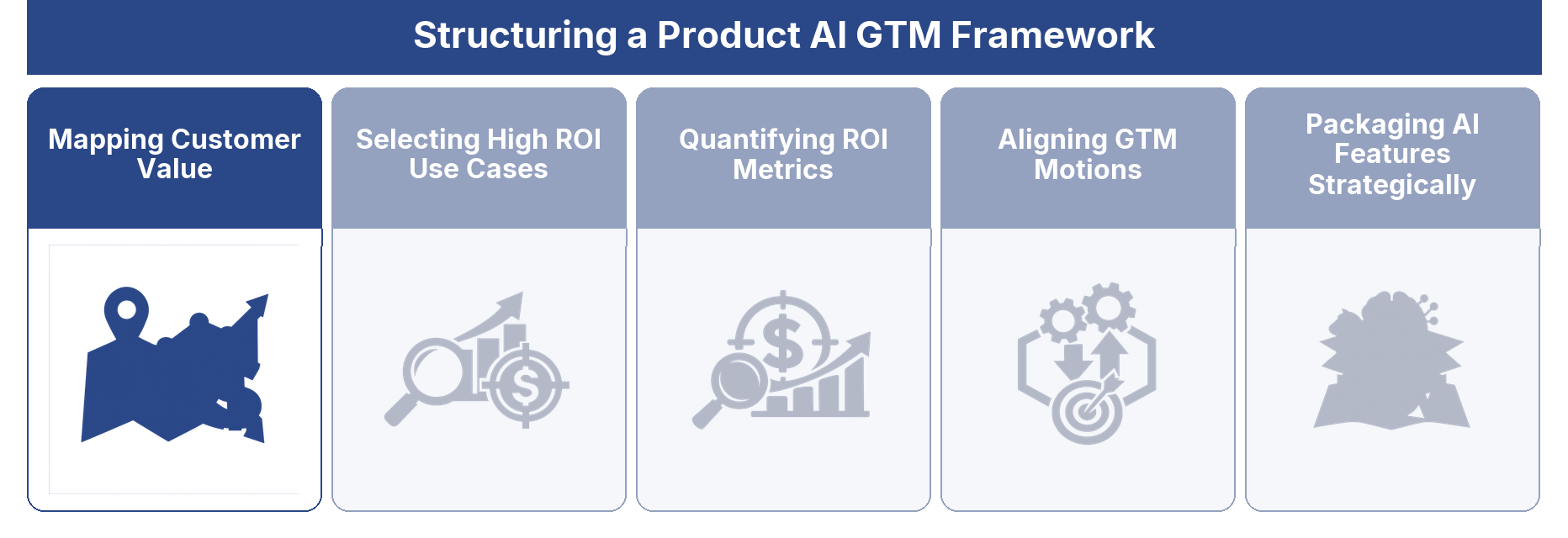
Customer value mapping begins with the persona, not the model. Product and commercial leaders should identify the economic pressure facing each buyer, whether cycle time, labor cost, compliance risk, customer retention, or revenue expansion, then translate the AI capability into a buyer specific narrative that quantifies the improvement. Andreessen Horowitz warns that when product teams prioritize roadmaps separately from GTM segmentation, customers gradually lose confidence because their needs remain unmet. That failure mode is common in AI launches, where technical novelty overwhelms operational relevance. Prior analysis of customer centric GTM transformation reinforces the same point: segmentation must shape the offer, the message, and the commercial motion.
Selecting High ROI Use Cases
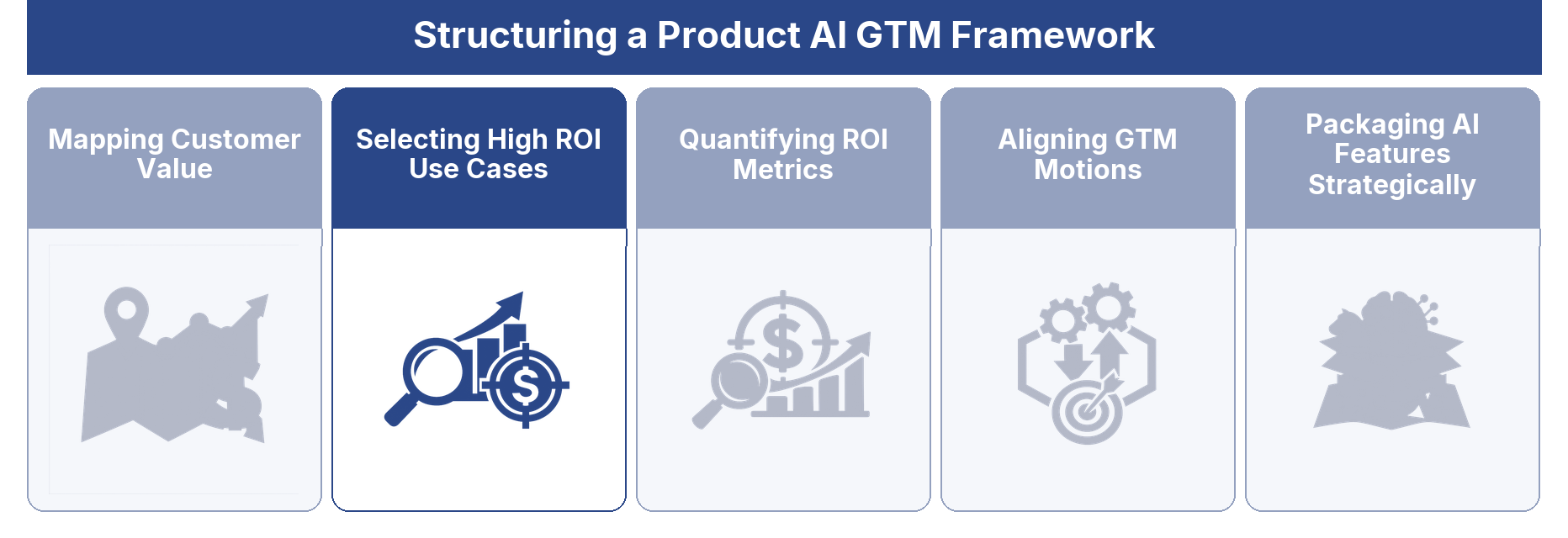
Use case selection should balance four filters: market demand, data readiness, implementation effort, and monetization potential. HubSpot’s benchmark found the greatest ROI for GTM in generative content creation at 29%, productivity and workflow automation at 24%, and visual content creation at 23%, a distribution that shows why commercial teams need disciplined prioritization rather than broad experimentation. The most attractive use cases combine credible payback, repeatable deployment, and visible differentiation against competitors. For acquirers and portfolio leaders, the same screen should test fit with Mergers and Acquisitions (M&A) objectives: whether the capability expands attach rates, improves retention, supports cross sell, or strengthens a strategic platform. Google’s agreement to acquire Wiz for about $32 billion to strengthen multicloud security illustrates how AI adjacent commercial logic often depends on portfolio fit, not feature count.
Quantifying ROI Metrics
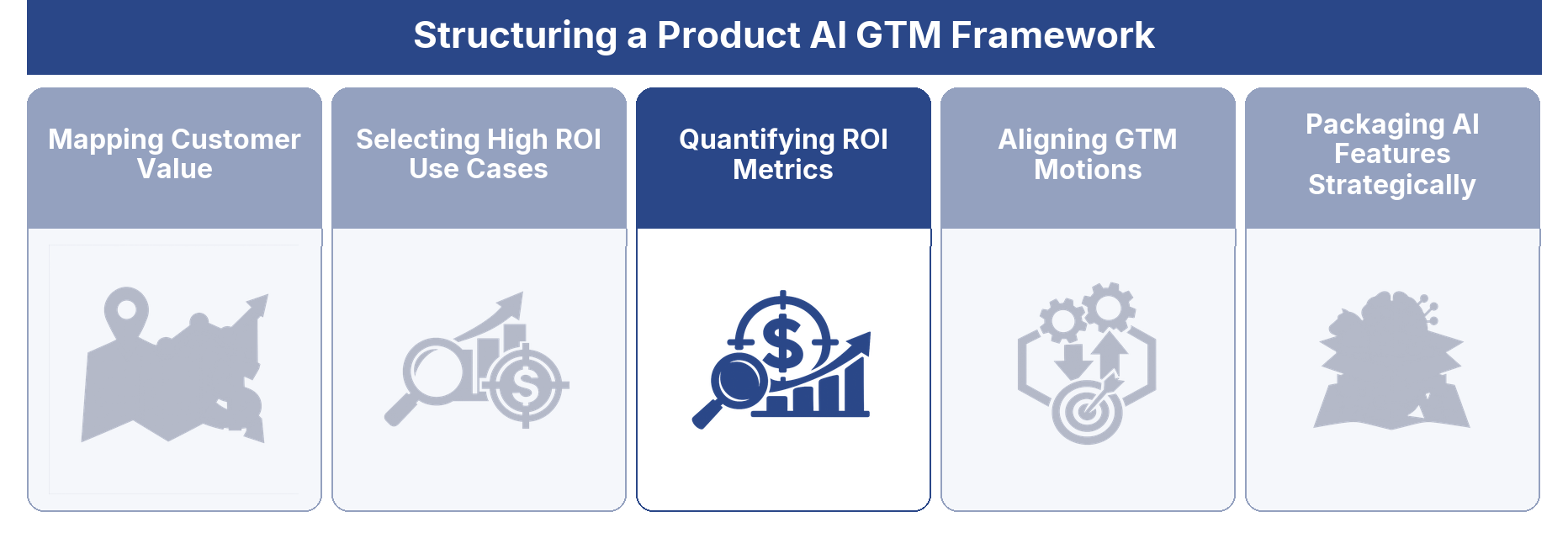
ROI discipline converts the AI value narrative into an investment grade case. The model should include payback period, Net Present Value (NPV), Internal Rate of Return (IRR), adoption assumptions, gross margin impact, and sensitivity analysis across usage, pricing, implementation cost, and time to value. Measurement plans need named data sources, baseline definitions, governance ownership, and success criteria that customers and internal stakeholders can both audit. Without that structure, sales teams rely on anecdotes while finance teams discount the claim. A practical framework also distinguishes leading indicators, such as activated users and workflow completion, from lagging indicators, such as renewal uplift, expansion revenue, and support cost reduction.
Aligning GTM Motions
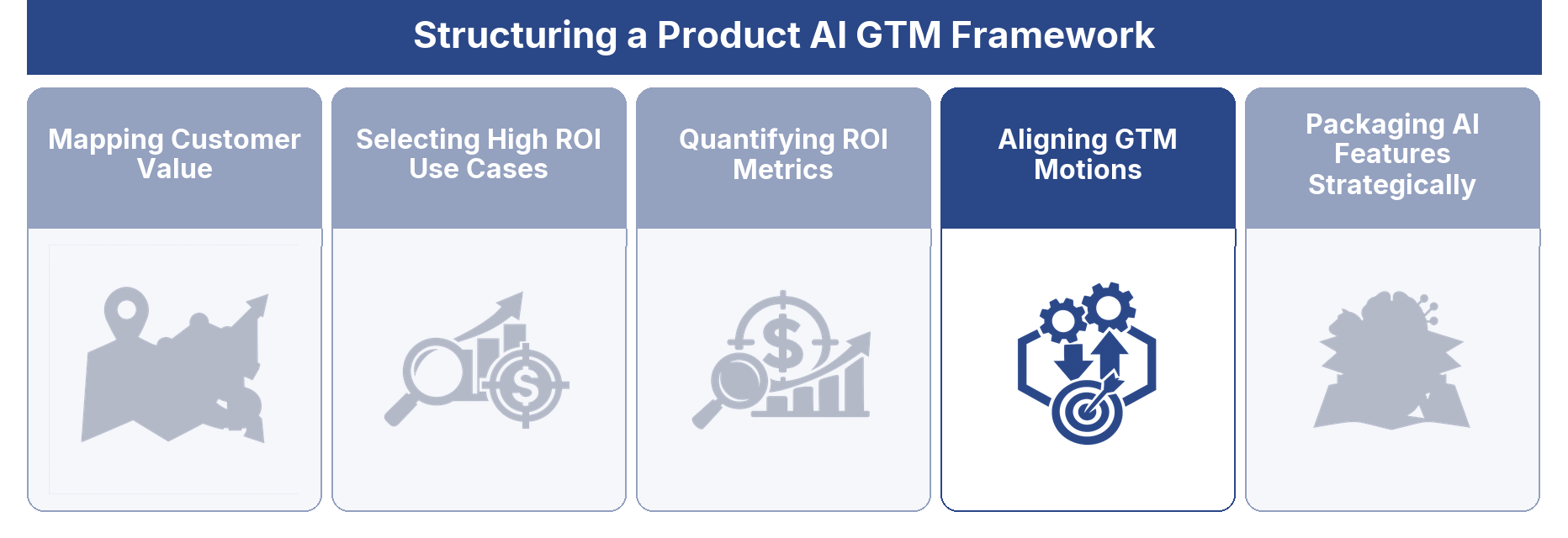
Once the value case is defined, product, marketing, sales, partner, and customer success motions must carry one commercial narrative. HubSpot reports that 75% of current generative AI use cases sit within customer operations, marketing and sales, software development, and research and development, which makes cross functional alignment a strategic imperative rather than a launch checklist. Sales training should clarify the buyer problem, the quantified outcome, the proof required, and the pricing logic; marketing should convert those same elements into messaging, calculators, case narratives, and objection handling. OpenAI describes low touch evals into daily workflows as a mechanism for keeping seller feedback close to product and customer success reality. Prior work on GTM organizational design frames this operating challenge as coverage, capability, and handoff design.
Packaging AI Features Strategically
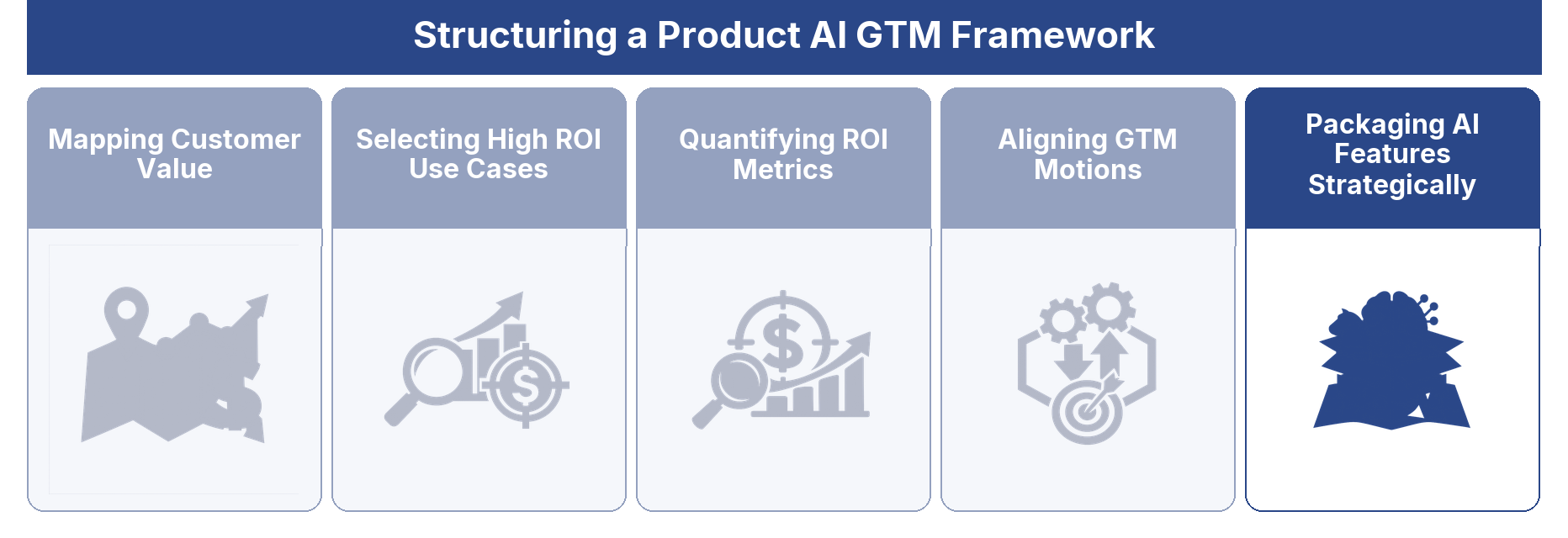
Packaging determines whether customers experience AI as an easy adoption path or a complex deployment burden. Product leaders should design bundles and tiers around realized value, with entry packages that prove the use case, expansion packages that scale usage, and enterprise packages that add governance, integration, support, and data controls. Research on product knowledge graphs shows how AI agents can perform end to end ontology creation, refinement, and knowledge graph population from product descriptions, a reminder that packaging can increasingly embed intelligence into workflows rather than sell AI as a detached module. Pricing should reflect the value metric most closely tied to the outcome, such as seats, transactions, workflows, records enriched, or risk events avoided. Clear privacy controls, integration ready options, and modular expansion paths build trust, accelerate procurement, and protect pricing integrity as adoption broadens across segments.
Synthesizing Product AI Value Across GTM and Readiness
Artificial intelligence creates commercial value only when product claims, buyer economics, and customer proof move in the same direction. The central risk is not weak technology; it is commercial ambiguity, where promising capabilities arrive in market as disconnected features, unclear pricing logic, and adoption stories that fail to survive procurement scrutiny. Executives who treat AI offerings as outcome systems, not feature bundles, create a clearer path from roadmap choice to revenue motion to measurable customer impact. That discipline turns innovation into value creation.
Looking ahead, disciplined practitioners should establish shared value metrics before launch, codify the proof points sales teams can defend, instrument adoption signals that reveal whether customers are realizing outcomes, and sequence packaging decisions around the problems buyers already fund. Product, revenue, customer success, and finance leaders then gain a common operating language for decisions that otherwise fragment across functions. The organizations that build this muscle can deploy AI capabilities with less commercial friction, operationalize customer feedback faster, and govern pricing around perceived value rather than internal cost. The question is not whether AI belongs in the commercial portfolio, but how quickly leadership can turn capability into measurable customer advantage.
Artificial intelligence creates commercial value only when product claims, buyer economics, and customer proof move in the same direction. The central risk is not weak technology; it is commercial ambiguity, where promising capabilities arrive in market as disconnected features, unclear pricing logic, and adoption stories that fail to survive procurement scrutiny. Executives who treat AI offerings as outcome systems, not feature bundles, create a clearer path from roadmap choice to revenue motion to measurable customer impact. That discipline turns innovation into value creation.
Looking ahead, disciplined practitioners should establish shared value metrics before launch, codify the proof points sales teams can defend, instrument adoption signals that reveal whether customers are realizing outcomes, and sequence packaging decisions around the problems buyers already fund. Product, revenue, customer success, and finance leaders then gain a common operating language for decisions that otherwise fragment across functions. The organizations that build this muscle can deploy AI capabilities with less commercial friction, operationalize customer feedback faster, and govern pricing around perceived value rather than internal cost. The question is not whether AI belongs in the commercial portfolio, but how quickly leadership can turn capability into measurable customer advantage.

Get new articles by email
Insights on M&A, revenue growth, and business transformation, delivered occasionally.