Augment, Automate, or Redesign: Choose the Right Operating Model
In 2016, Microsoft, a global software company, acquired LinkedIn for about $26 billion, creating a high-stakes test of how a platform business could connect with a larger enterprise without losing its network effects. The transaction preserved LinkedIn as a largely autonomous unit while allowing Microsoft to pursue commercial and technological synergies. The autonomous integration choice made the operating model itself a value creation decision, not an administrative detail. Integration leaders therefore had to determine which work should remain human-led, which activities could be automated, and which processes required fundamental redesign.
That tension has intensified as artificial intelligence moves from experimentation into operating decisions. Automation can accelerate value capture, while augmentation can preserve expertise and trust; redesign can unlock larger gains but demands stronger governance, new capabilities, and stakeholder alignment. In mergers and acquisitions (M&A), inconsistent choices can fragment the target operating model, disrupt talent resilience, and weaken synergy realization. How should leaders choose among augmenting, automating, or redesigning work to maximize value while managing risk and governance?
A disciplined choice framework evaluates work at the task level, connects each decision to strategic objectives and M&A synergies, and measures full cost rather than raw technology spending. The right model may differ across business units, depending on risk, scale, customer impact, and Integration Management Office (IMO) capability. Leaders who make those distinctions early can align governance, protect business continuity, and convert AI investment into measurable operating advantage.

Assessing Current Operating Model Readiness
Readiness begins with the operating model dilemma, not an ambition statement. When Microsoft acquired LinkedIn for about $26 billion in 2016, preserving LinkedIn’s autonomy protected the network’s credibility, culture, and user relationships, while still allowing Microsoft to pursue commercial and technical synergies. The choice was not between integration and inaction. It was between integrating the capabilities that created value and interfering with the conditions that made those capabilities valuable. That distinction should shape every baseline, design option, and migration plan.
A fact base should show how work gets done today, including human effort, handoffs, exception rates, system dependencies, and the controls that protect customers and compliance. Deloitte’s operating model research reports that 75% of surveyed leaders expect to change their operating models within 12 to 18 months, while only about a quarter make those changes continuously or dynamically. The gap makes disciplined assessment a strategic imperative, but assessment should lead to a decision rule rather than a catalog of inefficiencies: delay automation when exception economics, accountability gaps, or weak data make scale more expensive than controlled manual work. Activities suitable for augmentation should strengthen human judgment, repeatable rules based work should qualify for automation, and structurally fragmented workflows should undergo redesign before technology is layered on top.
The transaction record shows why operating model mechanisms matter more than deal labels. Kraft and Heinz’s cost synergy pursuit created pressure to standardize and remove duplication across a newly combined food company, making sequencing and accountability central to value realization rather than administrative details. By contrast, Intel’s autonomous treatment of Mobileye preserved operating independence after a transaction valued at about $15.3 billion, a choice that protected specialized capabilities and later supported Mobileye’s return to public markets. Adobe’s proposed combination with Figma demonstrates a different constraint: the approximately $20 billion transaction was terminated in 2023 amid regulatory opposition, showing that an operating model cannot be designed in isolation from external approval conditions and strategic reversibility.
The Integration Management Office (IMO) should own the evaluation architecture without becoming the permanent owner of every decision. Its remit should connect the current state baseline to capability gaps, risk thresholds, value cases, interdependencies, and migration sequencing, while business leaders retain decision rights over customer impact, workforce changes, and functional accountability. Earlier current state assessment discipline establishes why a future state cannot be credible without a defensible baseline. The IMO should also document escalation paths, approval authorities, and business continuity measures, because delayed ownership turns small design ambiguities into integration bottlenecks. Amazon’s coordination of logistics and retail through its approximately $13.7 billion acquisition of Whole Foods illustrates the same principle: the value thesis depended on coordinating distinct capabilities without allowing integration activity to erode the customer experience. McKinsey’s analysis of rewiring organizations for AI reinforces the conclusion that operating model design, not deployment volume, determines whether technology produces enterprise value. The consequential choice is therefore not how many processes can be automated, but which processes should remain deliberately human until ownership, exceptions, and migration dependencies are ready for scale.
Balancing Tradeoffs Across Models
AI investments rarely fail because an organization cannot identify an attractive use case. They fail when leaders optimize one dimension while neglecting the others. The tradeoffs are explicit: speed to value can increase risk exposure, tighter controls can raise governance burden, and aggressive automation can weaken talent resilience. A 2026 analysis of AI value realization reports that only 12% of chief executive officers see both revenue and cost benefits, while 60% of organizations still report no enterprise wide earnings before interest and taxes impact. The implication is direct: isolated gains do not constitute operating model value.
Context changes the balance. A low volume internal workflow may justify augmentation because the organization can capture speed without accepting material exposure, while a customer facing or regulated process may require stronger validation, human review, and clearer accountability before automation scales. Function matters as well: engineering, finance, security, and sales carry different error costs, decision rights, and workforce dependencies. The NIST AI risk framework treats validity, reliability, accuracy, and resilience as distinct characteristics, reinforcing that faster deployment cannot substitute for performance under changing conditions. Scale magnifies the choice, because a small control weakness becomes a governance burden when replicated across hundreds of workflows.
M&A synergies further shift the equation. Dell’s 2016 acquisition of EMC, valued at about $67 billion, required the integration of a sprawling enterprise portfolio, making speed to value inseparable from architecture, accountability, and talent decisions. A platform that consolidates data and distribution can create substantial value, but redundant tools, unclear ownership, and incompatible workforce models can delay synergy realization. Earlier analysis of total cost of acquisition frames this broader discipline: purchase price alone cannot capture the cost of technology integration, governance, and operating change.
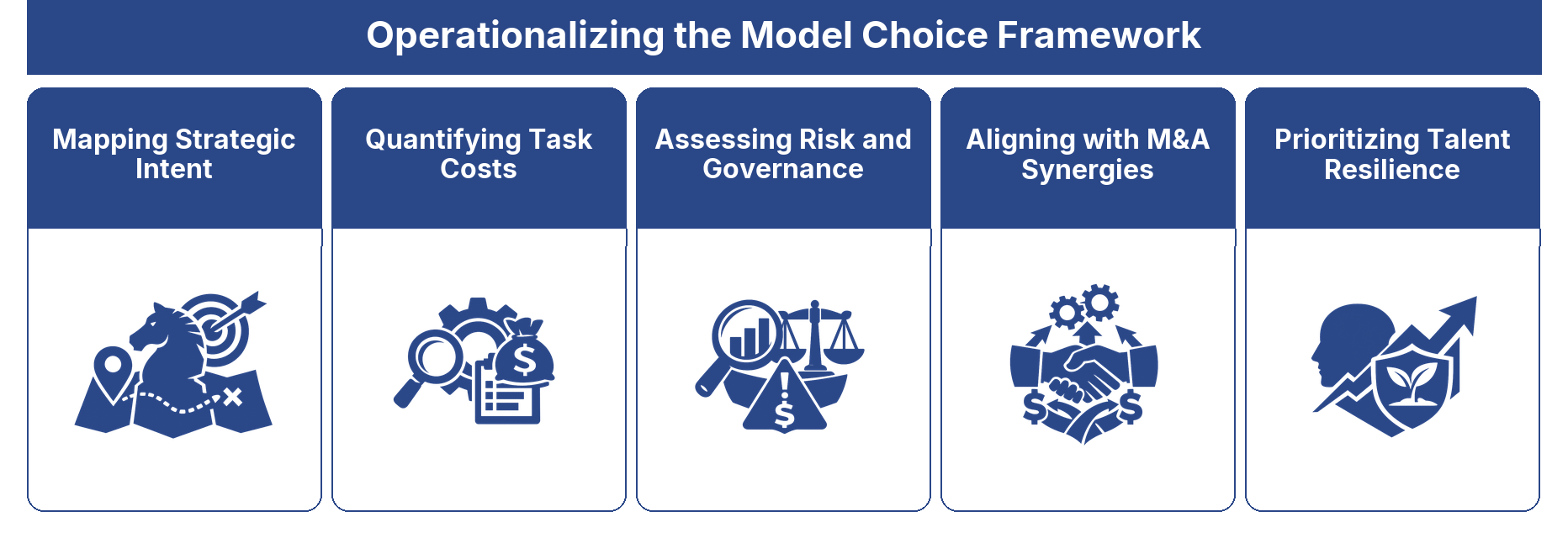
The practical danger is pursuing a fast automation win without deciding who governs the outcome, how exceptions are handled, or which roles must evolve. McKinsey research on the operating model for AI value similarly connects technology returns to organizational design rather than deployment volume. The five part choice framework therefore links Mapping Strategic Intent, Quantifying Task Costs, Assessing Risk and Governance, Aligning with M&A Synergies, and Prioritizing Talent Resilience. Earlier work on dynamic responsibility design makes the same operational point: governance must evolve as scale, evidence, and business conditions change.
Operationalizing the Model Choice Framework
Microsoft did not need to absorb every part of LinkedIn to capture value from the acquisition. The decision to preserve LinkedIn’s operating autonomy protected network trust, product velocity, and user neutrality, while Microsoft could integrate commercial capabilities such as enterprise distribution, identity, cloud infrastructure, and productivity workflows. In 2016, Microsoft acquired LinkedIn for about $26 billion, making the transaction a useful test of a broader principle: integration should follow the source of value, not the organizational convenience of the acquirer.
A durable model choice therefore requires more than a comparison of accuracy, speed, and price. It requires a causal decision sequence that connects strategic intent to task economics, accountability, integration priorities, and workforce capacity. Leaders should clear task economics and governance thresholds before scaling automation, and they should redesign fragmented workflows before selecting technology when process failure, rather than model capability, constrains performance.
Mapping Strategic Intent
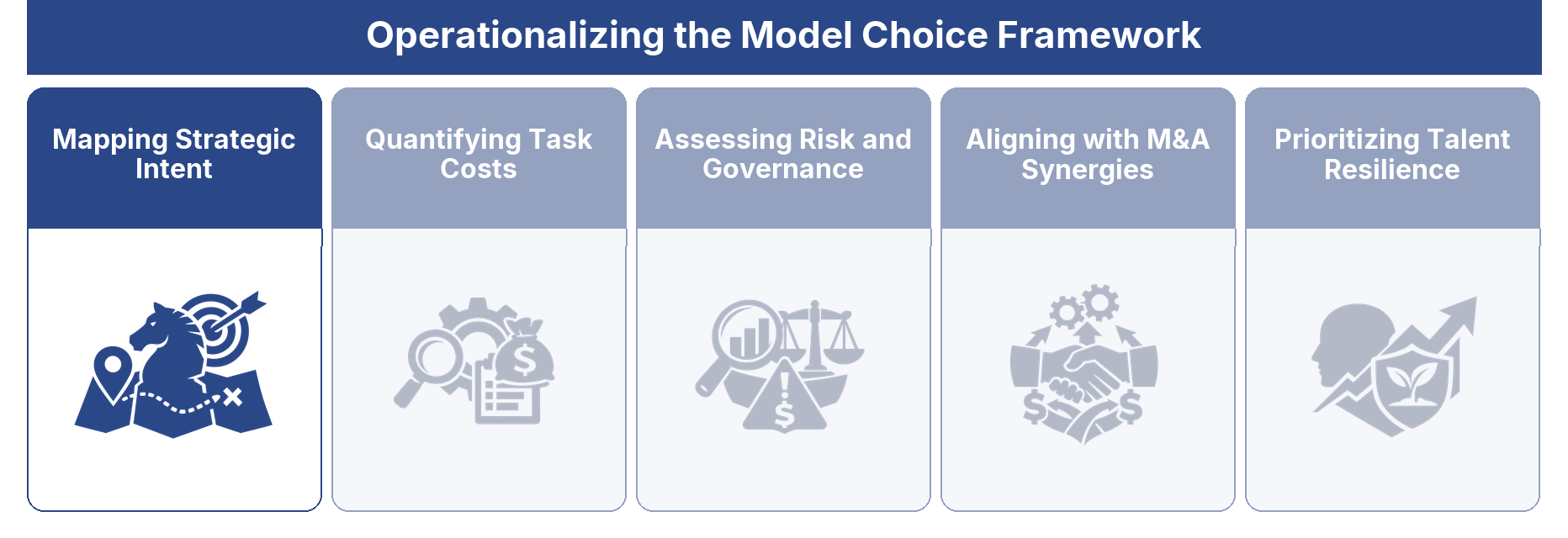
Decision criteria should begin with the business outcome, not the model’s technical specification. Leadership teams should define whether the priority is revenue growth, service quality, cost reduction, cycle time compression, or risk control, then establish the minimum acceptable performance for each outcome. A customer service workflow, for example, may require 90% correct triage at the first interaction, while a research workflow may tolerate lower automation if human judgment creates greater commercial value. OpenAI’s model selection guidance demonstrates why thresholds matter: a classification model needed 85.8% accuracy to cover costs, while a 90% target created a return on investment. The governing question is not which model performs best in isolation, but which level of performance makes the intended outcome economically and strategically viable.
Quantifying Task Costs
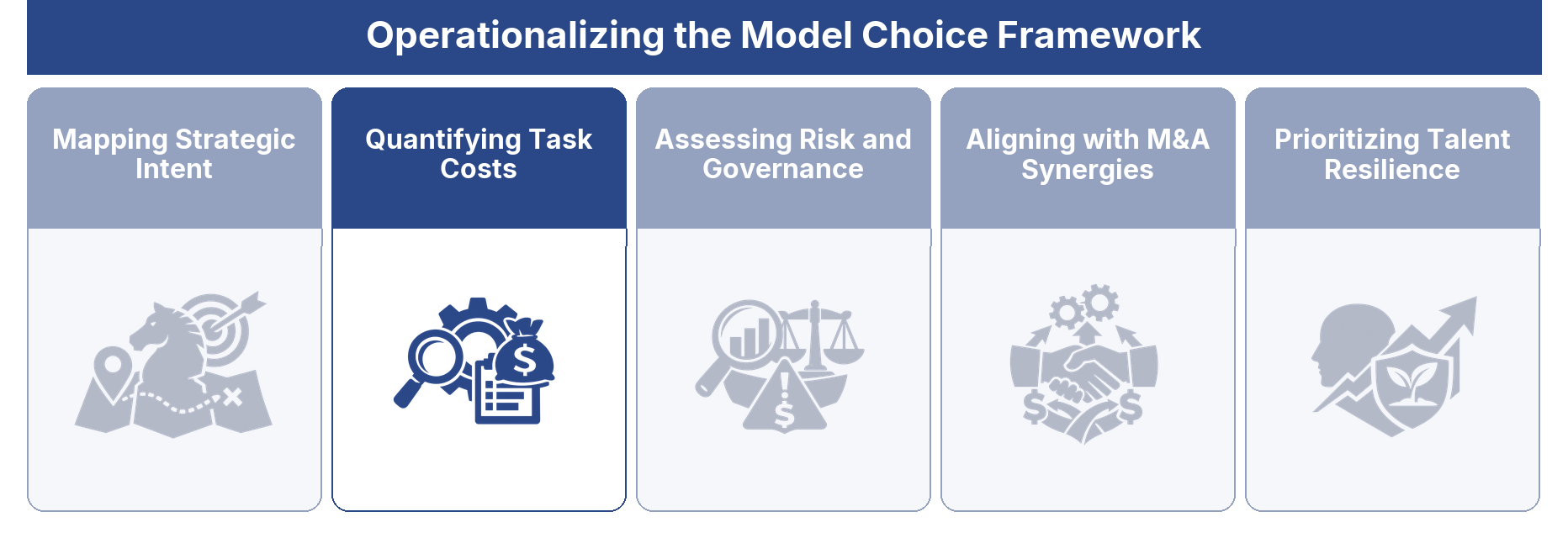
Task economics should be tested before automation is scaled. Total cost of ownership (TCO) includes model usage, integration, monitoring, human review, exception handling, security, and change management, and the calculation should be compared with the value of an acceptable outcome rather than the cost of a transaction. OpenAI’s published example contrasts a $50 saving from correct classification with a $300 cost from an incorrect result, showing how error asymmetry can reverse an apparently attractive business case. An exception heavy workflow can erase nominal labor savings through review and remediation costs. Each task therefore needs a baseline, a testable value hypothesis, and a stop condition, followed by a decision to augment, automate, or redesign.
Assessing Risk and Governance
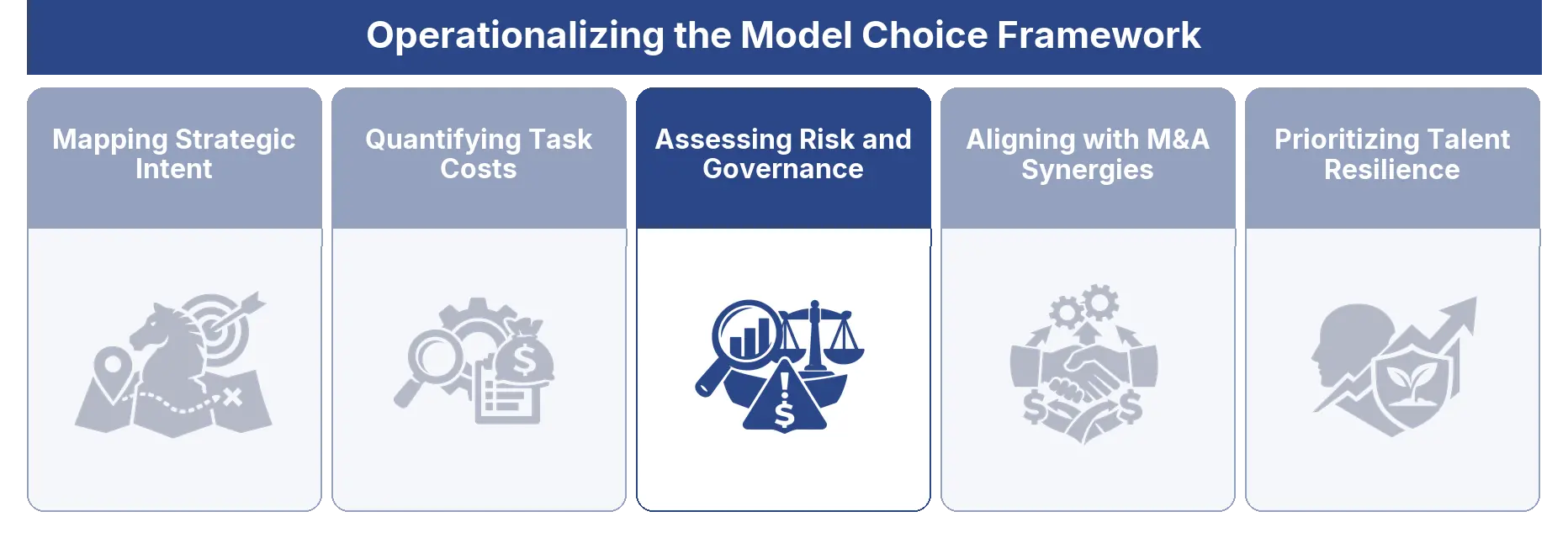
Governance should determine where human approval remains mandatory, how exceptions escalate, and which measures trigger retraining, model replacement, or suspension. The National Institute of Standards and Technology (NIST) emphasizes structured AI risk management, reinforcing the need to connect technical controls with accountable business owners. An Integration Management Office (IMO) can maintain the decision register, assign decision rights, review performance against agreed thresholds, and coordinate legal, security, data, and operating leaders. Disciplined scaling of agentic AI likewise makes governance a continuing operating capability rather than a launch stage approval. Automation should not scale until ownership is explicit and failure responses are operationally credible.
Aligning with M&A Synergies
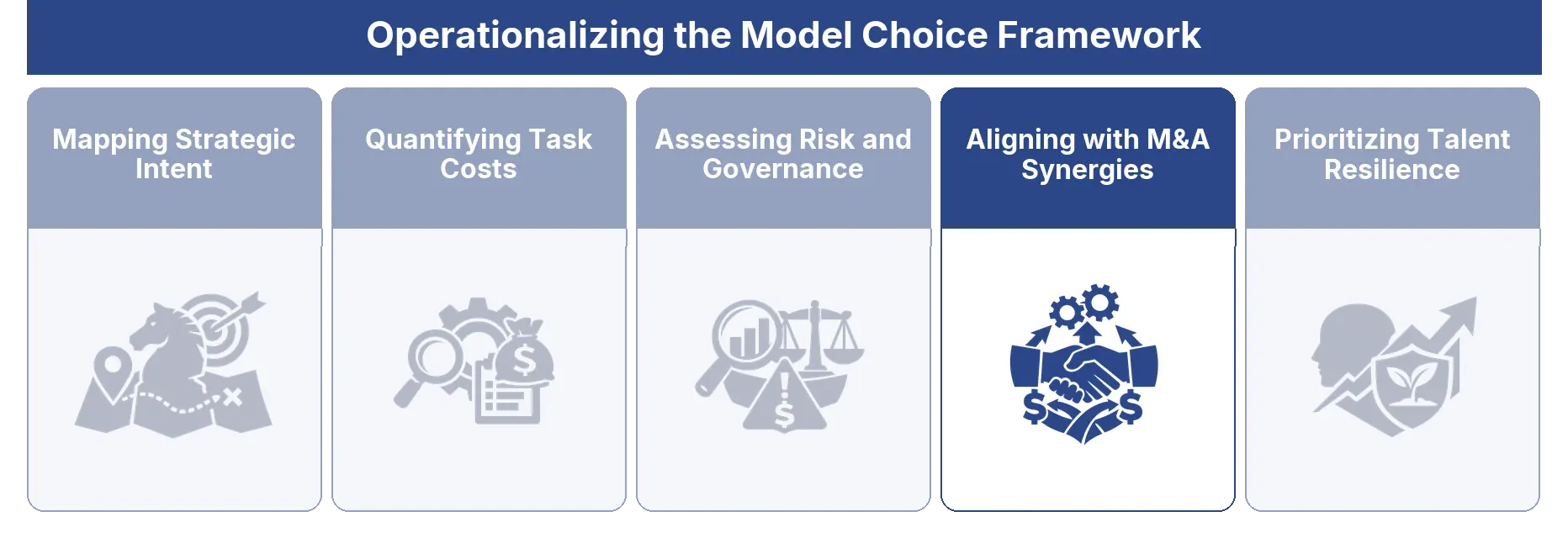
Mergers and Acquisitions (M&A) create a second decision layer: model selection must support the deal thesis without destabilizing the acquired business. In Dell’s 2016 acquisition of EMC for approximately $67 billion, the scale and breadth of the enterprise portfolio made sequencing and interdependency management central to value creation. The relevant decision is not whether every process should converge, but which capabilities contribute directly to synergy targets, which require temporary coexistence, and which should remain autonomous until evidence supports change. Microsoft’s treatment of LinkedIn illustrates the same logic from the opposite direction: network trust and user neutrality were protected, while distribution and platform capabilities offered integration opportunities. A transition operating model can bridge those phases, consistent with prior future state integration design that treats sequencing as a value protection mechanism rather than an administrative exercise.
Prioritizing Talent Resilience
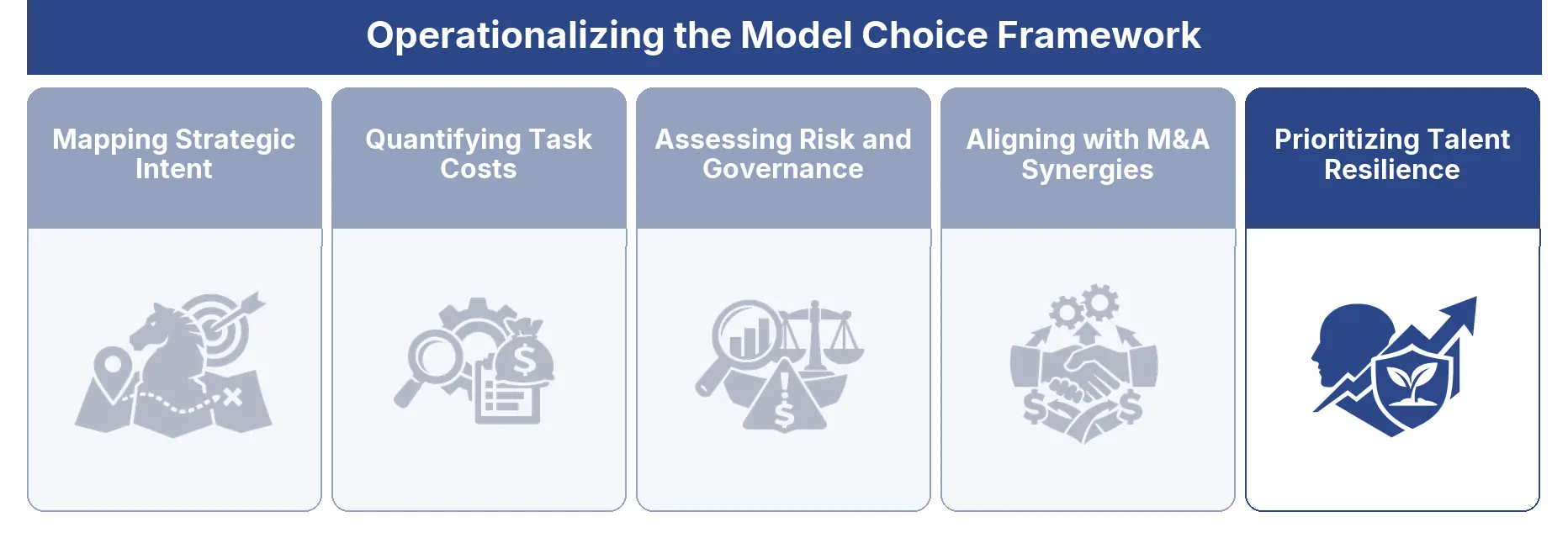
Automation decisions should account for the capabilities required after implementation, not only the labor removed from the current process. Harvard Business Review’s analysis of augmentation over full automation supports strengthening human judgment where context, relationships, or exception handling remain material. That principle has concrete operating implications: roles must be redesigned, supervisors must understand model limitations, and employees must know when to override an automated recommendation. Continuous improvement teams can test whether productivity gains persist, while an IMO tracks adoption, attrition, control failures, and customer impact. The sequence matters. Workflow redesign should precede technology deployment when fragmented handoffs are the binding constraint, because automation layered onto a broken process usually accelerates inconsistency rather than value creation.
Synthesizing Cross Model Value Across Units
Readiness is not demonstrated by an ambitious artificial intelligence roadmap or a compelling use case. It is demonstrated by a reliable fact base, a clear understanding of process constraints, and a disciplined choice among augmentation, automation, and operating model redesign. The executive implication is direct: accuracy, speed, and price matter, but none is sufficient without considering accountability, workflow disruption, data quality, adoption capacity, and the value the organization must protect or create. A sound model choice turns AI from an isolated experiment into an operating decision.
With this in place, executives can establish the baseline, instrument the work being changed, and sequence deployment according to business readiness rather than technical enthusiasm. Monday morning should bring concrete decisions: scope the priority workflow, codify decision rights, stand up accountable ownership, and govern the transition against measurable outcomes. Teams should implement the smallest credible test, execute against explicit assumptions, and escalate exceptions before they become operating failures. The disciplined practitioner does not ask whether AI belongs in the organization; the practitioner determines where it should augment judgment, where it should automate repeatable work, and where it warrants a redesigned model. Capability compounds when those choices are made deliberately, measured rigorously, and embedded into how the enterprise operates.

Get new articles by email
Insights on M&A, revenue growth, and business transformation, delivered occasionally.