Turn Time Saved Into Enterprise Value: Capture What Productivity Creates
In 2025, ServiceNow, a leading enterprise SaaS provider, agreed to acquire Moveworks for about $2.85 billion to extend agentic AI into front-line employee experiences. The transaction placed productivity at the center of the value proposition, but the economic outcome depends on more than deploying capable software. A minute saved in a service interaction can become additional capacity, faster resolution, lower cost, reduced risk, or new revenue. Without disciplined integration, those possibilities remain scattered across functions and absent from the financial case. The ServiceNow-Moveworks transaction illustrates why AI productivity must be managed as an enterprise value question.
The tension appears when time savings are measured locally but value is realized elsewhere, while incentives, data definitions, and operating decisions remain misaligned. Generic metrics such as AI spend per employee can obscure throughput gains, risk reduction, and monetizable capacity. Without an Integration Management Office (IMO) and governance model, benefits can weaken after pilots conclude. How can leaders turn quantified time savings from AI enabled work into durable enterprise value through governance, measurement, and monetization?
Durable value requires a traceable link between AI enabled work, financial outcomes, and accountable owners. Governance must establish baselines, test explicit hypotheses, monitor operational and customer signals, and convert productivity into cost savings, throughput, risk reduction, or growth. As deal complexity and scrutiny over technology investment increase, disciplined measurement becomes a strategic imperative rather than a reporting exercise. The organizations that sustain gains will connect executive decisions, cross functional execution, and monetization into one operating rhythm.

Grounding AI Productivity Premise
BCG’s controlled experiment found that consultants using generative artificial intelligence (GenAI) achieved an average score equal to 86% of a data scientist benchmark, while completing the task roughly 10% faster. The result clarifies why time savings sit at the center of AI economics: faster completion can increase capacity, reduce backlog, improve service levels, or redirect skilled employees toward higher value work. Time saved, however, does not automatically become enterprise value. The value appears only when leadership defines how recovered capacity will be redeployed and measures whether that redeployment changes cost, throughput, risk, revenue, or customer outcomes.
That discipline begins with a fully loaded baseline, not a narrow wage rate or software license. The baseline should include compensation, benefits, management capacity, supporting systems, training, quality controls, rework, and the opportunity cost of time assigned to low value activity. Against that baseline, AI total cost of ownership (TCO) must capture subscription or infrastructure costs, implementation, integration, security, data preparation, oversight, model changes, and ongoing enablement. McKinsey’s analysis of the generative AI productivity frontier reinforces the scale of the opportunity while also making the measurement challenge unavoidable: broad economic potential does not substitute for a defensible business case.
The practical implication is that productivity measurement should distinguish elapsed time from economic conversion. A team may complete a task 20 minutes faster, yet create no savings if staffing remains unchanged, demand expands to consume the capacity, or employees redirect the time without a measurable outcome. Conversely, the same time reduction may create substantial value when it supports faster customer response, higher sales coverage, fewer defects, or delayed hiring. Earlier analysis of technology investment tradeoffs makes the same strategic point: benefits must be assessed against initial expenditures, operating impacts, and scalability.
Governance turns those distinctions into an operating rhythm. Leaders need named owners for baseline integrity, adoption, quality, financial conversion, and risk, with assumptions recorded before deployment rather than reconstructed after results appear. McKinsey’s research on AI value creation in private equity similarly places value realization beyond isolated efficiency claims, linking technology to operating performance and investment outcomes. The five part structure that follows, Defining Time Based Outcomes, Measuring AI Total Value, Capturing Time Savings Differentials, Aligning Governance with Value, and Monetizing Productivity Gains, provides the governance ready path from minutes recovered to enterprise value.
Challenging Value Realization
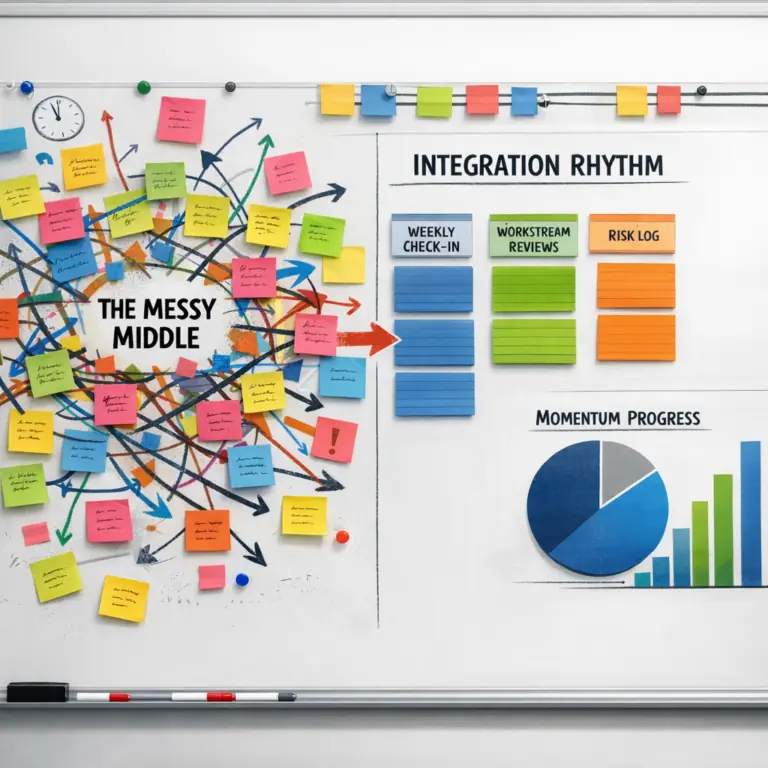
A team reports that a new workflow has eliminated 400 hours of manual work each month, yet finance cannot identify a lower cost, a capacity release, or a revenue consequence. Operations sees faster cycle times, information technology sees strong adoption, and the team sees a credible productivity gain. None of those observations proves that the enterprise captured value. McKinsey’s transformation research reinforces the broader point: sustained performance depends on translating change into managed business outcomes, not merely deploying new tools. The decisive question is not how much time a system saved, but who controls the redeployment decision and how that decision enters the operating plan.
Amazon’s approximately $13.7 billion acquisition of Whole Foods in 2017 created a particularly clear measurement tension because the strategic logic joined Amazon’s e commerce logistics with physical grocery retail. Suppose store labor hours declined as automation and centralized fulfillment improved efficiency, while service levels weakened because fewer employees remained available for replenishment and customer assistance. An executive tracking labor cost alone could classify the change as a success, even as lower product availability or weaker customer frequency eroded the broader value thesis. The conflict is not between good and bad metrics; it is between metrics that describe different economic consequences. Unless labor savings are tested against service levels, inventory accuracy, fulfillment speed, and customer behavior, an apparent gain can represent value creation, value transfer, or value leakage.
The distinction becomes sharper when leaders separate theoretical capacity from controllable capacity and from capacity that changes the economic plan. Theoretical capacity is the time a process appears to contain; controllable capacity is the portion managers can actually redirect; realized capacity is the portion assigned to a funded initiative, removed from the cost base, or converted into measurable revenue or service improvement. A fully loaded baseline still matters, including labor, technology, transition, and support costs, but the more consequential question is what happens after the baseline is established. BCG’s analysis of measurable AI impact distinguishes experimentation from economic performance, while PwC’s research on execution gaps highlights the difficulty of moving operational technology from isolated deployments into scaled results. Earlier analysis of integration complexity reaches a parallel conclusion: competing initiatives can dilute accountability unless governance reconciles them.
That requirement changes the order of operations. Before scaling a productivity initiative, leaders should specify whether recovered capacity will support growth, reduce external spend, absorb expected demand, improve service, or be removed from the cost plan; measurement without that destination merely legitimizes unclaimed capacity. An Integration Management Office (IMO) can connect the decision to financial baselines, operating targets, and accountable owners, while requiring finance to reject any benefit whose redeployment destination and accounting treatment were not defined before deployment. Deloitte’s research on digital value similarly frames maturity as an organizational capability, not a technology milestone. The practical test is therefore demanding but simple: no productivity benefit enters the value case until an accountable executive can explain where the capacity goes, which ledger records the result, and what evidence will confirm that the change endured.
Implementing Governance Driven Value Realization
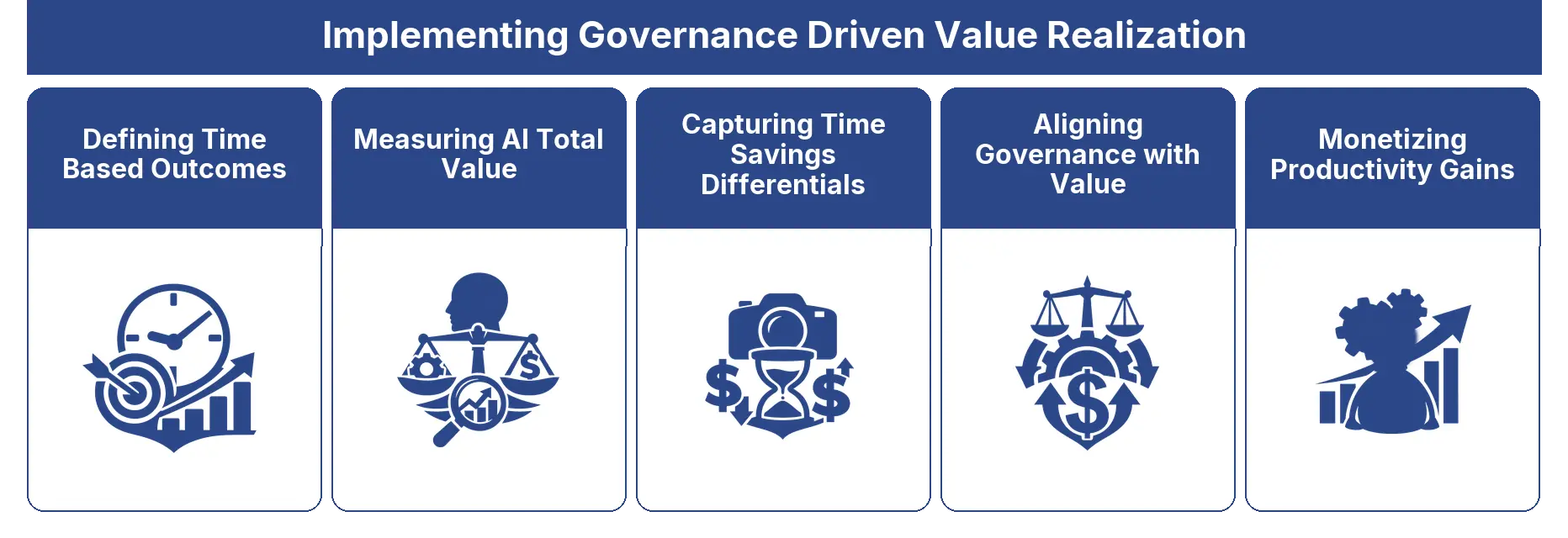
A governance system creates value only when it converts activity into measurable business outcomes. The sequence is causal: define the outcome and timing, identify the capacity that will be released, assign a redeployment or financial conversion decision, validate the economics with finance, and only then scale the use case. Prior go to market governance discipline shows why operating rules matter, while continuous improvement governance reinforces the need to manage performance after launch rather than treating implementation as completion. Unassigned capacity is not a benefit. It is an unbooked assumption.
Defining Time Based Outcomes
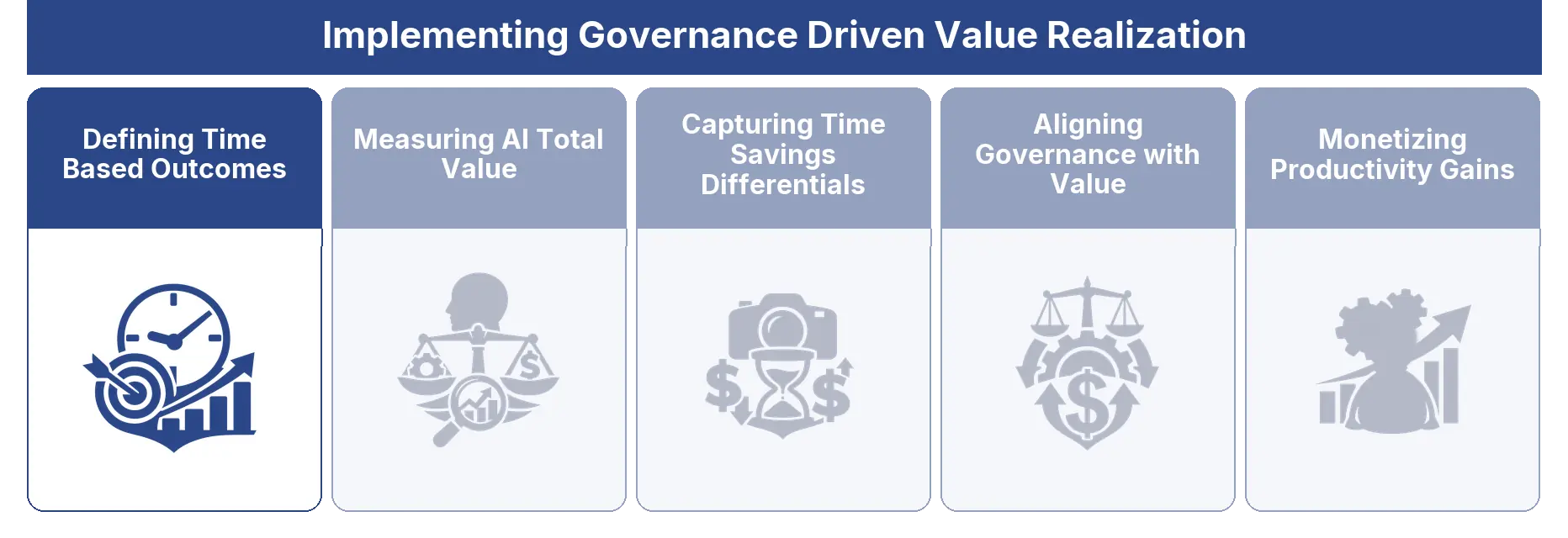
Value targets should specify what changes, for whom, and by when. A credible baseline might define reduced case handling time within 90 days, improved proposal throughput within two quarters, and measurable revenue capacity by year end. The target must distinguish adoption from impact, because usage alone does not prove value realization. Frontline AI time savings research found that 42% of regular artificial intelligence (AI) users report saving eight hours a week, yet 66% receive limited or no guidance on how to use that time.
That gap creates the first conversion gate. Before a claimed hour enters the value case, the operating leader must nominate one destination for the capacity: a redeployment, a hiring avoidance target, a throughput increase, or a defined strategic activity. If no destination exists, the hour remains a productivity signal rather than a financial benefit. The decision also establishes accountability, because the leader who claims the improvement becomes responsible for demonstrating where the capacity went.
Measuring AI Total Value
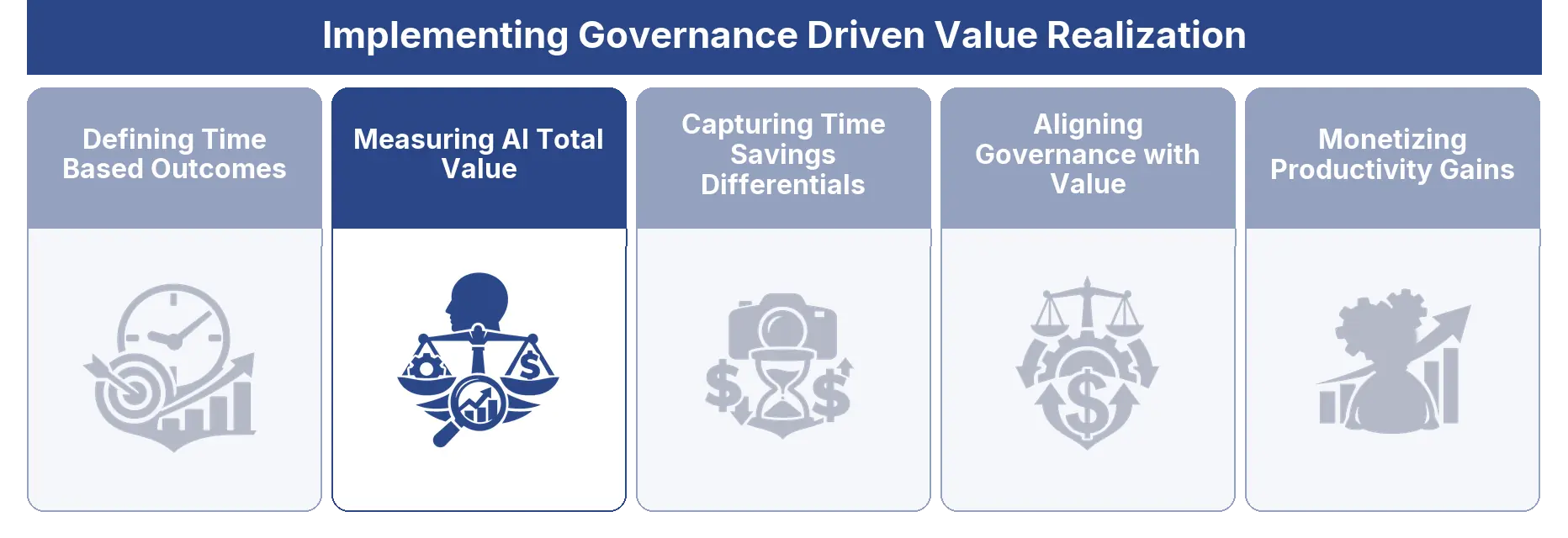
AI total value includes more than labor hours removed from a process. The measurement boundary should include software and implementation costs, quality changes, risk reduction, customer experience, revenue acceleration, and the opportunity cost of redeployed talent. A process that saves 20 minutes but increases rework, compliance exposure, or customer churn has not created economic value. Program value realization guidance supports this broader discipline by linking benefits to accountable owners, baselines, and sustained performance rather than isolated project milestones.
The scorecard should separate gross benefit from realized benefit. Gross benefit reflects theoretical capacity released; realized benefit reflects the portion converted into lower expense, additional output, faster revenue, or strategic work. Finance should validate the conversion logic before the use case moves from pilot to scale, including whether the benefit affects the income statement, the hiring plan, the service level commitment, or only management capacity. BCG’s cost research reports that 60% of companies see minimal or no value despite significant effort, a result that signals weak benefit capture, not merely weak technology.
Capturing Time Savings Differentials
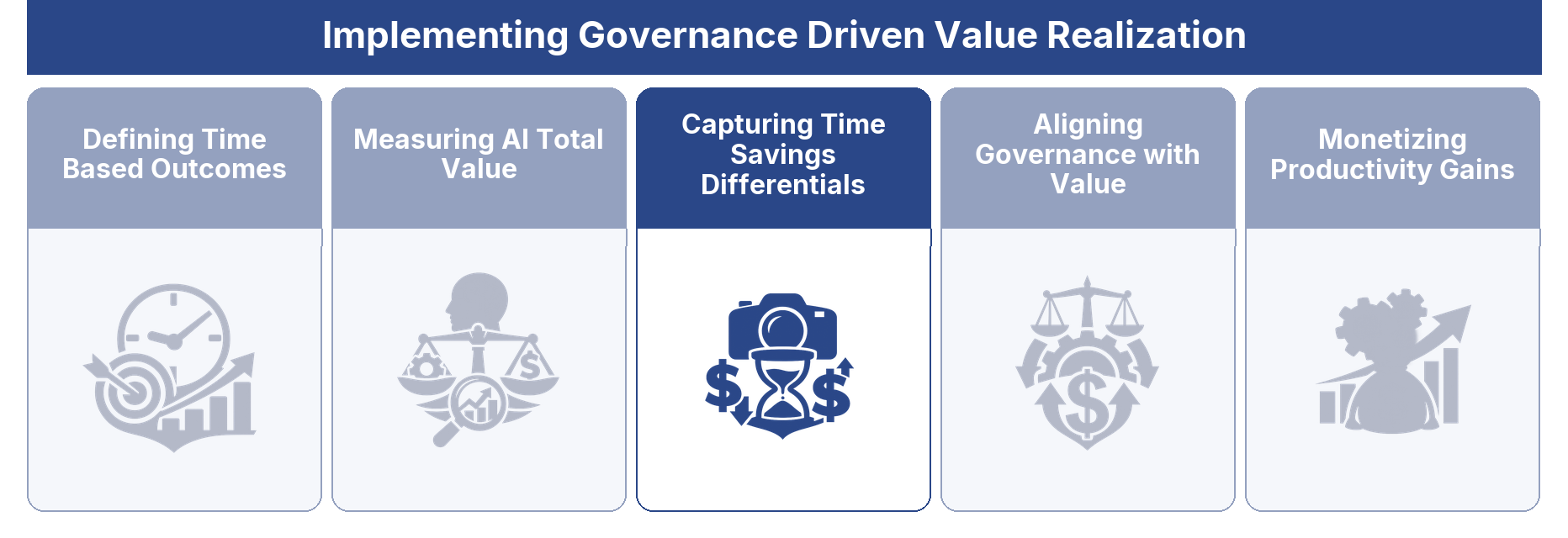
Time savings rarely distribute evenly across an organization. A senior account executive, service representative, analyst, and manager may use the same AI capability but recover different amounts of time, with different economic consequences. Governance should therefore track savings by role, workflow, volume, quality threshold, and redeployment destination rather than applying one enterprise average.
The differential determines the operating decision. One hour saved in a high volume support queue may increase service capacity, while one hour saved in strategic selling may accelerate pipeline conversion. BCG’s frontline adoption data reports that 74% of frontline workers now use AI daily or several times a week, up 23 percentage points from 2025, but broad adoption does not establish equivalent value across functions. The dashboard must show where time is released, who controls the affected work, and whether that capacity reaches a defined priority.
Aligning Governance with Value
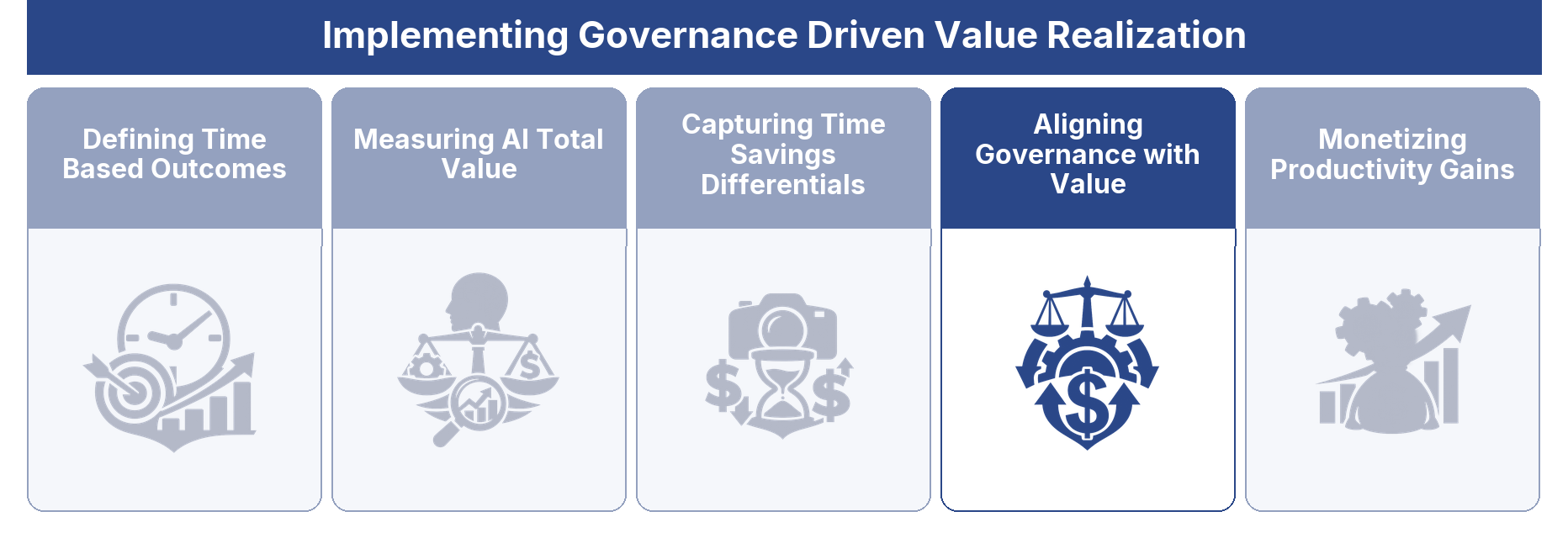
Decision rights should follow the value chain. The business owner defines the outcome, the functional leader validates process performance, finance confirms the economic treatment, risk owners approve controls, and an Integration Management Office (IMO) or equivalent central body resolves cross functional dependencies. Earlier integration governance principles make the same point in another setting: dedicated teams and clear accountability prevent strategic objectives from dissolving into local activity.
Governance forums should review exceptions, not merely report deployment counts. Each review should ask whether adoption is changing cycle time, quality, cost, or revenue, and whether the planned redeployment is occurring. A use case should be paused when the operating owner cannot evidence the destination of released capacity, or when finance cannot validate the proposed treatment. McKinsey’s transformation research emphasizes that sustained value depends on reinforcing new behaviors after implementation, which makes cadence, ownership, and escalation mechanisms essential.
Monetizing Productivity Gains
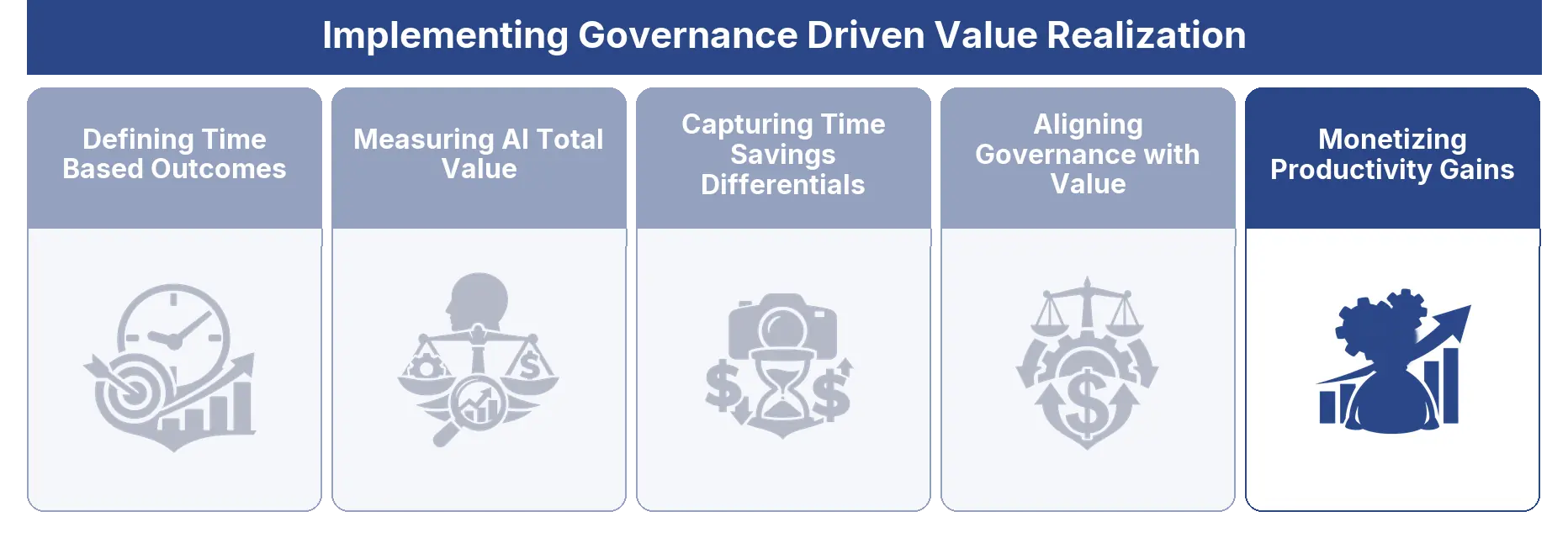
Recovered time becomes economic value through an explicit conversion decision. Finance and operating leaders should classify each gain as cost reduction, avoided hiring, increased throughput, improved service, accelerated sales, or capacity for higher value work. The operating leader must nominate the conversion before the benefit is counted, while finance must approve the treatment before the use case is included in the scaled value case. Without those two decisions, productivity remains a favorable metric with no effect on the income statement, forecast, or strategic capacity plan.
The conversion should also protect quality and workforce resilience. A team that saves eight hours per week but absorbs additional review burdens has produced less value than the time metric suggests. Gartner’s technology research can inform governance design, but the operating test remains practical: each material gain needs an owner, a financial treatment, a measurement date, and a documented reinvestment choice. Monday’s review should reject any claimed hour that cannot show all three: who owns it, where the capacity will go, and how finance will record the result.
Operationalizing AI Productivity Across the Enterprise
Time saved becomes enterprise value only when leaders translate it into measurable economic and operating outcomes. The central lesson is that productivity gains cannot remain trapped in team anecdotes, pilot dashboards, or enthusiastic adoption metrics. They must enter the financial and operating ledger through explicit baselines, accountable owners, and a governance rhythm that connects activity to margin, capacity, quality, revenue, or customer experience. Without that conversion, even credible gains remain difficult to defend, scale, or sustain. With it, productivity becomes a managed value creation lever rather than an isolated efficiency story.
Looking ahead, disciplined practitioners should establish the baseline before launching the initiative, instrument the metrics that reveal whether time saved is becoming business impact, and codify the decision rights that determine where recovered capacity goes. Leaders should embed those measures in operating reviews, formalize escalation when benefits stall, and operationalize validated gains across the functions best positioned to convert them into enterprise value. Monday morning should bring a practical test: can each material productivity improvement be traced from the work completed, to the capacity released, to the outcome funded or improved? If not, the governance system is tracking motion rather than value. The imperative is clear: build the measurement discipline, execute against the value case, and make every hour saved answerable to a strategic result.

Get new articles by email
Insights on M&A, revenue growth, and business transformation, delivered occasionally.