
AI Costs More Than the License: Build the Full TCO Stack
In 2021, Salesforce, a global customer relationship management software company, completed its approximately $27.7 billion acquisition of Slack to anchor collaboration across Customer 360, as the transaction announcement explained. The purchase price captured the platform and its growth potential, but not the full economic work required to connect data, redesign workflows, retrain teams, govern usage, and sustain performance. For B2B SaaS executives, the strategic rationale therefore depended on more than subscription economics or projected revenue synergies. It depended on whether the combined organization could convert technology investment into acceptable outcomes at a defensible cost.
That distinction creates a persistent valuation risk across software acquisitions and enterprise AI programs. Data readiness, legacy integration, model oversight, human review, error handling, and ongoing maintenance can accumulate across thousands of tasks while remaining invisible in license-level budgets. Without a task-level view, leaders may mistake lower software spend for lower operating cost and allocate capital toward initiatives that cannot scale. How can executives build a full AI total cost of ownership that reflects the complete economic footprint across tasks, beyond the license price?
A credible cost model treats AI as an operating system for work, not a line item in procurement. It separates upfront investment from recurring expense, compares AI-enabled tasks with traditional alternatives, and tracks quality, rework, risk, and labor alongside software fees. Cross-functional governance, anchored by an Integration Management Office (IMO), connects data, technology, finance, risk, and business ownership so that value capture remains visible after deployment. The result is a disciplined basis for investment, integration, and scale.

Framing the Full AI TCO Context
An AI workflow can reduce software cost per case while increasing total cost, because every inaccurate output creates review work, exception handling, rework, and sometimes a second manual process. The relevant baseline is therefore the fully loaded labor cost of the task being changed, including employee time, supervision, quality control, exception handling, and remediation. AI Total Cost of Ownership (TCO) extends beyond subscription fees to data preparation, system integration, training, governance, human review, error management, and ongoing sustainment. Research on AI demand at scale highlights why usage growth can expand infrastructure and operating costs faster than early business cases anticipate.
The binding constraint is often not model price but exception handling capacity. If an AI system maintains a stable error rate while transaction volume grows, the number of exceptions grows with it; a workflow that appears economical at low volume can become uneconomic when qualified reviewers, escalation managers, or quality control specialists reach capacity. The decision therefore depends on whether the organization can absorb the error distribution, not simply whether the AI enabled unit cost remains below the incumbent cost. Prior analysis of comprehensive TCoA analysis establishes the broader discipline: decision makers need a complete cost view before speed and enthusiasm obscure the economics.
Cost ownership is frequently fragmented across functions. Technology records model and platform charges, finance captures implementation spending, and operations absorbs review time, failed outputs, and process redesign without attributing those costs to the AI initiative. Governance must therefore sit inside the cost model, not beside it. The NIST AI Risk Management Framework organizes responsible AI practices around governing, mapping, measuring, and managing risk, making error thresholds, review responsibilities, and model monitoring relevant to both value creation and expense control. The same logic supports tracking hidden integration costs: expenses become manageable when ownership, measurement, and escalation are explicit.
A practical model begins with the labor baseline and compares the AI enabled task with the traditional alternative across quality, cycle time, review effort, rework, and risk. The four part sequence changes four decisions: what work belongs in the baseline, which performance threshold justifies adoption, which costs occur before and after launch, and how the full cost stack will be governed. An Integration Management Office (IMO), working with finance, technology, risk, and business owners, can keep those measures connected from approval through sustainment. Scale should be gated against validated economics and available exception capacity. When qualified reviewers cannot absorb the projected exceptions, the correct decision is to stop scaling, regardless of how inexpensive the model appears.
Expanding the AI Cost Lens
A software license comparison captures only the visible entry price. AI deployments add recurring inference and token consumption, data preparation, model evaluation, security controls, monitoring, workflow redesign, user training, and the internal capacity required to manage exceptions. Deloitte reports that only 28% of global finance leaders see clear, measurable value from AI investments, while nearly half expect basic AI automation to require up to three years to produce return on investment, underscoring the gap between purchase approval and realized value through measurable AI investment returns.
The cost lens therefore must follow the task, not the vendor invoice. Finance may track subscription and usage charges, while technology absorbs integration and infrastructure work, risk evaluates controls, operations funds process redesign, and business units carry training and productivity effects. Without a shared ledger, those costs remain distributed across budgets and appear individually immaterial, even when their combined effect changes the economics of the deployment. Earlier analysis of technology investment cost discipline similarly frames technology selection around both initial expenditure and ongoing operational impact.
Governance turns that inventory into a management system. An Integration Management Office (IMO), working with data, information technology, risk, finance, and business owners, can assign cost ownership, establish decision rights, and require evidence at each stage from approval through sustainment. The NIST Artificial Intelligence Risk Management Framework reinforces the need to manage AI risks through structured, repeatable practices rather than isolated technical reviews. The IMO does not replace functional accountability. It connects it, ensuring that a model change, data quality issue, or usage surge triggers both a risk assessment and an economic review.
The operating discipline becomes practical when the four part sequence remains connected: Mapping Task Level Costs, Benchmarking AI vs Licenses, Quantifying Upfront and Ongoing, and Establishing a Total Cost Stack. Each stage should produce an owner, a measurable baseline, and a threshold for intervention, such as escalating token consumption or declining task accuracy. McKinsey’s discussion of infrastructure requirements for agentic AI highlights why architecture choices can reshape both capacity needs and operating economics. Earlier work on integration costs in valuation provides the broader financial principle: costs omitted from the initial case do not disappear, they surface later as reduced capital for growth and weaker value creation.
Implementing the Full AI TCO Framework
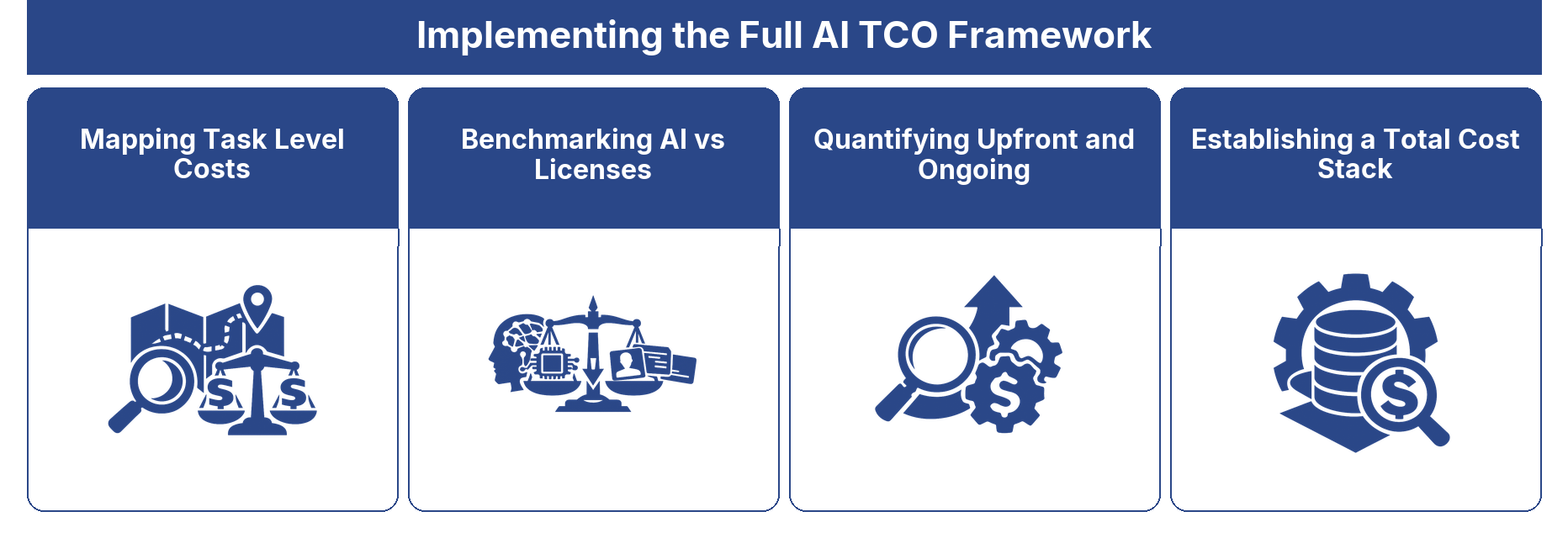
A credible artificial intelligence (AI) investment case begins below the platform level. The unit of analysis is the task, because a model that costs pennies per call can become uneconomic once data preparation, workflow integration, human review, exception handling, and governance enter the operating model. The practical sequence is straightforward: map the full task cost, compare the AI enabled process with the incumbent alternative, separate upfront from recurring economics, and assign each cost layer to an accountable owner. Cost data becomes strategically useful only when the organization defines it consistently, governs it over time, and links it to a deployment decision.
A simple task level calculation exposes the difference. Suppose an AI workflow processes 100,000 cases at $0.01 per model call, creating $1,000 of direct usage cost. If 8% of cases require three minutes of human review at $40 per hour, review adds $16,000; if 2% require five minutes of rework, another $6,667 enters the model. Before integration, monitoring, and governance, the apparent $1,000 AI expense has become approximately $23,667. Against an incumbent process costing $0.20 per case, or $20,000, the low per call price does not produce savings. The break even rule is clear: AI should scale only when the combined cost of review, rework, and recurring controls remains below the incumbent cost at the targeted error rate and available review capacity.
Mapping Task Level Costs
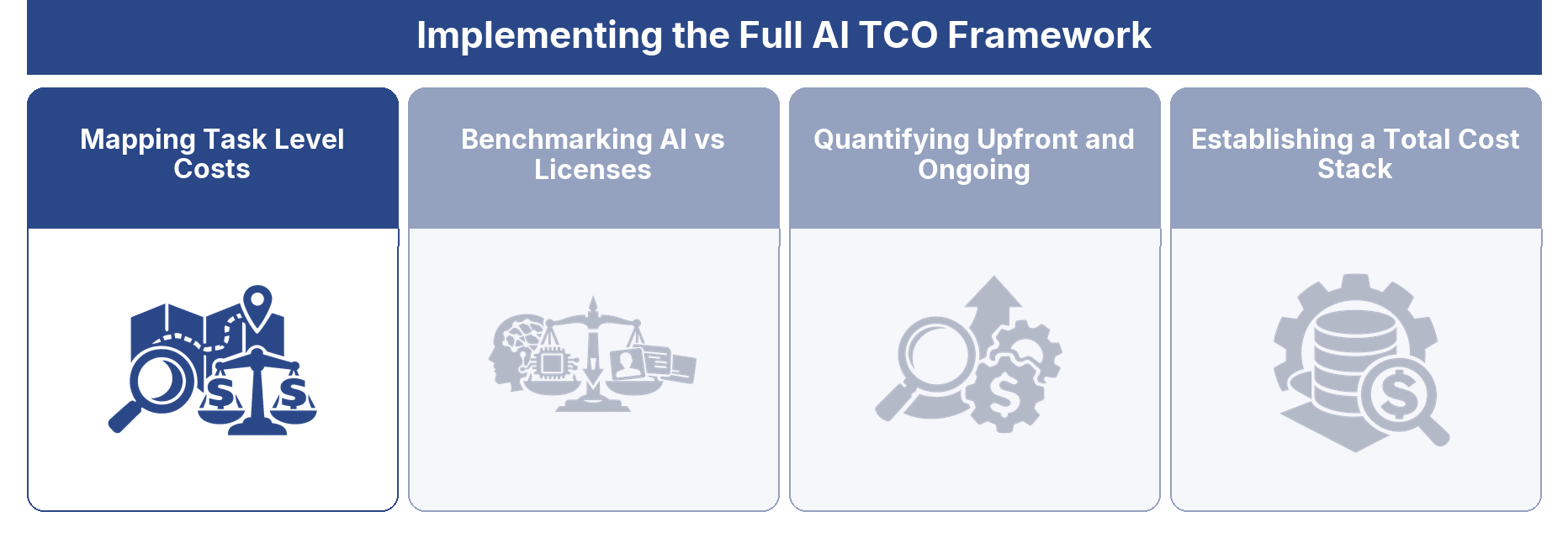
Start with an inventory of the work AI will perform, not with a vendor quotation. For each task, record data acquisition and preparation, model or software licensing, application programming interface usage, integration, cybersecurity, governance, employee training, human review, error correction, rework, monitoring, and platform sustainment. The map should distinguish one time implementation effort from recurring activity while recording the process volume, service level, quality threshold, and escalation path attached to each task.
This discipline prevents technology teams from treating exceptions as edge cases when they are actually the main cost driver. A customer service response that requires manual correction, or a finance workflow that triggers duplicate review, carries labor and delay costs even when the model call itself costs pennies. The NIST AI Risk Management Framework provides a useful governance reference for assigning controls, evidence requirements, and monitoring responsibilities alongside financial estimates. The management implication is direct: no task should enter a business case without an owner for its errors, exceptions, and human interventions.
Benchmarking AI vs Licenses
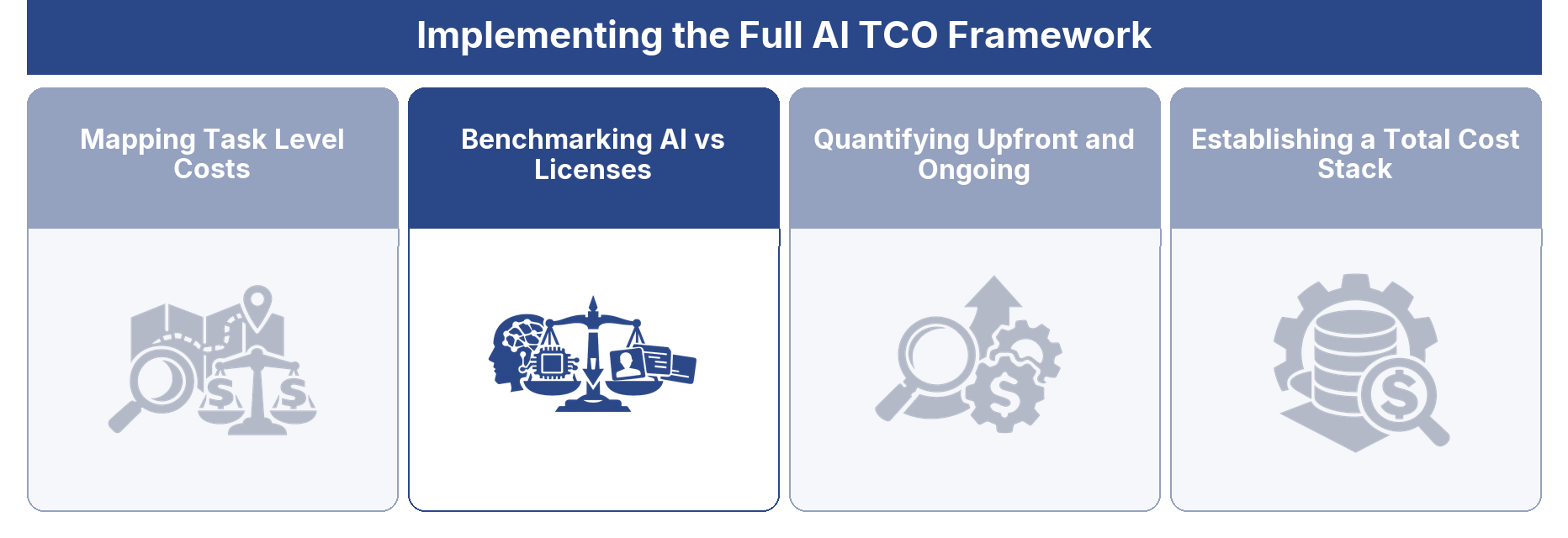
The comparison should place the AI enabled task beside the traditional license, labor, or outsourced process it may replace or augment. Both sides should use the same unit of output, such as cost per resolved case, approved invoice, qualified lead, or completed analysis, while also recording speed, quality, escalation rates, and capacity. A license that appears more expensive may deliver predictable performance, whereas an AI workflow may offer greater scale but require review capacity that the operating model does not possess.
An apples to apples baseline also prevents false savings. If the incumbent process includes a software license, administrator time, manual reconciliation, and periodic upgrades, those costs belong in the comparison; if the AI alternative depends on proprietary data pipelines or specialized oversight, those costs belong there as well. A standardized AI deployment metric reinforces the need to evaluate deployment economics systematically rather than treating model price as the economic outcome. The decision should therefore be based on cost per acceptable output, not cost per prompt or API call.
Quantifying Upfront and Ongoing
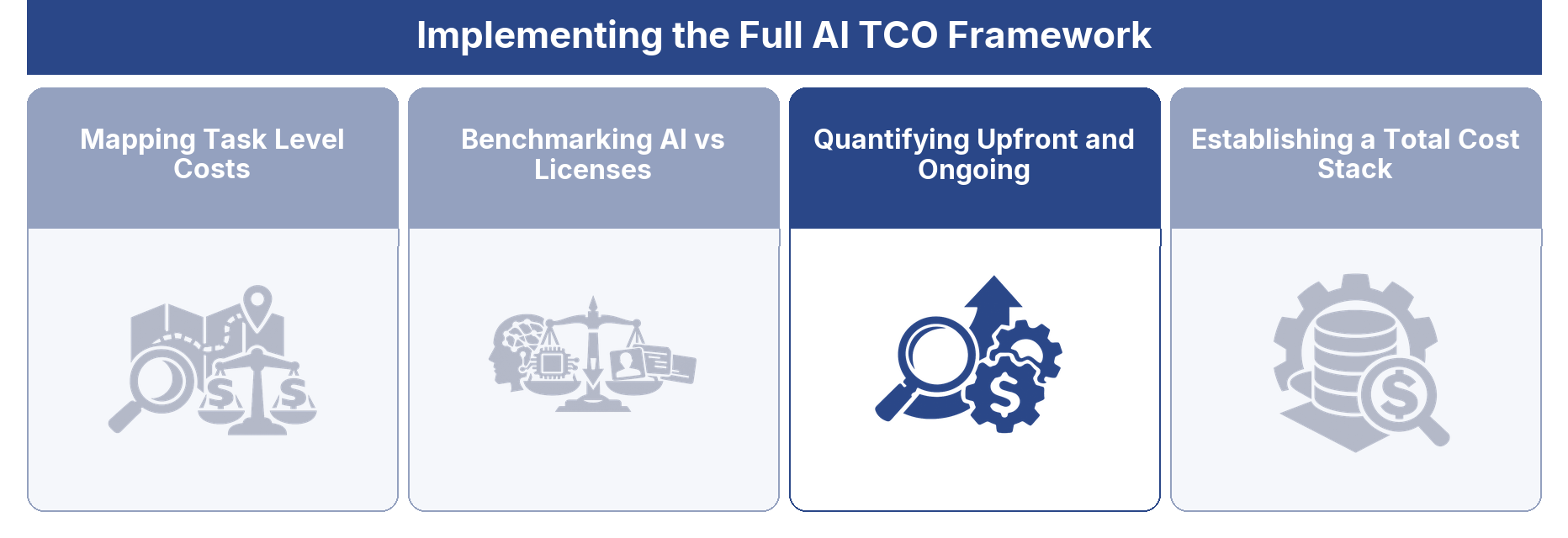
The model should separate capital expenditures from operating expenses, then show how each changes as adoption, quality, and transaction volume increase. Upfront costs may include data remediation, architecture, workflow redesign, security reviews, integration, and employee training; ongoing costs may include inference, storage, monitoring, human validation, incident response, retraining, and vendor support. This separation reveals whether a rapid deployment has merely shifted expense from design into recurring review, rework, or incident management.
Scenario analysis should test at least three operating conditions: limited deployment, scaled adoption, and higher quality control. Each scenario should state its volume, accuracy threshold, staffing model, and refresh cadence, rather than presenting a single blended estimate. Research on AI data center lifecycle economics reinforces why architecture choices can materially change capacity requirements and lifecycle economics. Expansion should be gated when volume rises faster than review capacity, because a stable error rate can still produce an unmanageable absolute number of exceptions.
Establishing a Total Cost Stack
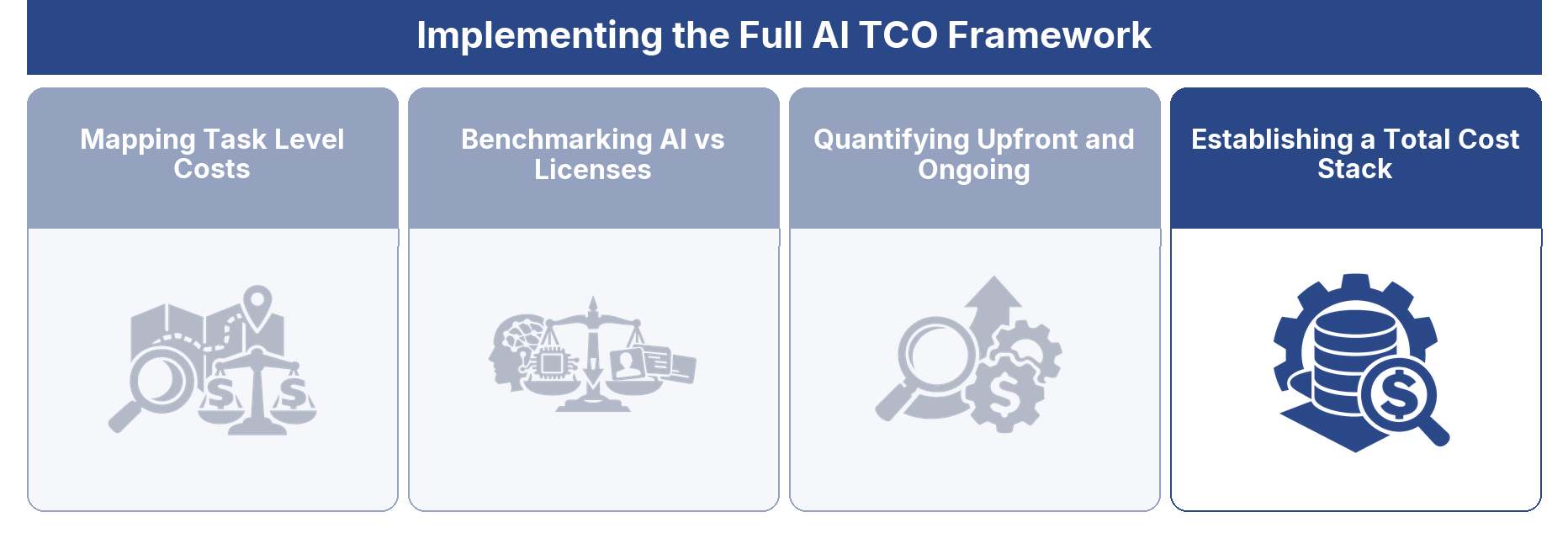
The final step is a layered cost stack that follows the AI lifecycle from data and infrastructure through applications, controls, people, and sustainment. Each layer needs a named owner, a measurable driver, and a review cadence. The Integration Management Office (IMO) should coordinate cross functional ownership when AI spans technology, operations, finance, legal, security, and business units, while functional leaders remain accountable for the costs their processes generate.
NIST’s system life cycle risk framework supports this governance logic by connecting controls to planning, implementation, assessment, authorization, and monitoring. The stack should operate as a living management instrument, with assumptions updated as volumes, error rates, vendor terms, and regulatory requirements change. Executives should approve additional adoption only when three conditions hold: validated unit economics remain favorable at the new volume, trained review capacity can absorb projected exceptions, and error rates remain below the threshold that protects service quality and regulatory obligations. Otherwise, the correct decision is to redesign the workflow before adding scale.
Operationalizing AI TCO Across Portfolio
An AI investment case becomes credible only when it accounts for the full operating burden beneath the platform fee. Licensing is visible, but data preparation, integration, security, governance, model management, user support, and ongoing maintenance determine whether the investment creates value or consumes capital. Treating these costs as part of Total Cost of Ownership (TCO) changes the executive conversation from price comparison to economic design. It also exposes whether a proposed deployment can scale without eroding the capacity needed for product roadmaps, operational excellence, and growth.
With the framework established, executives can establish a complete cost baseline before approval, instrument the assumptions that will change as adoption grows, and codify ownership for every material cost driver. Finance and technology leaders should sequence investment gates around validated usage, risk controls, and measurable operating value, while business sponsors formalize the threshold for expanding, redesigning, or stopping a deployment. The Monday morning discipline is practical: build the cost stack, reconcile it to the business case, and govern it as rigorously as revenue synergy. The organizations that do so will not merely purchase AI capability; they will create the financial visibility required to deploy it with confidence and pace.

Get new articles by email
Insights on M&A, revenue growth, and business transformation, delivered occasionally.