
Stop Comparing Seats, Compare Work: Measure Cost per Acceptable Outcome
In 2025, Salesforce, a global customer relationship management software company, agreed to acquire Informatica for about $8 billion to strengthen the trusted data foundation behind its agentic artificial intelligence strategy. The transaction placed a familiar M&A question in a new operating context: whether the cost of additional technology capacity would translate into measurable improvements in enterprise work. As integration planning began, executives, investors, and operating leaders had to distinguish platform spend from the value created across data quality, cycle time, risk, and customer outcomes. The deal’s economics could not be judged by software seats alone.
Seat counts offer a clean budgetary reference, but they conceal how tasks are performed and whether AI produces acceptable results. Two workflows with identical employee coverage can carry sharply different quality thresholds, risk exposure, and economic value. Without a common outcome-based measure, capacity created can be mistaken for value realized, and integration costs can disappear inside broad productivity claims. How can cost per acceptable outcome redefine value in AI enabled work design?
Cost per acceptable outcome provides the missing discipline by connecting fully loaded investment to the quality, speed, risk, and value of delivered work. The shift matters as AI expands across operating models and M&A programs, where leaders must govern technology integration while protecting accountability for results. A rigorous baseline, task-level comparison, and explicit treatment of redeployed capacity can turn AI economics from a seat allocation exercise into a value creation system. The practical challenge is to make that measurement precise enough for investment decisions and durable enough for operating governance.

Establishing the Baseline for AI Economics
In a Salesforce Informatica integration decision, a disputed claim that AI agents will reduce account research labor can appear compelling when it is expressed as 500 additional licenses and a projected reduction in headcount. The defined workflow is narrower: clean duplicate customer records, generate an account recommendation, route exceptions to a service representative, and measure the cost of each completed action. The 2026 Stanford AI Index reports that 88% of surveyed organizations used AI in 2025, while generative AI appeared in at least one business function at 70% of organizations. Adoption is no longer the principal question. Seats do not measure value.
The sequencing failure is straightforward: executives monetize capacity before proving that the workflow produces acceptable work. Outcome quality must be validated first, released capacity must be separated from payroll savings second, and only evidenced redeployment or avoided hiring should be booked third. Informatica’s data quality, governance, and integration capabilities could reduce duplicate records and manual remediation before an agent generates a recommendation, but the benefit exists only if those capabilities are embedded in account, service, and revenue workflows. The business case therefore needs a quality threshold, baseline cycle time, exception rate, human review burden, and fully loaded cost per completed action, not simply a license count.
The transaction evidence reinforces the point. Microsoft acquired LinkedIn for about $26 billion and preserved substantial autonomy because immediate consolidation could have damaged the network that justified the purchase. That choice illustrates a specific integration failure mode: removing organizational or workflow independence too early can destroy the capability being valued, even when consolidation promises lower cost. The contrast appears in Kraft Heinz, where aggressive cost synergies made execution timing and cost removal central to the thesis, and Amazon Whole Foods, a 2017 transaction valued at about $13.7 billion, where the value depended on connecting e commerce logistics with physical retail rather than merely installing common systems. AI integration faces the same choice: preserve a distinct capability where it creates value, integrate the workflow where economics depend on connection, and time synergy recognition to operational proof.
Payroll savings become fictional when software completes a task faster but employees remain assigned to the same work, demand expands into the released time, or review costs rise. The control point therefore belongs to the business owner, who must define the acceptable output and approve the evidence before finance records a benefit; the Integration Management Office (IMO) then tracks adoption, quality, exception rates, and redeployment. McKinsey’s analysis of measuring AI value supports that discipline, while earlier technology investment analysis and comprehensive TCoA analysis show why implementation and operating costs belong in the same decision. Before approving the next integration wave, require every AI synergy to name its workflow, quality threshold, and proof of labor redeployment or avoided hiring.
Highlighting Seat Based Metric Pitfalls
A seat is an access right, not an outcome. Two employees may occupy identical licenses while completing tasks that differ sharply in complexity, judgment, cycle time, and business risk; an AI agent may also complete thousands of low value actions or a small number of high consequence decisions under the same commercial contract. Seat counts therefore obscure the economics that matter: quality, speed, risk reduction, and value created. McKinsey’s data driven software pricing research points toward a broader principle, pricing and investment decisions become stronger when usage data connects to customer value rather than activity alone.
The distortion becomes more acute as AI assumes work that was previously distributed across roles. A customer service seat, an analyst seat, and a compliance seat may each generate different volumes of work, require different levels of human review, and carry materially different consequences when an output fails. BCG reports that 40% of technology buyers identify seat reduction as the primary lever for lowering software spending, while 47% of buyers struggle to define clear, measurable outcomes for AI investments. Those figures reveal a governance risk: reducing seats may look efficient even when the organization has not established whether the underlying work improved.
Task level mapping provides the necessary discipline. Each workflow should specify the task performed, the acceptable quality threshold, the cycle time target, the degree of human intervention, and the operational or regulatory risk attached to failure. Cost comparisons then become meaningful because they evaluate equivalent work, not nominal access rights. Prior measurement and continuous improvement reinforces the same management logic: metrics must guide decisions and expose whether performance is actually improving.
Without apples to apples comparisons, prioritization becomes political, governance becomes reactive, and return on investment remains difficult to defend. A low cost workflow that produces unreliable outputs may demand more review capacity than a higher priced tool that delivers consistent results, while a fast workflow may create downstream rework that erases its apparent savings. The five part outcome based framework addresses that gap by connecting task definition, acceptable performance, capacity treatment, cost per outcome, and workflow comparison. Earlier data driven operating metrics make the same case in a broader setting: organizations need measures tied to strategic outcomes, not merely visible activity.
Implementing the Outcome Based Framework
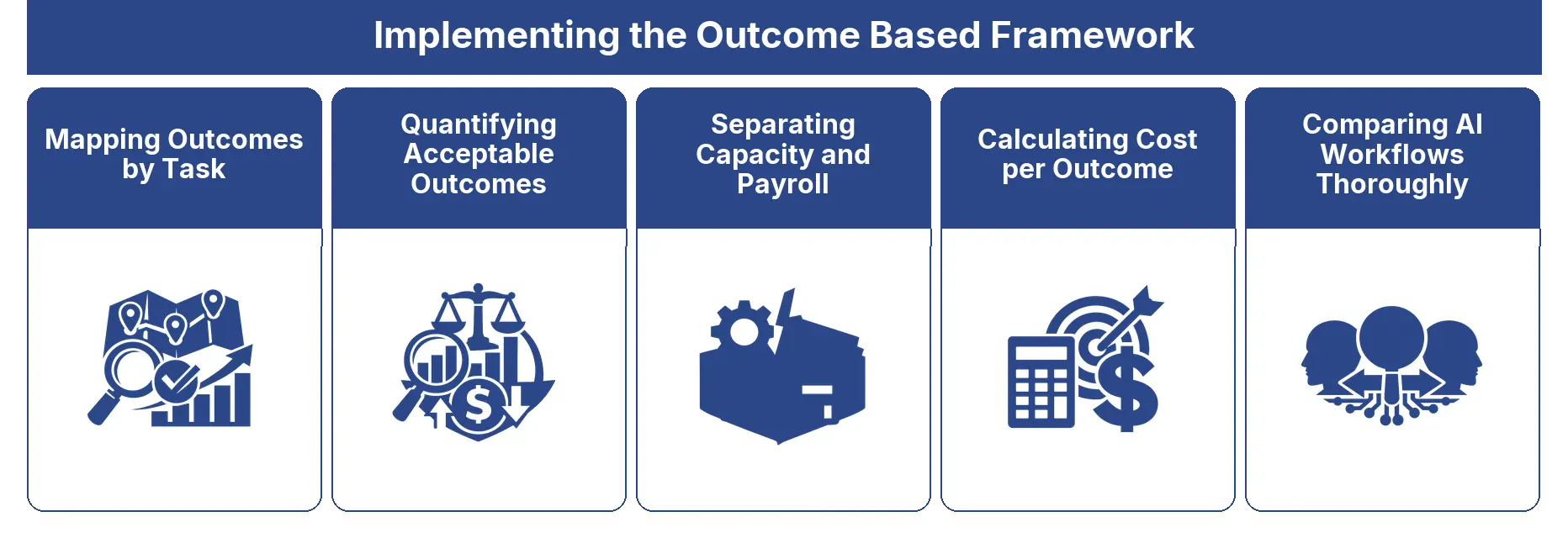
A disciplined measurement system begins with the work itself, not with the seats, licenses, or headcount assigned to it. The structure moves from task definition to outcome thresholds, then separates productive capacity from payroll, consolidates the full economics into a cost per outcome measure, and finally compares workflows on consistent terms. This sequence prevents automation claims from resting on activity volume alone. Earlier data driven operating metrics made the broader case for linking measurement to strategic outcomes rather than visible effort.
Mapping Outcomes by Task
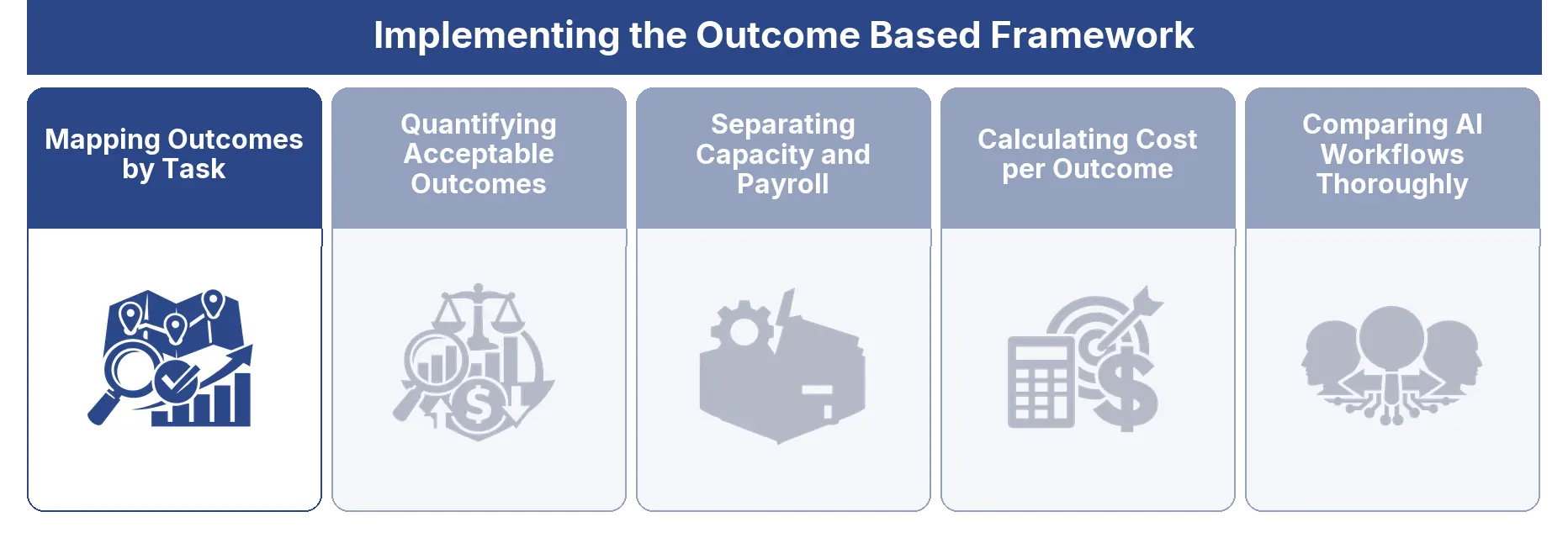
The first step is to identify the discrete tasks that produce a deliverable, then connect each task to the outcome that makes the deliverable useful. A customer support workflow, for example, may include classification, response drafting, escalation, and resolution verification. Each task carries different quality requirements, human dependencies, and automation potential. McKinsey’s research on turning ideas into implementation reinforces the importance of translating broad objectives into operational actions that can be managed and evaluated. Without this task level map, AI appears to replace a role when it may only accelerate one step within a larger chain.
Quantifying Acceptable Outcomes
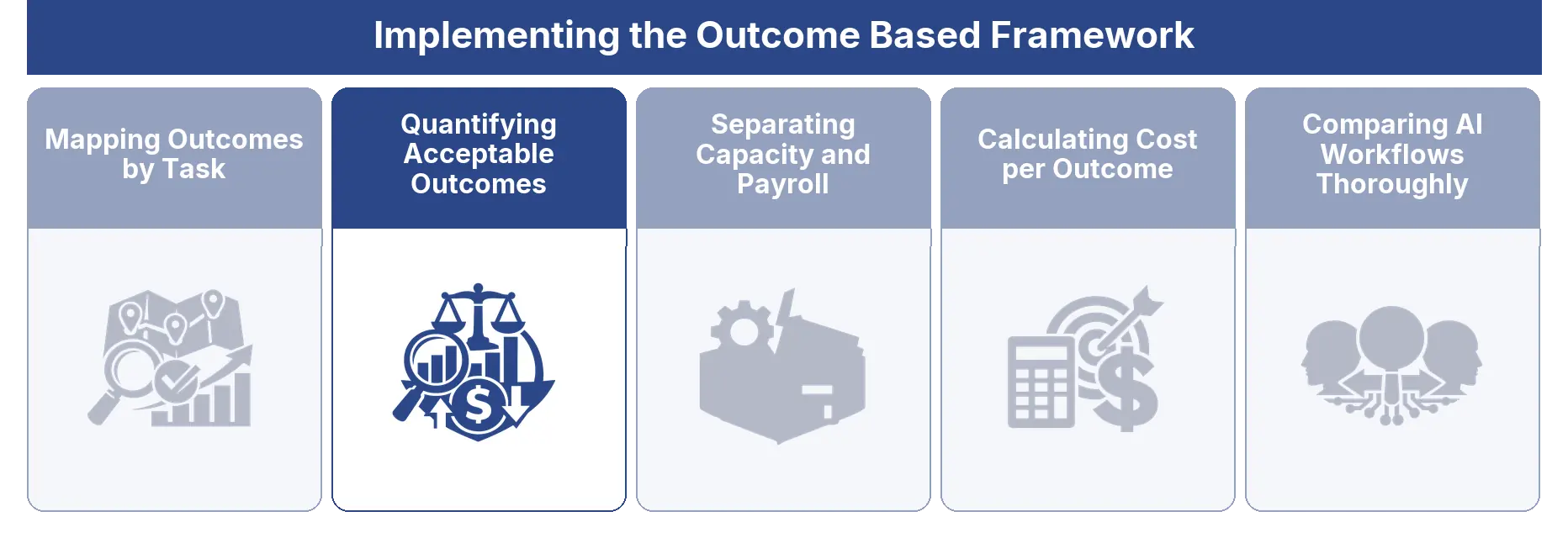
Qualitative goals become decision useful only when an organization defines what acceptable performance means. Thresholds might include accuracy, completeness, response time, compliance, customer satisfaction, or the percentage of cases requiring rework. The threshold need not represent perfection. It must represent the minimum result that protects the customer, the process, and the investment thesis. The NIST framework’s uses and benefits emphasizes structured assessment against organizational objectives, a principle that applies equally to AI enabled operating workflows. A response delivered twice as quickly has no economic value if it falls below the quality threshold and requires manual correction.
Separating Capacity and Payroll
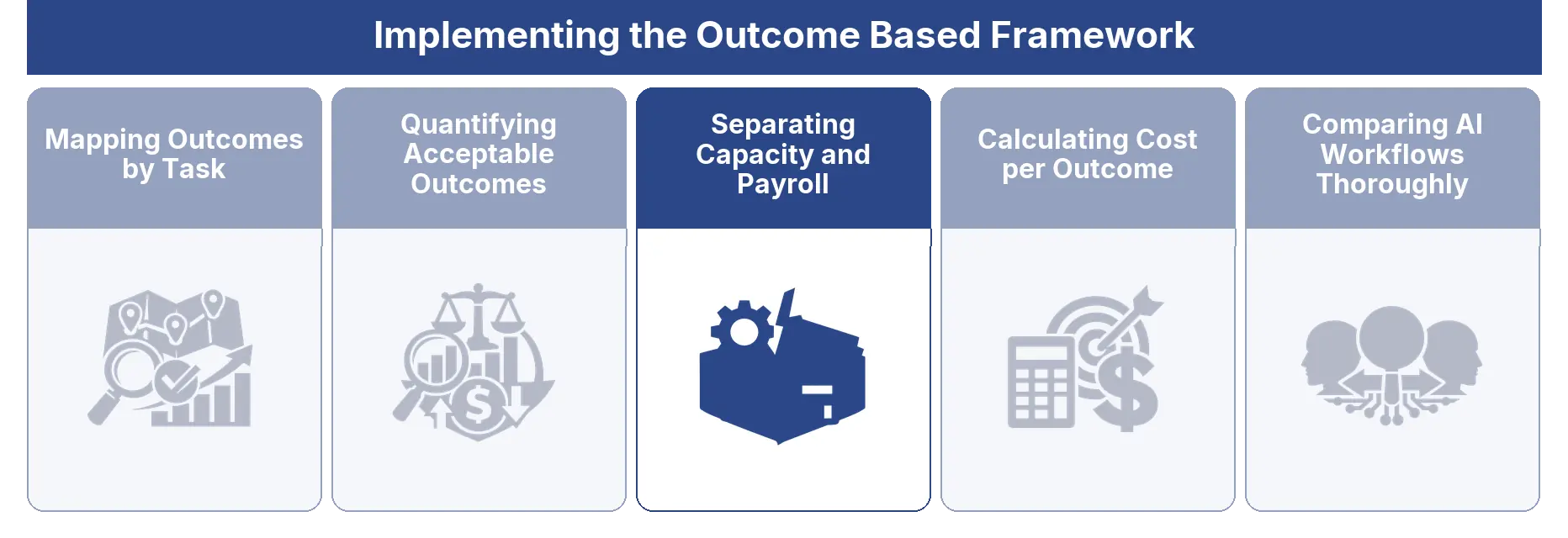
AI changes available capacity before it necessarily changes payroll. That distinction matters because a workflow can produce more acceptable outcomes without reducing headcount, particularly when employees redirect time toward complex cases, revenue generating work, or quality control. Capacity should therefore be measured as the volume of acceptable outcomes that the system can support, while payroll should capture the labor cost that remains in the operating model. The systematic review of productivity factors shows why productivity measures require more than a single output count: context, coordination, quality, and task complexity shape the result. Treating every capacity gain as an immediate labor saving overstates value.
Calculating Cost per Outcome
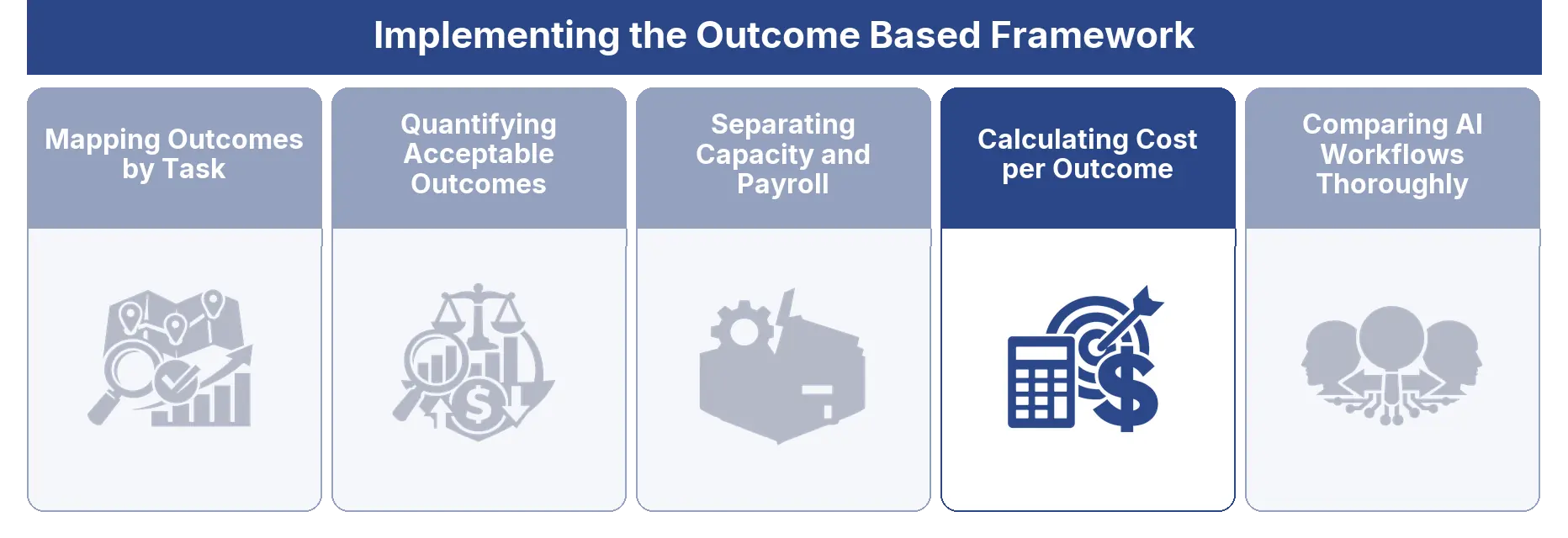
Cost per outcome aggregates the expenses required to produce an acceptable result, including software, model usage, implementation, supervision, exception handling, training, infrastructure, and human labor. The calculation is straightforward: total workflow cost divided by the number of acceptable outcomes delivered during the same period. KPMG’s analysis of outcome based contracting principles supports the underlying discipline of tying commercial and operational evaluation to measurable results rather than inputs alone. A lower unit cost is meaningful only when the outcome definition, quality threshold, and measurement period remain consistent.
Comparing AI Workflows Thoroughly
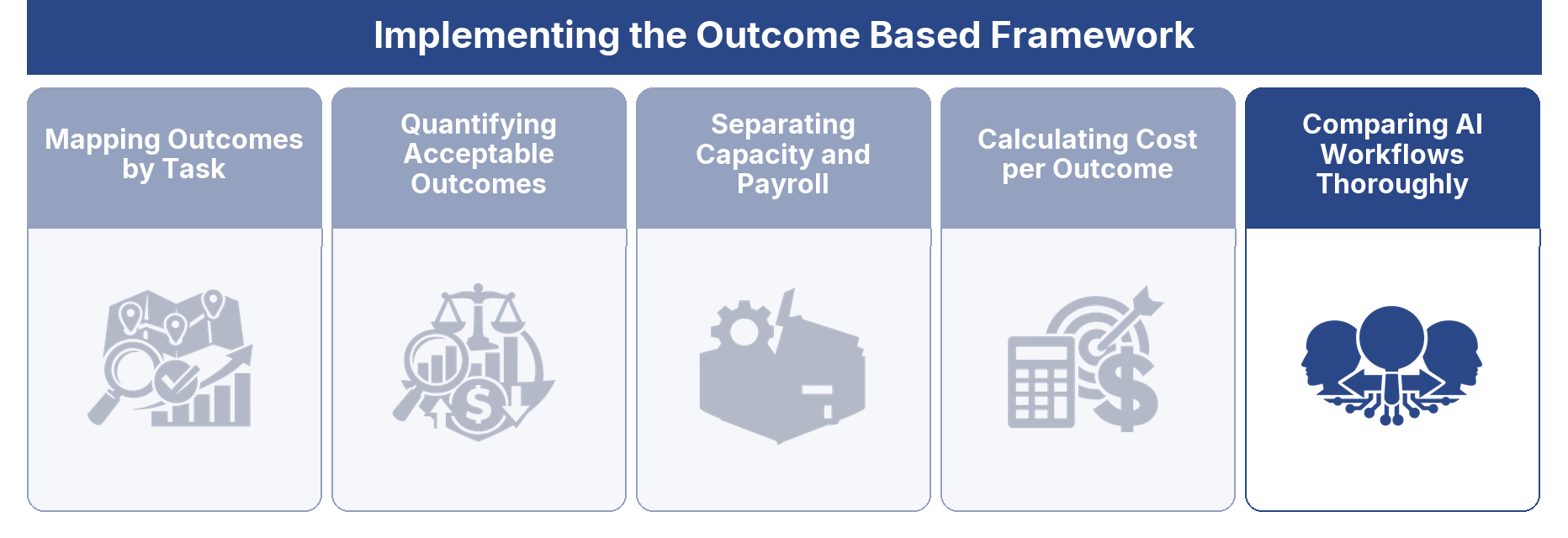
Comparison requires more than placing an automated workflow beside a manual one. Each option should be assessed across outcome quality, throughput, cycle time, exception rates, payroll exposure, technology cost, implementation burden, and resilience under changing demand. Research on organizational and individual measures highlights the risk of confusing individual activity with organizational performance, a distinction that becomes critical when AI redistributes work across teams. A workflow that performs well in a stable pilot may weaken when volume rises, inputs vary, or oversight becomes expensive. Continuous improvement teams can sustain the discipline through structured improvement practices, testing assumptions against live operating data and revising thresholds when the work changes.
Synthesizing Value Realization Across AI Work
AI investment becomes strategically meaningful only when spending is connected to completed work, acceptable quality, and the cost required to produce both. Seats, licenses, and gross vendor spend remain useful control measures, but they cannot explain whether an organization is improving cycle time, reducing rework, or expanding capacity. A cost per acceptable outcome view changes the executive conversation from access to performance, making value creation visible across workflows, teams, and operating units. It also gives leaders a common basis for comparing human effort, software consumption, and AI enabled execution without treating any one input as the result.
With this in place, executives can establish outcome definitions before approving additional licenses, instrument the workflows that matter most, and codify a measurement rhythm that connects operating performance to investment decisions. Finance, technology, and business leaders can then deploy resources against proven work improvements, scope pilots around measurable outcomes, and escalate spending that produces activity without meaningful value. The disciplined practitioner should build the baseline, formalize ownership, and govern the portfolio against what the organization successfully delivers, not how many seats it has purchased.

Get new articles by email
Insights on M&A, revenue growth, and business transformation, delivered occasionally.