
An Employee Costs More Than Salary: Establish the True Baseline
In 2025, enterprise software company ServiceNow agreed to acquire Moveworks for about $2.85 billion, aiming to extend agentic artificial intelligence into front-line employee experiences. The acquisition of Moveworks connected the investment to how work gets performed, not simply to a software line item. That distinction matters in M&A, where the value of an AI platform depends on the tasks it changes, the capacity it creates, and the hiring it may prevent. A license can be priced precisely while the labor economics around it remain largely unmeasured.
AI adoption does not automatically create value, because capacity only matters when redesigned workflows allow it to be redeployed or replace future hiring. Organizations that measure spend per employee can overstate productivity gains, understate governance and deployment costs, and mistake tool adoption for economic impact. The central challenge is separating payroll and benefits from AI-enabled capacity at the task level, then connecting both to investment decisions. How can leaders establish and operationalize a fully loaded baseline to measure AI economics at the task level rather than by per employee spend?
A credible baseline combines payroll, benefits, and AI-enabled capacity, while distinguishing capacity created, capacity redeployed, and hiring avoided. That discipline gives executives and M&A practitioners a clearer basis for comparing task economics, testing valuation assumptions, and governing realized value. The result is a more rigorous path from workforce data to investment decisions, grounded in how work changes rather than how many licenses an organization purchases.

Grounding Baseline Payroll Realities
A credible AI business case begins with the cost of the work already being performed, not with the price of a software license. A fully loaded labor baseline combines wages or salaries with benefits, payroll taxes, facilities, management overhead, and the time employees devote to recurring tasks. That baseline creates a more useful comparison than headcount alone because the relevant economic unit is the task, not the position. McKinsey’s research on frontline talent investment reinforces the connection between workforce capability and operational performance, making labor context central to any serious productivity analysis.
The baseline must also distinguish three different outcomes: capacity created, capacity redeployed, and hiring avoided. Capacity created represents additional productive work that becomes possible within existing labor hours. Capacity redeployed captures time released from administrative or repetitive activities and redirected toward higher value responsibilities, such as customer engagement, analysis, or quality control. Hiring avoided reflects demand that the existing workforce can absorb without adding a position, although the economic benefit depends on whether the organization can sustain service levels and execution quality.
These outcomes are related, but they are not interchangeable. That distinction prevents a common error in AI valuation: treating every minute saved as a cash reduction. If an employee completes a report in half the time, the organization may create capacity without reducing labor costs; the value may appear through faster decisions, greater account coverage, or delayed hiring rather than immediate expense removal. Gartner’s research on technology value realization supports the need to connect technology investments to measurable business outcomes rather than adoption metrics alone.
The practical implication is straightforward: capacity should be assigned to a specific workflow, measured against a baseline, and traced to the business result it enables. This approach also strengthens diligence and governance in Mergers and Acquisitions (M&A), where optimistic productivity assumptions can distort synergy estimates and integration priorities. A labor cost baseline gives executives a common reference point for testing whether AI changes the economics of customer service, finance, sales operations, or internal support. It also clarifies which benefits require organizational redesign, which depend on employee adoption, and which remain contingent on demand.
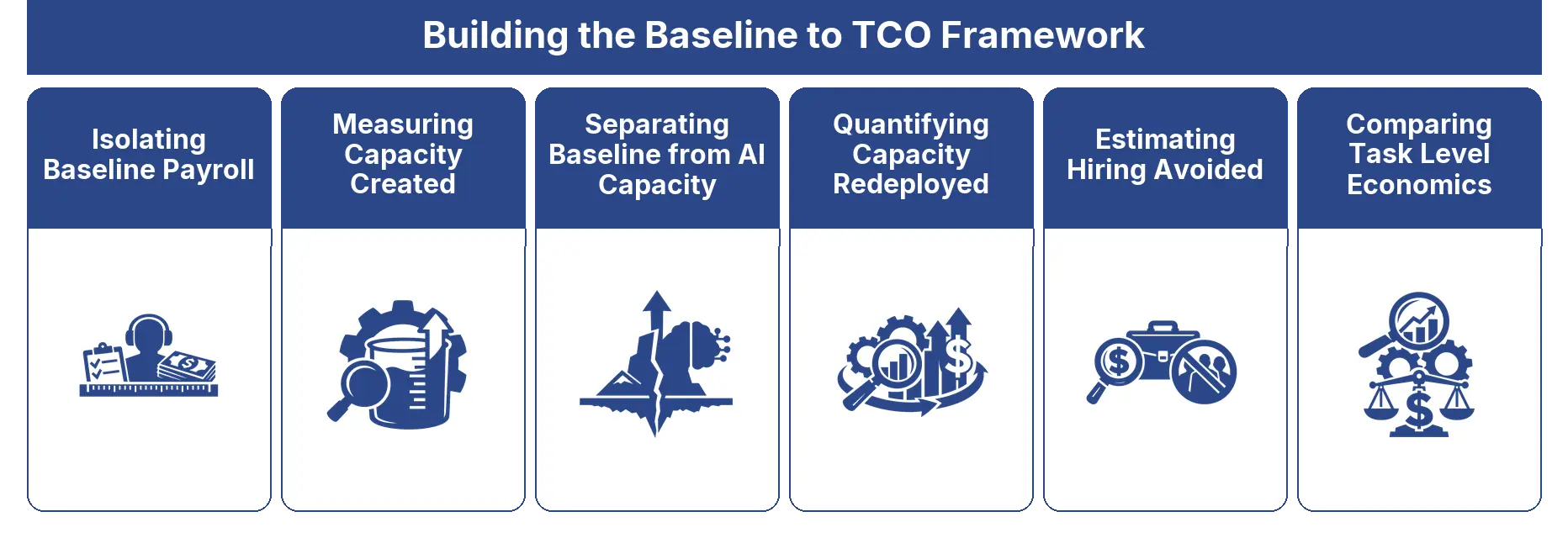
The six part structure that follows turns those distinctions into an operating discipline, moving from baseline labor costs through capacity measurement to task level economic comparison.
Highlighting AI Adoption Blind Spots
A software license rarely creates capacity by itself. Executives often treat artificial intelligence (AI) value as a choice between lower labor costs and cheaper licenses, yet the economic gain depends on whether the organization redesigns the work surrounding the tool. McKinsey’s research on moving from adoption to impact emphasizes that scaled value requires changes across workflows, operating models, and employee practices, not merely broader access to technology. Without a defined baseline, AI spending disappears into general information technology budgets, while hiring changes, overtime, demand shifts, and normal productivity gains distort the result.
A service organization may report that a copilot reduced handling time, for example, without establishing whether employees used the recovered minutes for additional cases, quality improvements, training, or lower staffing demand. Gartner’s research on measuring AI business value reinforces the need to connect adoption measures with business outcomes rather than treating usage as proof of return. The distinction is material: activity can rise while economic value remains unchanged. Task level economics provide the clearer lens.
The relevant comparison is not an annual software subscription against an employee’s salary, but the cost of a specific task before and after workflow redesign, including review time, exception handling, data preparation, training, integration, and governance. McKinsey’s findings on organizational rewiring for AI value point toward this operating model question: which activities change, who owns the redesigned process, and how does management measure the result? Earlier work on technology adoption in transformation similarly frames technology selection as a fit with transformation goals, rather than a race to acquire the newest feature. This blind spot produces three predictable consequences: uneven return on investment, underfunded Integration Management Office (IMO) capacity, and governance gaps that obscure realized value.
When leaders compare license cost with labor cost, they may approve pilots that never reach production, overlook the data and workflow dependencies that determine adoption, or claim savings that actually reflect an unfilled vacancy. Stanford’s analysis of AI’s economic impact underscores why adoption metrics and productivity outcomes must remain distinct. The six part sequence, from Isolating Baseline Payroll through Comparing Task Level Economics, creates that discipline by separating capacity created, capacity redeployed, and hiring avoided before any value claim enters the business case.
Building the Baseline to TCO Framework
A diligence model credits an assumed AI productivity gain, removes planned hiring, and trims Integration Management Office (IMO) resources before anyone has measured a live workflow. The synergy improves on paper while the people, process redesign, data work, and change management required to produce it disappear from the integration budget. ServiceNow’s agreement to acquire Moveworks for about $2.85 billion in 2025 makes the tension visible: the ServiceNow Moveworks transaction rationale centered on extending agentic artificial intelligence into front line employee experiences, but strategic rationale alone does not establish a financeable benefit.
The central risk is sequencing. An unverified capacity claim can reduce IMO staffing, defer systems work, and compress adoption funding before the operating model has changed. The paper benefit then removes the conditions needed for realization.
A credible baseline starts with a simple principle: employee cost is not limited to salary, and an AI tool’s price is not evidence of value. Payroll, benefits, employment taxes, equipment, management time, and the cost of maintaining required capabilities belong in the starting measure. AI enabled capacity must then be recorded as an operating change, not treated as an automatic saving.
Without those distinctions, diligence teams overstate synergies and underfund the integration work required to capture them. The task ledger should separate what the work costs, how capacity changes, which costs belong to the intervention, where released time goes, whether hiring is avoided, and whether the economics justify investment. That discipline extends prior analysis of comprehensive TCoA governance and establishes an evidence ladder: modeled capacity receives no base case valuation credit, observed capacity receives discounted credit, and realized savings or documented hiring avoidance enters the case only after finance and operations validate the result.
Isolating Baseline Payroll
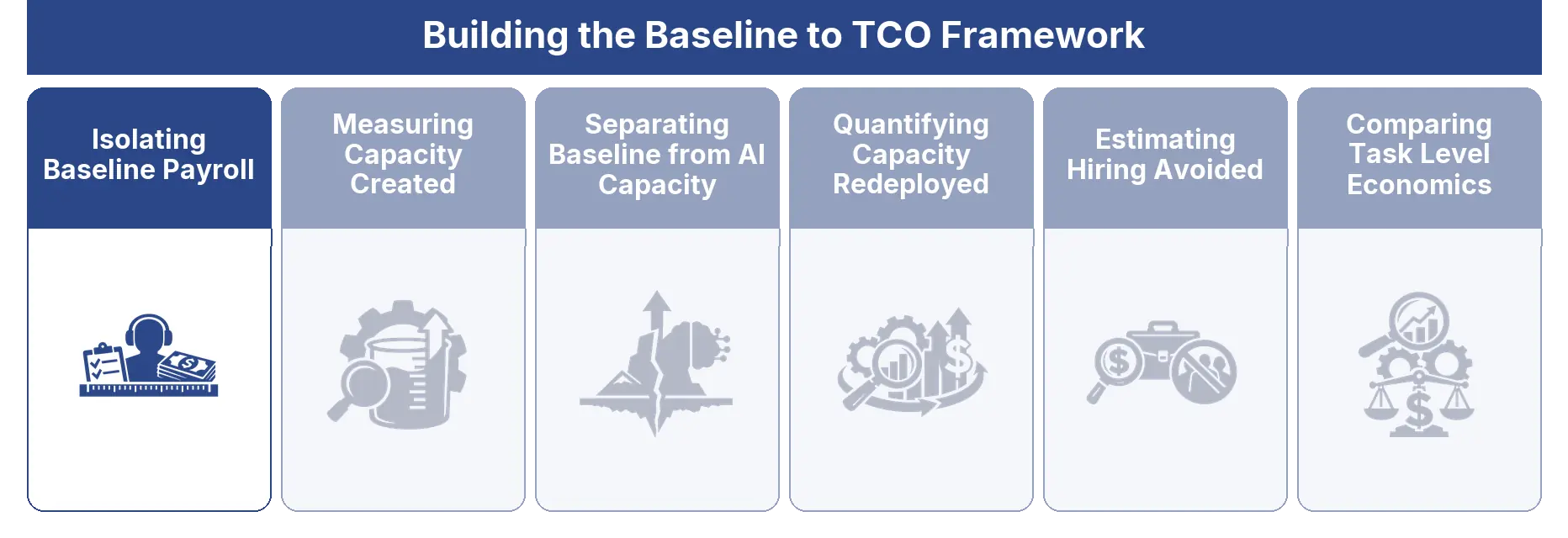
The baseline should capture payroll, benefits, employment costs, equipment, management time, and the systems required to sustain the role. It should also identify the share of paid time devoted to the affected task. A finance analyst earning $120,000 cannot be evaluated against a generic productivity percentage if only 20% of the role involves report preparation, because the relevant economic unit is the task, not the employee label.
Making cost engineering count supports treating cost as an operational measure rather than a finance only total. Finance, human resources, operations, and technology should agree on definitions, allocation rules, time periods, and data owners before the figure enters diligence. If the task mix remains undocumented, the baseline should remain directional rather than valuation grade. An unsupported labor allocation can understate process owner time, controls, migration requirements, and training demand, giving executives permission to remove the resources that realization requires.
Measuring Capacity Created
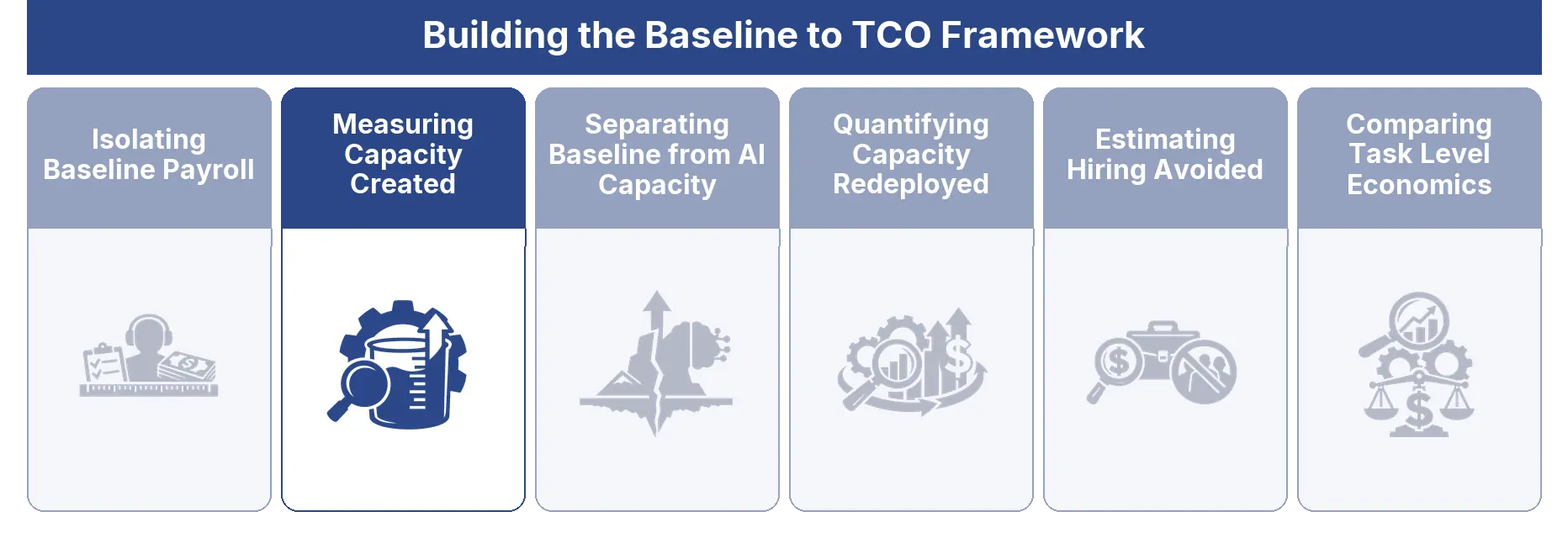
Capacity exists only when a task requires fewer labor hours at equivalent or better quality. Measurement should compare a pre adoption time study with observed post adoption performance across a defined operating period. If customer support falls from 30 minutes per case to 20 minutes, the ledger should record affected volume, quality, exception rates, adoption level, and the portion attributable to the AI workflow.
Elapsed time alone is insufficient. The result must not be explained solely by seasonality, staffing changes, case mix, or normal learning, and the task owner should demonstrate stable service and controls. Two or more measurement periods may provide a practical threshold when the task cycle supports it, but the period should be set before value is booked. Modeled capacity can guide prioritization; it cannot justify reducing IMO resources before the workflow has changed.
Separating Baseline from AI Capacity
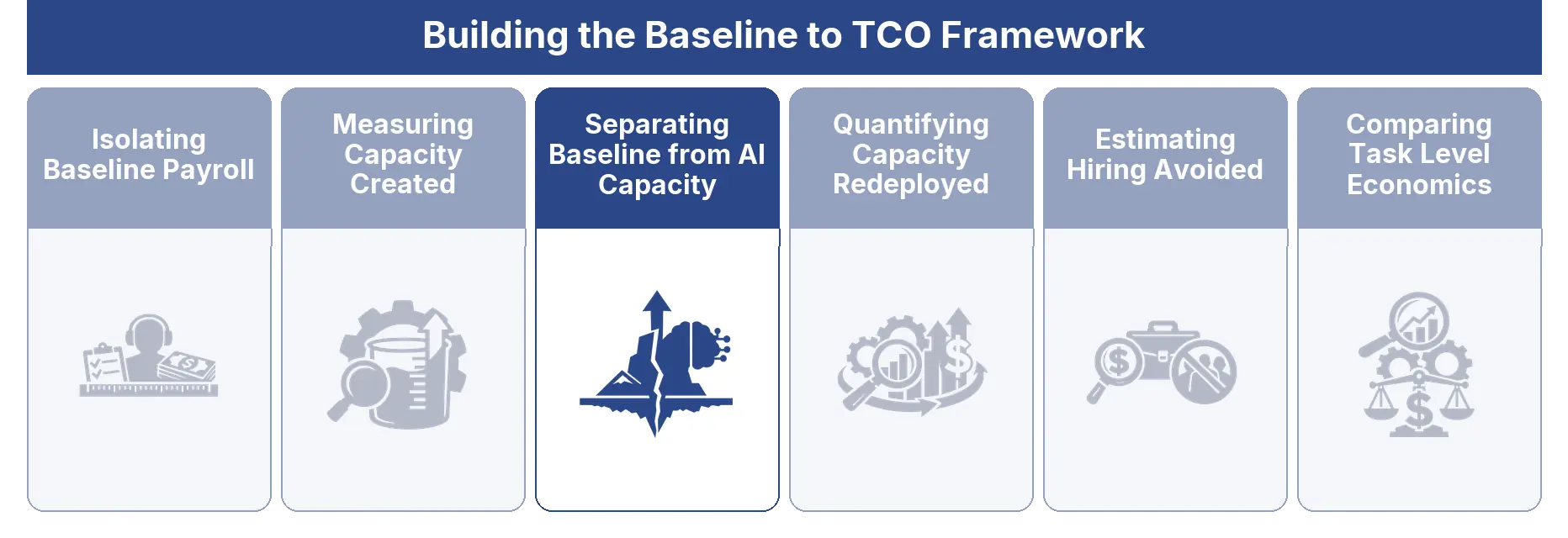
AI enabled capacity should sit beside the baseline, not inside it. The baseline shows what the organization pays to maintain current capability; the AI measure shows additional capability after licensing, implementation, training, oversight, rework, and exception handling. Combining those figures obscures whether the benefit comes from labor efficiency, higher output, or a reporting change.
Standard cost model discipline points toward consistent unit economics. A common task record should show baseline labor cost, AI cost, incremental control cost, realized hours, adoption rate, quality impact, and confidence level. Attribution must also be explicit: if process redesign or normal learning explains part of the improvement, AI receives only the share supported by evidence. The same hours cannot appear as both an AI synergy and an avoided hire, while implementation costs cannot disappear because productivity is expected to improve.
Quantifying Capacity Redeployed
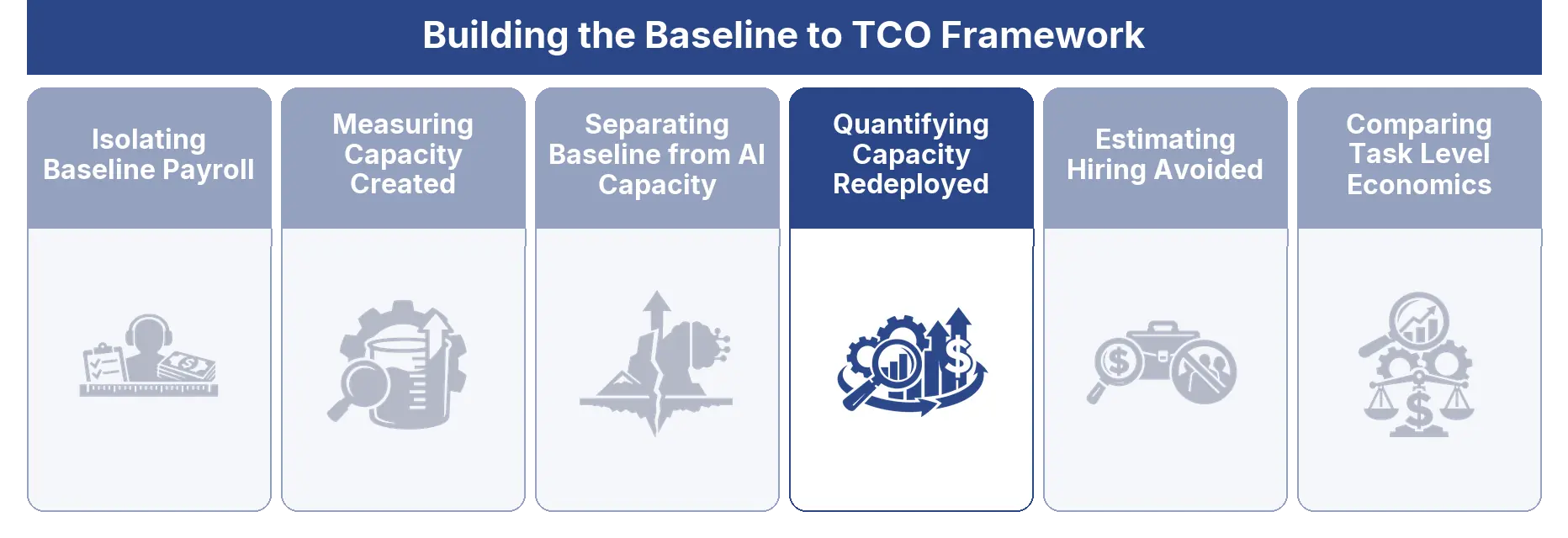
Redeployment converts available time into an operating decision. Released hours should be linked to a receiving activity, an accountable manager, and a measurable outcome, such as additional onboarding volume, faster documentation, or stronger control testing. Released time is potential value. Redeployed time is a management choice.
The IMO, finance, and functional leaders should review a monthly ledger separating hours released from hours actually reassigned. Contracting for performance outcomes reinforces the principle that value follows observed performance, not activity alone. If the case assumes that 100 released hours will fund a strategic workstream, the integration budget must still cover transition effort, receiving manager capacity, training, and controls.
The sequencing failure is self reinforcing: an inflated productivity estimate reduces integration staffing, reduced staffing delays data and process work, delayed work weakens adoption, and weak adoption prevents redeployment. The synergy fails not because the tool lacked potential, but because the deal model removed the resources required to capture it.
Estimating Hiring Avoided
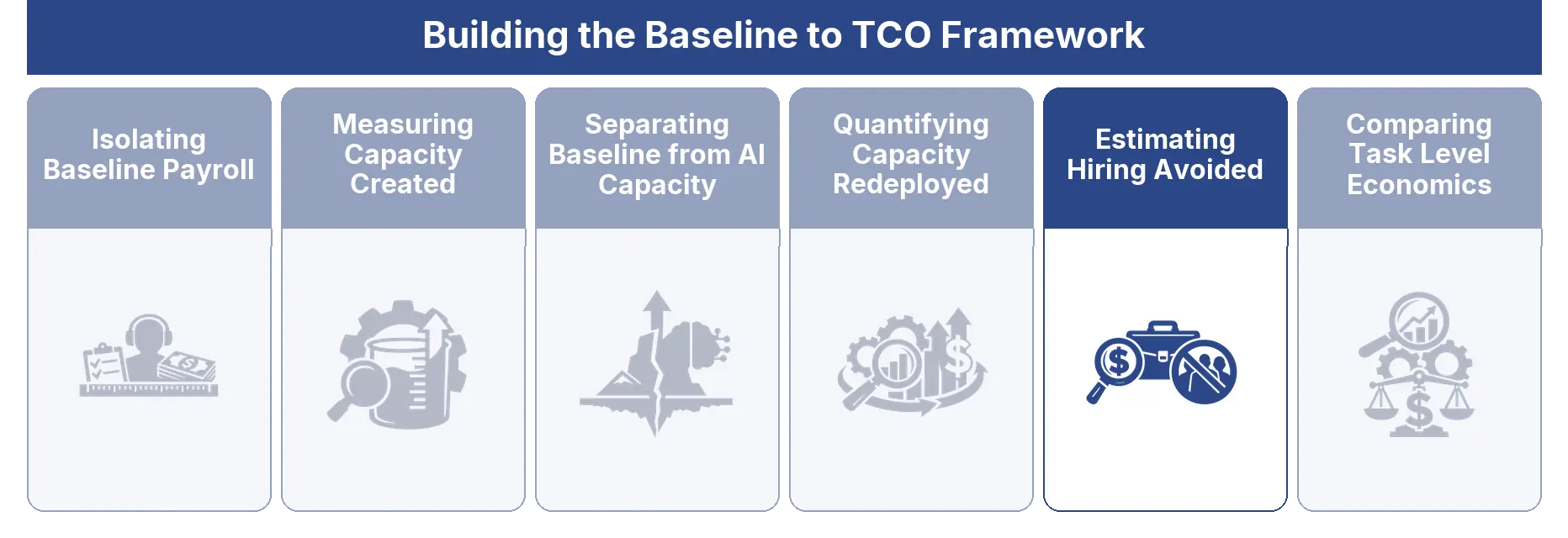
Hiring avoided is distinct from productivity. It exists when quantified incremental demand would otherwise require an approved role, and AI enabled capacity meets that demand without degrading service, controls, or employee sustainability. Evidence may include an approved staffing plan, vacancy request, forecasted workload, or documented capacity threshold. Informal discussion does not qualify.
Three conditions should be present: demand is incremental and quantified, the role is approved or strongly supported by the operating plan, and the AI enabled capacity covers the work at the required quality level. If any condition is absent, the benefit remains a productivity observation rather than an avoided hiring synergy. The calculation should separate timing, role type, geography, and duration, because avoiding a six month contractor differs from avoiding a permanent specialist.
Prior work on integration hidden costs established why indirect and deferred costs require explicit treatment. Hiring avoided should include loaded compensation, recruiting expense, onboarding time, management capacity, and the probability that the role would otherwise have been filled. A probability weighted benefit may enter the forecast, but an unapproved role should not enter the base case, and the same capacity should not be counted again as redeployed time.
Comparing Task Level Economics
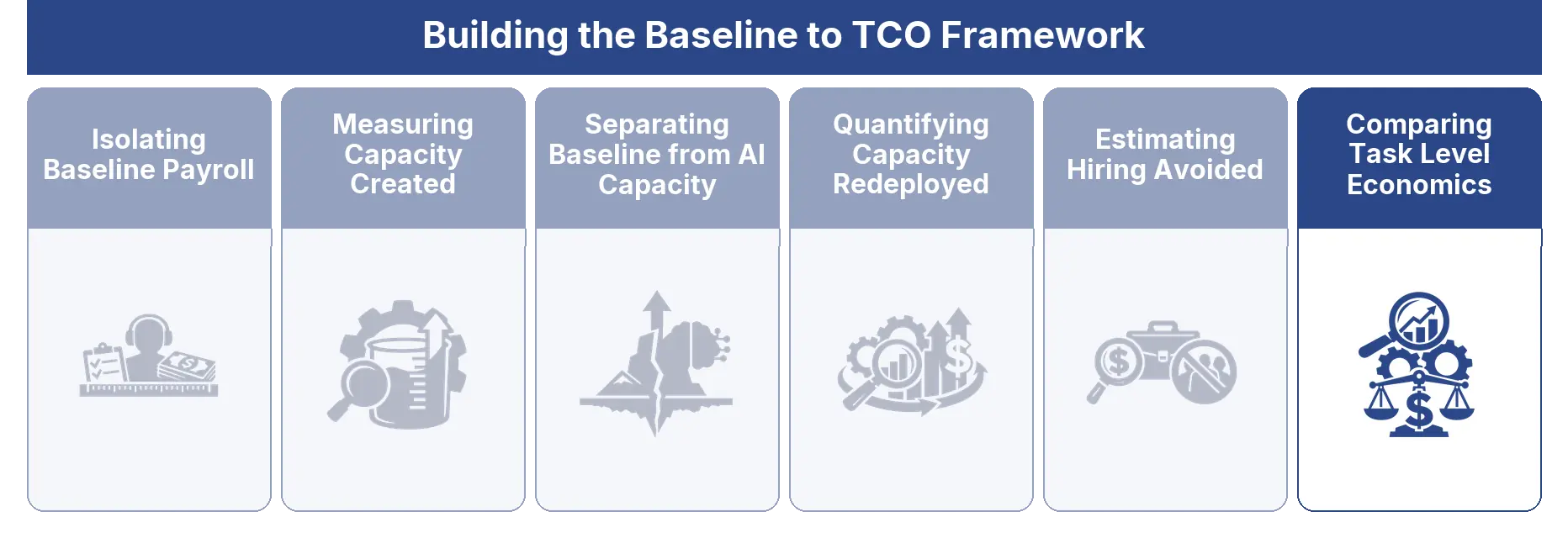
The final comparison belongs at the task level. Leaders should compare fully loaded baseline cost with AI licensing, implementation, training, oversight, rework, and control costs, then assess capacity, quality, and business use. A high volume, repeatable task may justify investment despite an expensive per employee license; a low volume task may not.
Each material use case should carry an owner, baseline, adoption rate, expected value, realized value, confidence level, and review date. Finance validates the calculation, while operations validates the result. A directional estimate can inform prioritization, measured improvement can support discounted valuation credit, and realized output or documented hiring avoidance can support booked synergy when the workflow, owner, quality result, and financial treatment are documented.
The broader Total Cost of Ownership (TCO) view can compare baseline cost, AI enabled capacity, redeployment, hiring avoided, and realized outcomes without confusing expenditure with value. The transaction test is narrow: price only capacity that has an owner, a measured workflow, and a credible path to redeployment or avoided hiring.
An AI business case becomes credible when it starts with the economics of work already being performed and protects the operating capacity required to change that work. Measure one workflow, refuse unverified synergy credit, and protect the IMO, process, data, and change resources needed for redeployment. That is the pace disciplined integration demands.
Synthesizing Baseline Driven AI Valuation
An AI business case becomes credible only when it starts with the economics of the work already being performed. Salary is one component of employee cost, while a software license is only an input, not proof of value. Without a complete baseline, executives cannot determine whether an AI initiative creates capacity, reduces cost, improves quality, or simply adds another expense to the operating model. The practical implication is decisive: value creation depends on connecting labor economics, workflow capacity, adoption, and measurable outcomes before investment approval.
With this in place, disciplined practitioners can implement a role level baseline, establish the full cost of the work, and build a value model that distinguishes real capacity from theoretical productivity. On Monday morning, leaders can instrument the highest volume workflows, sequence the first use cases against measurable constraints, and govern progress through explicit owners and review points. Finance can challenge assumptions, operations can validate process changes, and technology teams can execute deployment against a defined business case rather than a license count. The result is a more durable decision standard: establish the baseline, codify the value hypothesis, and operationalize the evidence before scaling. That discipline turns AI from a software purchase into an accountable business investment.

Get new articles by email
Insights on M&A, revenue growth, and business transformation, delivered occasionally.