The Messy Middle: Maintaining Momentum Through a Structured Integration Rhythm
In 2025, Salesforce agreed to acquire the enterprise data platform Informatica for about $8 billion, a move to strengthen the trusted data foundation behind its agentic AI. The deal linked a leading CRM with deep data management, promising a richer platform while asking both organizations to preserve product momentum. Yet integrations of this kind routinely see cross functional decision rights blur and milestones slip in the months after close, as governance structures wrestle with speed and clarity. This scenario, a real and public example of integration complexity, illustrates why momentum must be protected with structured governance.
Despite Day One readiness, cross functional work stalls as decision rights blur and priorities shift. Milestones slip as hidden dependencies in roadmaps and data flows complicate execution. The consequence is delayed value signals and a thesis at risk. How can momentum be maintained in the middle of integration by instituting an IMO led rhythm that gates milestones, tracks dependencies, and manages risks to realize value?
That challenge calls for a governance mechanism that binds the organization to a durable rhythm. Day One readiness becomes a starting line when an Integration Management Office moves from planning artifacts into a live spine. In practice, a disciplined IMO led rhythm gates milestones, tracks dependencies, surfaces risks, and anchors progress with blueprint for M&A success and comprehensive TCOA analysis in M&A. The ensuing analysis translates this discipline into an actionable operating rhythm designed to preserve speed and enable sustained value realization.
Establishing the Mid Integration Baseline for Sustained Momentum
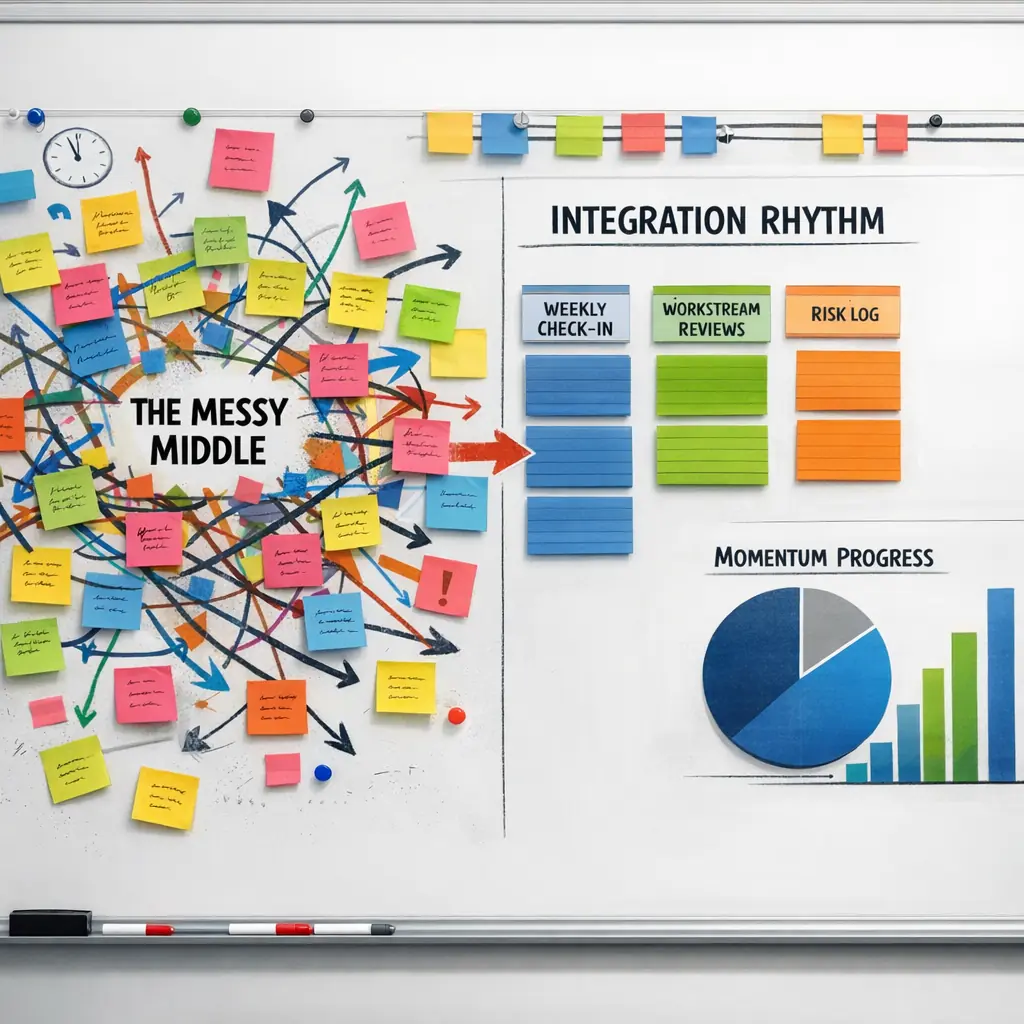
Momentum often deteriorates in the mid course of integration, specifically weeks six through twelve, when governance becomes blurred and interdependencies multiply. In that window, decision rights may drift and cross functional teams face conflicting priorities, causing work to stall and the value thesis to fray. A roughly $8 billion data platform deal illustrates the frictions: despite strong strategic rationale, the integration gained velocity only after a formal cadence anchored by a clear operating model and a single decision making forum. External perspectives on the messy middle emphasize the same pattern: momentum requires a routinized rhythm that keeps actions aligned even as complexity grows. The core implication is that momentum is not a function of ambition alone; it is a discipline that requires a structured cadence, explicit ownership, and disciplined risk management. The concept is widely discussed in accessible literature on the messy middle, which underscores that momentum deteriorates when routine gives way to ad hoc problem solving. The Messy Middle.
Establishing a repeatable integration rhythm, anchored by an Integration Management Office (IMO), creates predictable cadences that keep cross functional work aligned across IT, product, HR, and finance. The IMO serves as the central hub for governance, coordinating dependencies, surfacing risks early, and ensuring escalation follows a pre agreed path rather than ad hoc escalation. Day One readiness provides a baseline that translates near term wins into ongoing governance and measurable progress. When the operating rhythm is explicit, milestones become the motor for value realization rather than mere checkmarks. This approach builds on the same logic advanced in prior industry analysis work on turning integration into a financial discipline, where milestones are tied to value outcomes and cost to integrate metrics are embedded in diligence and tracking. Grounding this in the blueprint for M&A success and the comprehensive TCOA analysis in M&A provides a practical footing for disciplined execution. blueprint for M&A success and comprehensive TCOA analysis in M&A.
Operationalizing the mid integration baseline requires translating Day One readiness into ongoing governance and performance metrics. Large scale deals such as the Cisco Splunk $28 billion acquisition demonstrate that even with strong intent, value realization hinges on formal cadences that constantly surface what is working and what is not. The governance framework should also link to early value signals, ensuring attention shifts quickly to activities that compress time to impact. In practice, this means synchronizing cross functional roadmaps with a finite set of decision rites, and tying progress to explicit, auditable milestones. The integration program becomes a living plan, not a post close appendix, with regular reviews that feed back into the IMO’s cadence and the overall strategy, echoing the logic laid out in the blueprint for M&A success and in the TCOA framing. Cisco Splunk $28 billion acquisition.
Diagnosing Momentum Drags in the Messy Middle
Momentum in large scale mergers often distinguishes realized value from theoretical potential. Public deal histories illustrate this dynamic with tangible numbers: Microsoft’s acquisition of LinkedIn closed in 2016 for about $26 billion and kept LinkedIn largely autonomous to safeguard its network. Dell’s acquisition of EMC in 2016 for $67 billion integrated a sprawling portfolio while preserving operating units where necessary. Amazon’s acquisition of Whole Foods for $13.7 billion aimed to fuse ecommerce logistics with physical stores. And Disney’s acquisition of Pixar in 2006 deliberately protected Pixar’s creative culture amid the broader corporate integration.
Momentum often frays in the messy middle, where governance gaps distort execution. A four phase Integration Management Office (IMO) lifecycle, strategy, diligence, transaction execution, and post close integration, aligns milestones and governance to the deal thesis, while maintaining separate yet connected oversight to enable timely decisions and risk tracking. This disciplined approach reduces the misalignment that erodes value as day to day operations clash with the original rhetoric. The blueprint for M&A success emphasizes disciplined decision rights and structured handoffs; without such discipline, integration teams chase overlapping programs and dilute impact. This theme is echoed in the integration discipline, which outlines how governance should be structured to preserve momentum, and is complemented by the total cost of acquisition analysis to illuminate where resources will be consumed most.
Human in the Loop with Modeling remains essential: analytics guide decisions, but governance and calibration prevent overreliance on automation. Structured, task level planning with owners and deadlines keeps momentum even as pace accelerates, tying day to day work to strategic milestones and ensuring that the integration roadmap remains an executable constraint rather than an aspirational outline. The four phase IMO approach anchors these disciplines in practice, ensuring that the early focus on value levers translates into Day 1 actions and beyond. In the end, the real test lies in translating disciplined cadence into tangible synergies, a challenge that survives the messy middle when governance and judgment align.
Implementing the IMO Led Integration Rhythm

Implementing an IMO led integration rhythm translates the disciplined cadence of Day One readiness into a durable working rhythm for the entire integration program. An Integration Management Office (IMO) oversight layer sets the tempo, aligns cross functional teams, and anchors milestones to governance gates. The result is a tangible sequence that keeps the post merger program moving with purpose while preserving critical operating tempo. Within this rhythm, Day One is not a single date but a repeatable set of checks, decisions, and transitions that turn strategy into practical execution. A real public deal underscores the stakes: a roughly $8 billion data platform acquisition demonstrated that even large scale transactions can lose momentum without disciplined cadence and governance. The practical takeaway is clear: Day One readiness must become a living, auditable process rather than a static milestone.
Establishing Day One Cadences

Day One cadences begin with a centralized command rhythm that the IMO administers across functions such as IT, operations, and customer care. Daily stand ups, weekly review sprints, and monthly governance forums create visible defaults for decisions, issue closing, and policy alignment. This is not mere meeting hygiene; it is a framework to protect continuity of service while the organization absorbs the acquired entity’s operating model. The cadence should be explicit about dependencies and owners, reducing the risk of silent handoffs and misaligned priorities. A high profile example of cadence discipline is seen in a $34 billion open hybrid cloud platform integration, where Day One rituals helped preserve essential operating stability while the integration scaled. The cadence also serves as a force multiplier for early value signals, enabling the program to confirm progress against a shared operating vision. The approach aligns with the idea that the IMO’s governance is not a bottleneck but a synchronization mechanism, a theme echoed in external guidance on defining how the IMO should guide integration Defining how the IMO guides integration.
Aligning Milestones with Integration Governance
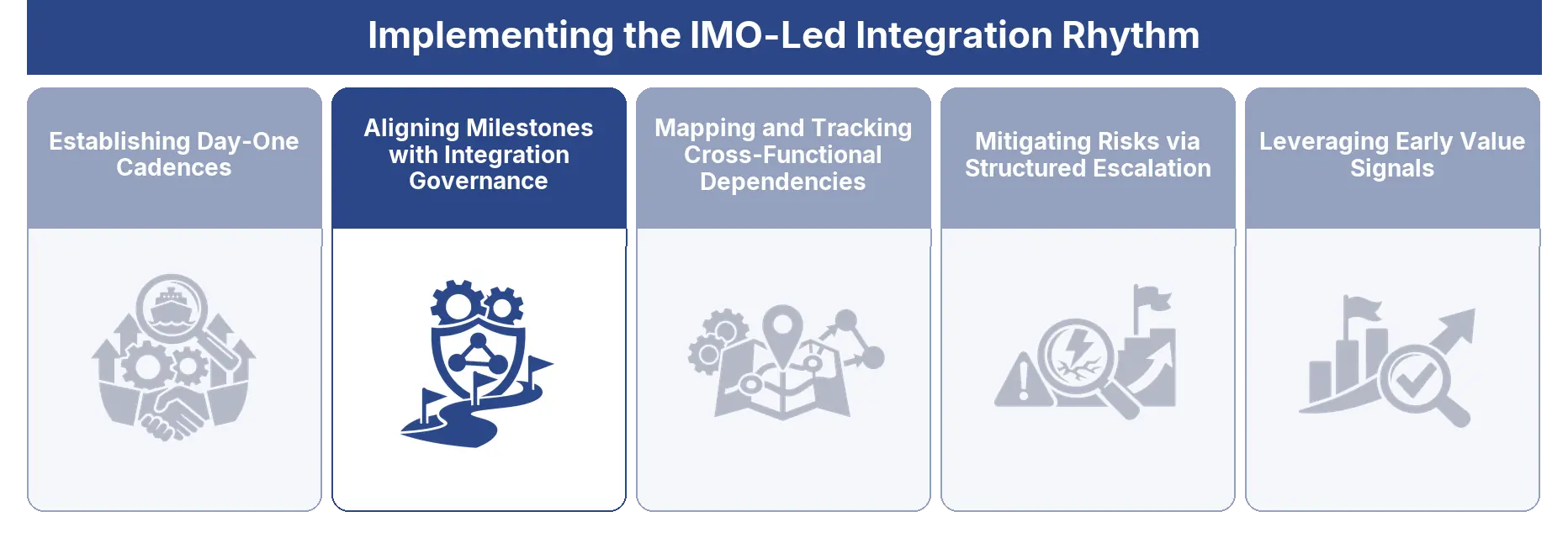
Milestones must map directly to governance gates where explicit decision rights are exercised and accountability is documented. The IMO architecture should define who approves scope changes, how budget drift is resolved, and when functional teams must converge on critical path actions. This alignment reduces rework and accelerates decision turns during the PMI (post merger integration) period. External practitioners emphasize that the IMO should synchronize activities rather than arbitrate each action, ensuring a cohesive program architecture rather than a collection of parallel efforts Setting the Tone, Defining How the IMO Will Guide the Integration. Within the internal framing, the integration plan should reference the four classic milestones, Day One readiness, the first major integration release, the stabilization phase, and the scale up period, and tie each to a formal approval mechanism. When milestones are tied to governance, the program preserves momentum even as business units negotiate competing priorities, a pattern documented in public discussions of IMOs and governance structures IMO charter and governance.
Mapping and Tracking Cross Functional Dependencies
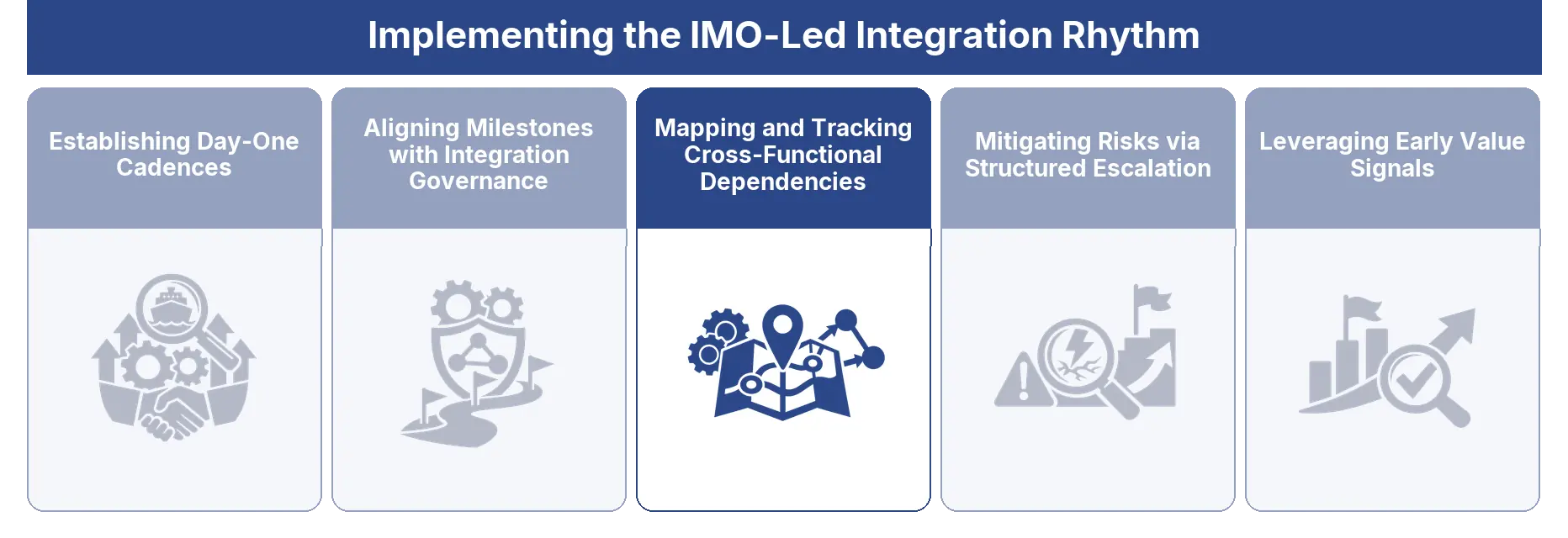
A successful rhythm requires explicit mapping of cross functional dependencies, with owners, handoffs, and service levels defined up front. Dependencies span IT environments, data migrations, HR onboarding, and customer communications, each with its own risk posture and escalation path. The mapping process should leverage a shared language across legacy organizations, ensuring that interdependent work streams speak a common protocol. Public guidance on structured governance highlights the importance of mapping teams, responsibilities, and decision rights to synchronize the effort across functions Integration Management Office: A Comprehensive Guide. Real world practice shows that when dependencies are identified early, the organization can sequence work to minimize contention points, reducing the chance that a critical path is delayed by a single function misalignment.
Mitigating Risks via Structured Escalation
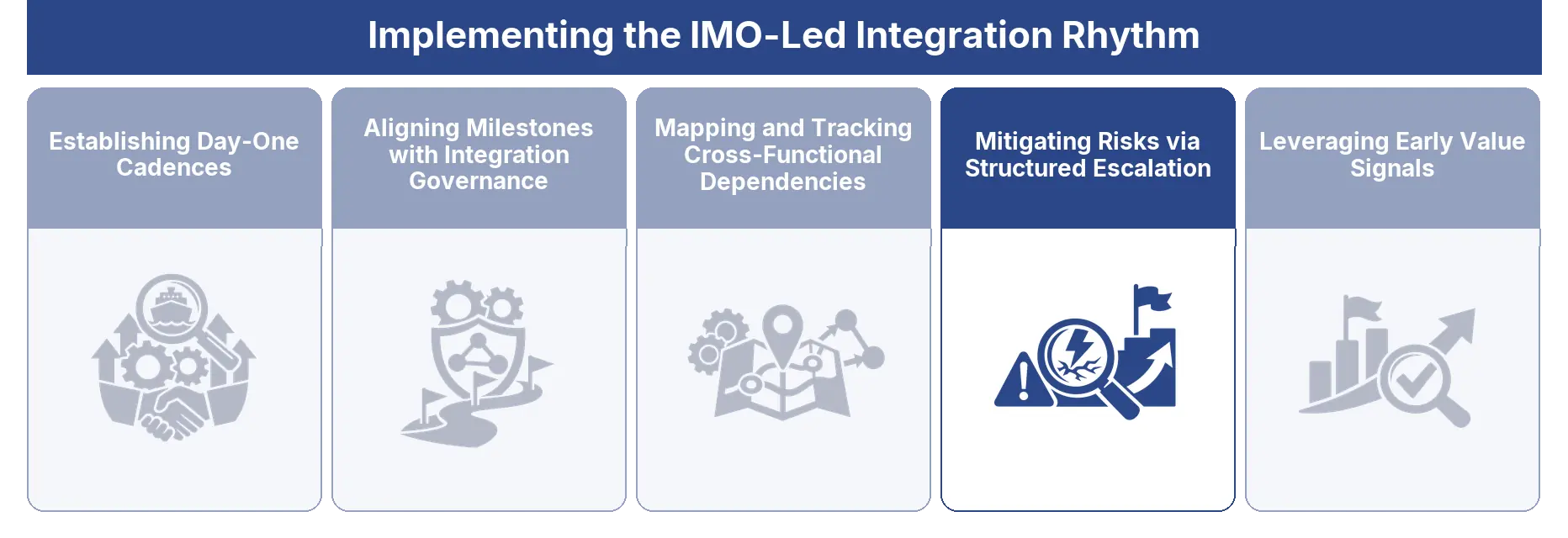
Structured escalation protocols translate risk into action. The IMO should codify escalation criteria, define thresholds, and specify who participates in escalations and how decisions are escalated. This reduces the common risk of escalation fatigue and ensures timely responses to blockers without creating bureaucracy. External perspectives on momentum emphasize the need for formal, repeatable escalation channels that preserve momentum while driving corrective actions Creating Momentum Through Structured Business Rhythms. A disciplined escalation framework also supports cross functional risk reviews that can surface subtle dependencies or policy conflicts early, allowing the program to reallocate resources or adjust sequencing before issues compound.
Leveraging Early Value Signals
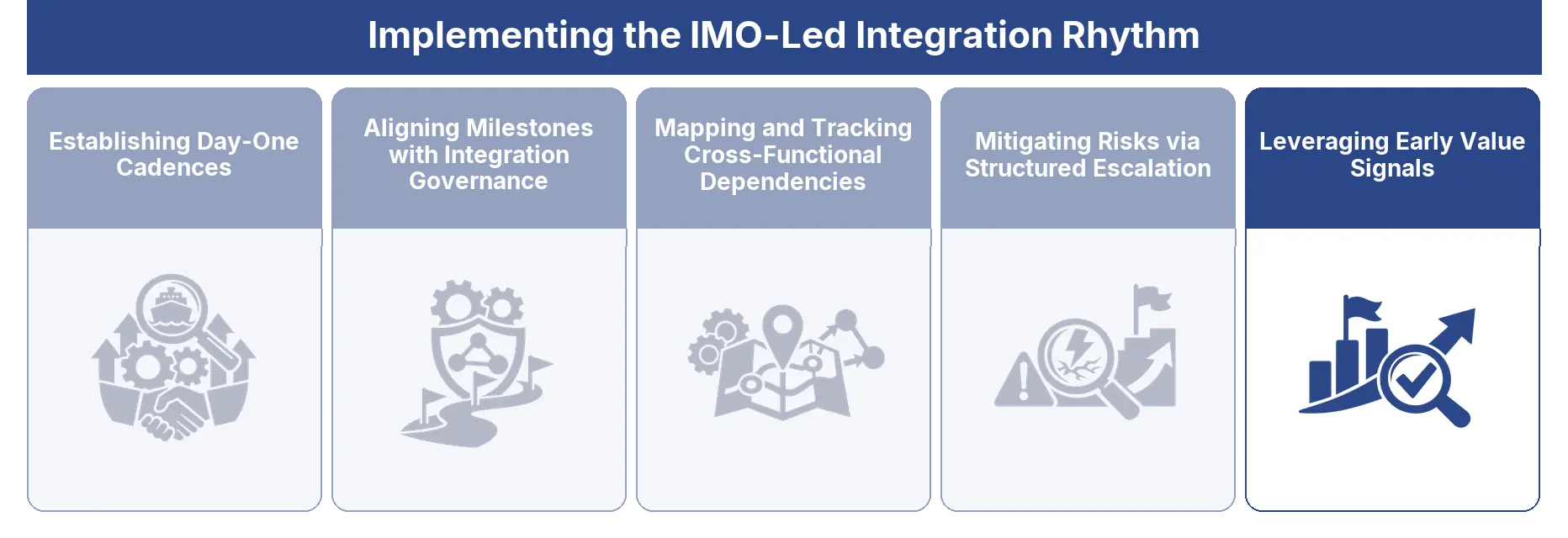
Early value signals validate progress and sustain executive confidence in the integration thesis. Cadences should embed metrics that reflect customer continuity, operating discipline, and the realization of synergy targets. Structured rhythms enable rapid readouts on cash flow, service levels, and product delivery, providing concrete evidence that the plan remains viable. The interplay between cadence and early value signals is central to momentum; in practice, organizations that connect Day One readiness to measurable early wins experience stronger execution discipline. External insights on momentum stress the importance of consistent messaging and cadence to avoid mixed signals that erode stakeholder confidence Winning in the Messy Middle: How brands build momentum. In addition, early value signals should be triangulated with external market benchmarks and internal benchmarks to confirm that migration toward the target operating model is on track. For cadence validation, reference to a $27.7 billion all stock integration underscores the scale that benefits from early signals and disciplined governance Salesforce Slack.
Consolidating Momentum Across IMO Driven Cadences to Enable Value Declaration
Momentum in large-scale integrations rarely collapses at signing; it erodes in the messy middle between weeks six and twelve as governance blurs and interdependencies grow. The four-phase Integration Management Office rhythm keeps day-one commitments alive as a durable program cadence, aligning milestones with the deal thesis and preserving value realization. Disney’s acquisition of Pixar demonstrates how protecting culture and brand sustains value during integration, while the Dell-EMC combination highlights the challenge of stitching sprawling portfolios. Microsoft’s LinkedIn and IBM’s Red Hat moves illustrate how governance drift and speed misalignment erode upside. Momentum, in this frame, is a design choice anchored in disciplined cadence, a pattern described in the blueprint for M&A success and reinforced by the case for TCOA analysis.
Looking ahead, Day One planning becomes the operating norm, with cross-functional leads shaping the integration blueprint before close and sustaining momentum thereafter. The IMO cadence translates into weekly reviews, explicit decision rights, and a live map of interdependencies that ties activity to the investment thesis. This structured rhythm reduces the risk of value leakage by turning strategy into measurable, ongoing progress.
Implement cross-functional Day One ownership with explicit roles. Stand up the Integration Management Office as the central command center with scheduled governance cadences. Codify escalation paths and decision rights in a living charter. Establish Day One planning with functional leads to anchor the integration roadmap.

Get new articles by email
Insights on M&A, revenue growth, and business transformation, delivered occasionally.