Day One Is a Promise, Not a Milestone: Building Trust Through Go Live Governance
In 2025, Google agreed to acquire the cloud security platform Wiz for about $32 billion, its largest acquisition to date, with a pledge to keep Wiz operating across multiple clouds to protect its customers and momentum. That structure aimed to preserve the Wiz culture and product velocity while enabling deeper security integration across Google Cloud. Executives anticipated the integration would unfold with clear governance signals and a staged transfer of capabilities. Yet deals of this scale routinely surface tensions around data governance, product roadmaps, and the speed of decision making across two organizations. The Wiz deal, therefore, provides a concrete lens on Day One readiness and the governance discipline required to translate a close into lasting trust.
Day One pressure in large software acquisitions has shifted from a ceremonial milestone to a trust event that tests clarity and stability. Even well structured plans can falter when governance signals are inconsistent and ownership is not visibly assigned. That friction threatens employee morale, customer continuity, and partner collaboration on the first day and beyond. How can Day One readiness and go live governance translate activity into trust for employees, customers, and partners on the first day of ownership?
Regulatory scrutiny and competitive pressure have intensified the demand for disciplined go live governance in technology deals. Fragmented readiness across policy, risk, and operating models can derail trust on Day One and invite customer and employee risk. The bridge to trust lies in an integrated governance approach that ties the Day One vision to the operating model, policy stance, and clear escalation paths. The ensuing framework translates readiness into decisive action and reliable messaging across the organization from Day One onward.
Grounding Day One Trust in Readiness Baselines
Grounding Day One trust in readiness baselines requires attention to what exists before the close, not only what happens after. A stable operating model with auditable ownership across functions creates the architecture for a frictionless Day One, reducing disruptive surprises in customers, systems, and policy. The Integration Management Office (IMO) serves as the coordinating spine, linking pre close readiness with Day One execution and ensuring policy positions, access governance, and customer commitments are holistically integrated into the go live cadence. When Day One readiness is anchored to a defined target operating model, a concise set of functional requirements, and a synchronized transition plan, the organization moves from activity to momentum. Wiz was set to operate across clouds after close to protect customer trust, demonstrating how operating boundaries can preserve confidence while enabling scale.
The largest deals of the past decade tell a consistent story. In 2015, Kraft-Heinz set the template: Kraft and Heinz merged in 2015 to form one of the largest food companies, pursuing aggressive cost-synergy targets. In 2022, Adobe-Figma set the template: Adobe agreed to acquire Figma for about $20 billion in 2022 but terminated the deal in 2023 amid regulatory opposition. In 2025, Salesforce-Informatica set the template: Salesforce agreed to acquire Informatica for about $8 billion to strengthen the trusted data foundation behind its agentic AI.
Readiness baselines translate strategy into a durable operating rhythm. The base layer includes a defined target operating model for carved out operations, with functional leads owning auditable requirements and a pre close plan that maps dependencies to a single Day One cadence. The IMO coordinates a governance rhythm that ties policy stances to execution milestones, while establishing clear ownership lines to prevent last mile handoffs from triggering disruption in IT, HR, or customer services. When baselines are explicit, executives can push decisions earlier in the process, reducing the risk that scope creep or unclear accountability derails the Day One window. External perspectives reinforce this approach, including Equipping leaders for merger integration success on disciplined governance and leadership, trust implications of deal announcements on stakeholder confidence, Recommendations for transition service agreement negotiations for stabilization between close and Day One, and unified culture after a merger for culture integration.
The practical implication is that the Day One frame should be inseparable from governance and operating model design. An anonymized, roughly $2.5 billion deal serves as a cautionary tale: without crisp Day One baselines, the post close period can erode trust through missed commitments and inconsistent customer messaging. Conversely, well defined baselines anchored in a cohesive Day One vision and explicit ownership across IT, operations, and commercial functions create a predictable launch sequence, reducing rework and accelerating value realization. Internal practitioners can anchor these ideas with Prior work on integration discipline and Day One discipline, which translate readiness baselines into concrete, auditable actions.
Challenging Day One Trust Amid Fragmented Readiness
Day One trust amid fragmented readiness hinges on a disciplined operating design that mirrors public sector governance, where trust accrues from auditable transitions and customer continuity. Public sector trust dynamics emphasize transparent handoffs, documented interfaces, and auditable outcomes, lessons that transpose cleanly to corporate governance during close encounters. The signal from recent deals underscores this point: Microsoft’s acquisition of LinkedIn for about $26 billion preserved LinkedIn as a largely autonomous unit to protect its network; IBM’s Red Hat purchase for about $34 billion kept Red Hat open source culture intact; Disney’s Pixar acquisition for about $7.4 billion safeguarded creative independence. These moves illustrate that Day One readiness is a strategic design problem, not a back office footnote.
Fragmented readiness introduces a real risk: systems and processes go live on different cadences, creating operational gaps that ripple to customers. When HR, facilities, and IT go live on mismatched timelines, disruptions in service and increased support demands follow. GovExec and Day One Trust highlight that trust in transition depends on auditable handoffs and verified continuity across critical interfaces. A recurring pattern across large scale integrations is delayed go lives, signaling governance drift rather than execution depth, a point highlighted in prior work on integration discipline. Treating Day One as a design problem rather than a scheduling issue is essential.
Public deal signals reinforce governance lessons: Microsoft’s LinkedIn deal demonstrates the value of maintaining autonomy to safeguard network effects; IBM’s Red Hat integration signals the merit of cultural continuity; Disney’s Pixar tie up shows how protecting a creative culture sustains brand value. These signals argue for an operating model that combines an Integration Management Office (IMO) with a tight cadence across functions, ensuring Day One readiness translates into value realization. When governance drifts, the risk is not only delayed go lives but missed opportunities to capture cross functional synergies. The discipline around this framework echoes prior work on integration discipline, which highlights auditable milestones and risk controls. The evidence base also emphasizes how disciplined cost planning supports speed, leading to comprehensive total cost of acquisition analysis.
Operational implications center on establishing an IMO driven governance cadence, defining Day One readiness criteria, and aligning HR, IT, payroll, and facilities on synchronized timelines. Department specific checklists translate Day One actions into concrete steps, reducing gaps and accelerating readiness across IT, operations, HR, sales, and support. Automation for critical handoffs minimizes disruption and preserves customer facing continuity at close. The emphasis on disciplined cost planning aligns with comprehensive total cost of acquisition analysis, reinforcing that the price paid must be matched by the speed and certainty of execution.
Implementing a Day One Trust Framework for Go Live Governance

Implementing a Day One Trust Framework for Go Live Governance begins with a Day One Vision spanning functions and outcomes. A concrete Day One Vision translates into essential requirements operable immediately after close, guiding cross functional planning across IT, product, GTM, finance, and HR. The go live milestone remains the most perilous moment in technology programs, underscoring the need for transparent risk management and decisive leadership. Public deal histories illustrate the value of preserving networked capabilities and distinctive assets while aligning multiple functions post close: Google Wiz demonstrates protecting a multicloud security platform during integration, and IBM Red Hat highlights cultural preservation as a governance priority. See Day One post merger framework and GTM governance blueprint.
Establishing Day One Vision Across Functions
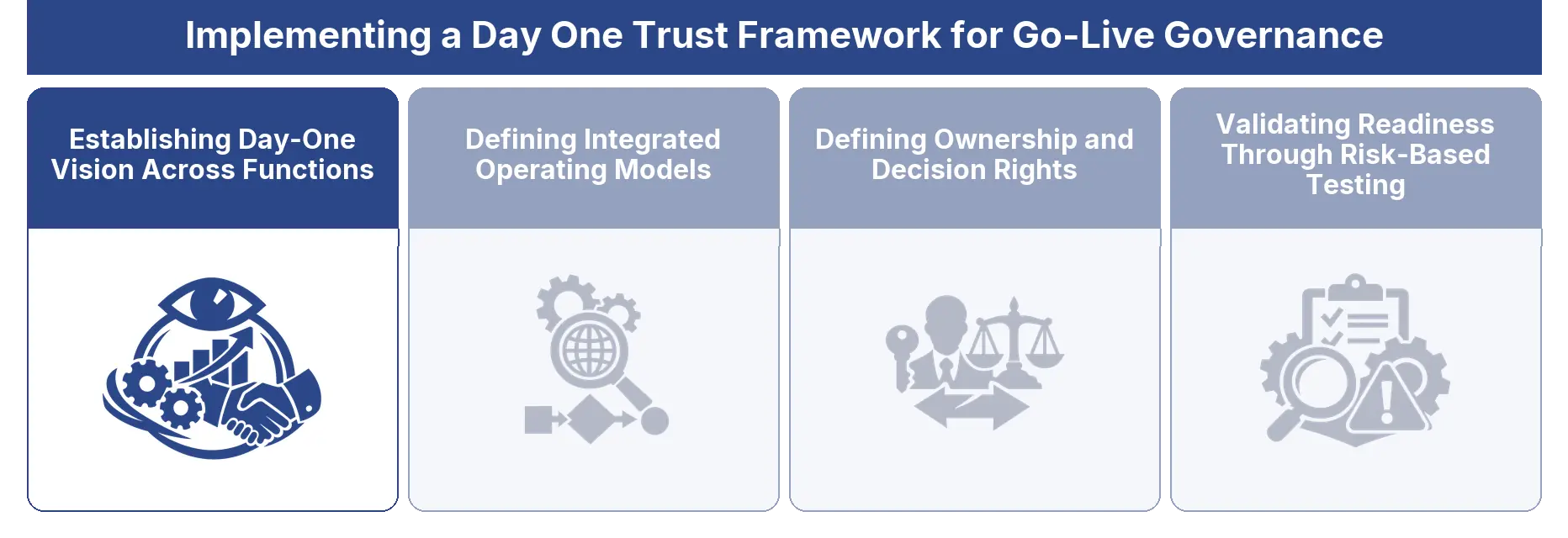
Cross functional Day One Vision anchors execution by specifying immediate actions across IT, operations, and risk management, and by codifying a target operating model that designates ownership on Day One and how decisions are made in the first 24 hours. The Google Wiz combination shows how preserving a core security capability enables rapid cross functional collaboration across finance, HR, and product leads following a close, and the roughly $32 billion valuation in that deal underscores the scale and risk involved. The IBM Red Hat arrangement reinforces the need to protect distinctive cultural boundaries while enabling a new operating rhythm. In practice, codify a short list of non negotiables and ensure visibility through a centralized Day One command forum, with governance forums convening in the first week post close. See Day One post merger framework for further grounding.
Defining Integrated Operating Models
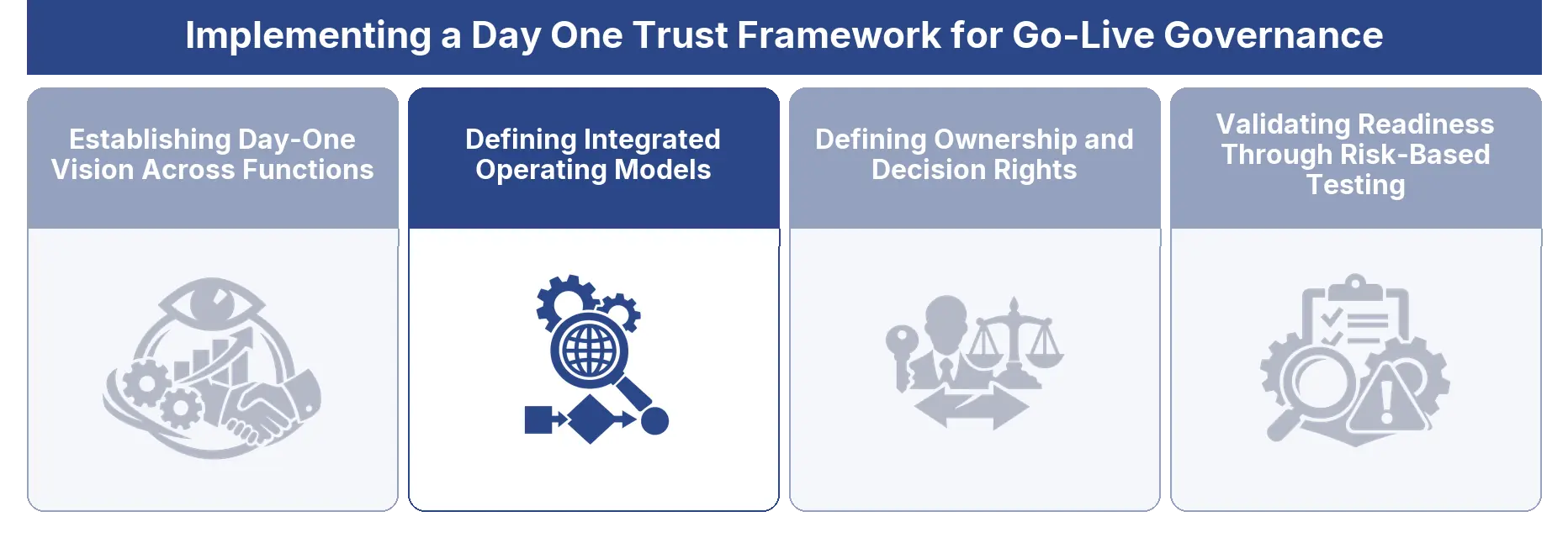
Defining integrated operating models means balancing continuity with targeted transformation. The objective is to preserve mission critical capabilities while establishing the mechanisms for higher velocity decisions in the post close period. IBM’s Red Hat acquisition illustrates the value of separating governance while preserving cultural openness that underpins open source collaboration, an approach that informs operating models that respect distinct unit strengths. In practice, map authority boundaries across functional streams, detail the operating rhythm, and set milestones that cap pace where necessary. The model should describe how IT, product, and GTM interact in the early weeks, how risk controls are exercised, and how data flows support real time decisions. The Dell EMC experience of portfolio harmonization under a single accountability framework provides a concrete benchmark for governance structure and escalation.
Defining Ownership and Decision Rights
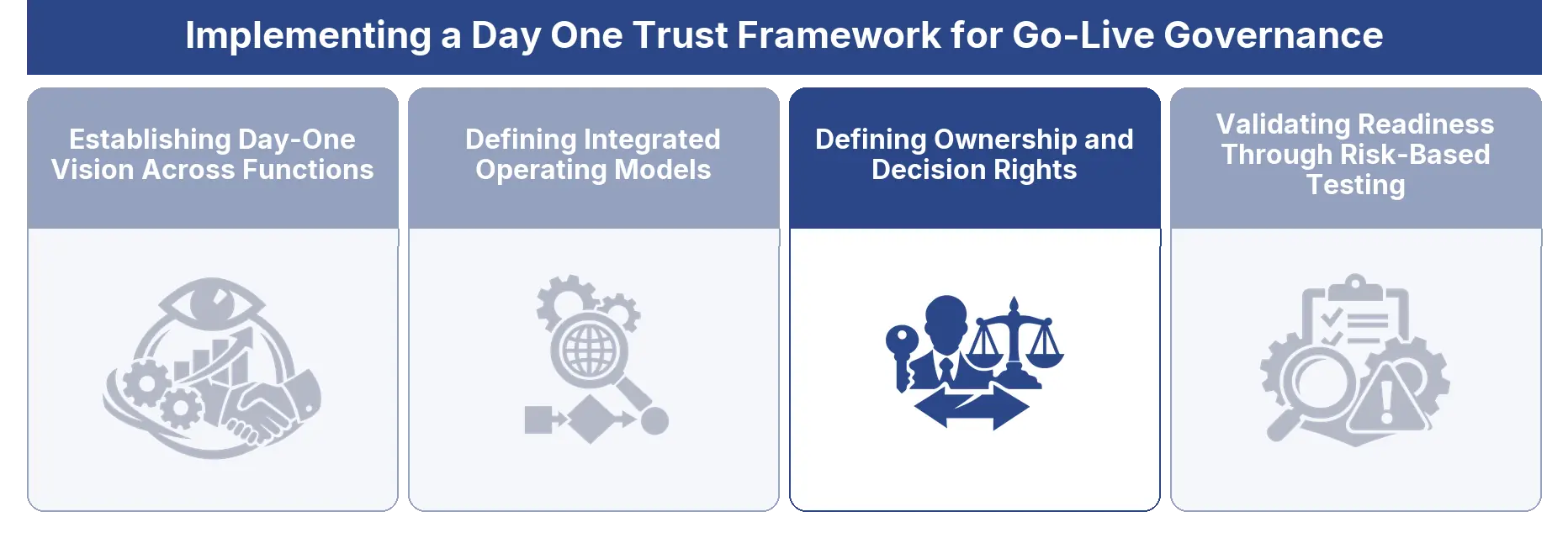
Clear ownership and decision rights are the backbone of Day One governance. A well defined structure prevents decision latency and aligns incentives with the overarching strategic thesis. The Salesforce Tableau integration shows how maintaining autonomy in critical domains while weaving governance around shared goals can sustain performance at go live. Large scale integrations like Dell EMC show the art of harmonizing disparate portfolios under a unified accountability framework. In practice, ownership should be codified in the IMO, with explicit authority levels for incidents and for strategic changes in GTM or product strategy. RACI clarity should translate into concrete, publicly communicated thresholds, ensuring Day One leadership can resolve issues quickly without re circulating requests through multiple committees.
Validating Readiness Through Risk Based Testing
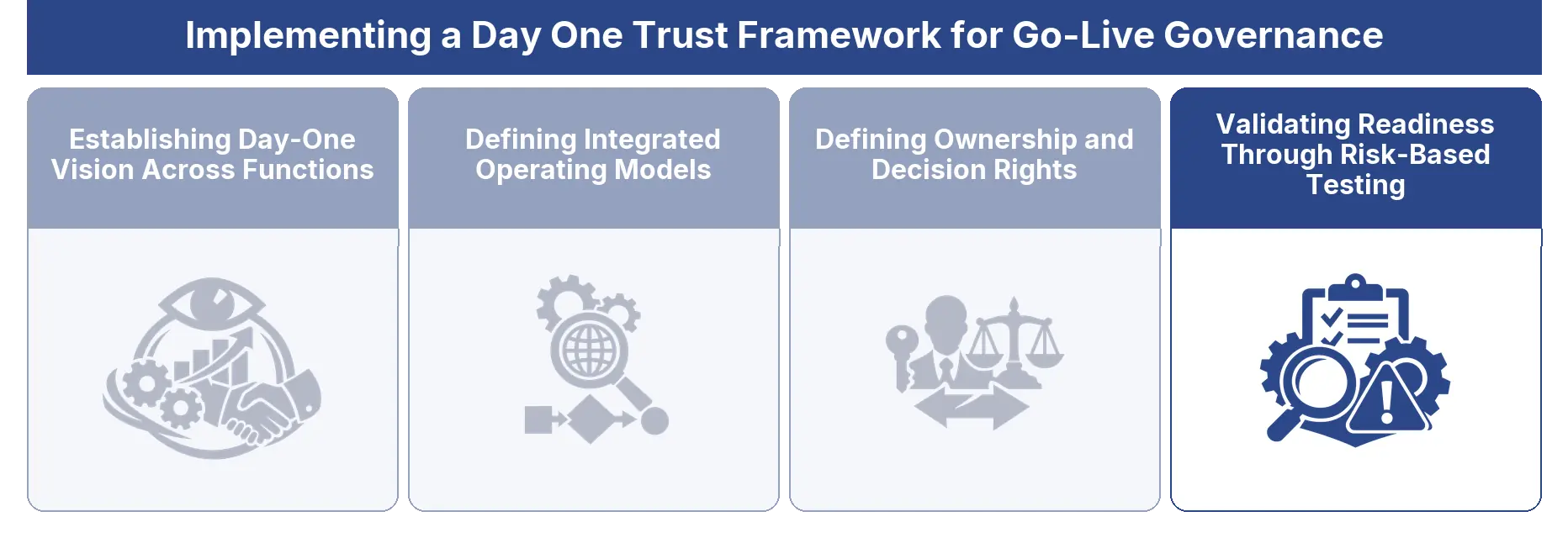
Readiness validation relies on risk based testing and a disciplined communication cadence. A disciplined approach to testing, prioritizing mission critical systems and data flows, reduces surprises during go live and supports customer trust. Go live literature highlights that many go lives stumble when testing is insufficient or communication is delayed; the risk is quantifiable, with risk governance correlating to success rates. A practical test regime should include live test runs of critical customer journeys, data integrity checks, and incident response drills conducted under Day One Command Center oversight. Transparent, regular communications with stakeholders, internally and with customers, should accompany testing, creating a credible narrative that supports trust on Day One and beyond. A structured Go Live Plan template anchors readiness and stakeholder alignment.
Synthesizing Day One Governance Into a Reusable Trust Framework Across Acquisitions
Day One trust is earned before the close through baselines that endure beyond signing. Grounded in pre-close readiness discipline, the Day One Vision anchors an operating design that mirrors disciplined governance, reducing fragmentation and preserving continuity for customers and employees. The four elements, stage-gate cadence, four-phase integration governance, phased separation program, and cross-functional integration rhythm translate the deal thesis into auditable transitions framework. When phase gates are explicit and owners accountable, execution remains aligned with the intended value mix, and the risk of disruption shortens the path from close to steady-state performance.
Looking ahead, disciplined practitioners implement Day One readiness baselines before signing, execute a Day One Vision across functions, deploy an auditable transition plan, establish Day One ownership before close, stand up the governance rhythm in week one, and codify escalation protocols to resolve blockers early. With governance in place, the organization can sequence dependencies in governance, govern handoffs with clarity, and operationalize the Day One requirements across people, processes, and systems, preserving customer continuity and sustaining value realization from Day One onward.

Get new articles by email
Insights on M&A, revenue growth, and business transformation, delivered occasionally.