
Capacity Leakage: Four Mechanisms to Harvest AI Released Capacity
In 2016, NICE completed its acquisition of inContact, a cloud contact-center provider, on November 14, marking a transaction whose economics depended on post-close decisions about work, systems, and service commitments. The official closing release confirms the transaction, but not AI savings, staffing reductions, or integration outcomes. Released capacity is not cash by itself. It can absorb growth, enable higher-value work, influence approved backfills, or support restructuring only after evidence and accountable decisions exist. Without that discipline, productivity becomes unclaimed capacity.
The tension is operational as much as financial: gross hours can disappear into review, rework, governance, or service protection before any value reaches the P&L. In a hypothetical B2B SaaS workflow, 1,000 gross hours released less 250 hours of review and rework produces 750 net hours, but the outcome remains unresolved until leaders allocate them deliberately. The question is not whether automation creates capacity, but whether governance can prevent that capacity from leaking away. How can released AI capacity be captured as measurable value without letting it leak away?
Released AI capacity should be managed through four explicit paths: absorbing growth without proportional hiring, redeploying people to higher-value work, managing attrition and approved backfills, and restructuring residual capacity after validation. A tracker should assign owners, evidence, timing, and financial classification, distinguishing capacity, avoided future cost, recurring expense reduction, and growth or service benefit. Integration governance keeps the record active until the decision is executed and measured. The practical standard is clear: redesign the work, document the choice, and measure what the business captures.

Grounding Capacity Realities
When NICE completed its acquisition of cloud contact center provider inContact on November 14, 2016, the transaction created a larger platform whose economics would depend on how work, capacity, and customer service were coordinated after closing, not simply on the purchase decision itself. The official closing release confirms the transaction, but it does not establish any staffing outcome, artificial intelligence savings, or integration benefit. That distinction matters because AI driven capacity release is often treated as immediate savings before anyone establishes what work disappeared, what work remains, and who owns the resulting capacity.
McKinsey’s research on productivity and work redesign supports a more disciplined premise: technology creates value only when organizations redesign activities and management practices around measurable outcomes. In growth SaaS and post merger environments, unbaselined capacity can therefore drift into the profit and loss statement as leakage. A reduction in activity may represent capacity, avoided future cost, actual recurring expense reduction, or a growth and service benefit. Those categories are economically different, and treating them as interchangeable produces overstated business cases.
A practical control system pairs value capture with explicit work redesign. It establishes the starting workload, validates the net capacity released after review and rework, assigns an accountable owner, and records the decision that converts capacity into value. The four harvest mechanisms are distinct:
| Mechanism | Decision trigger | Primary owner | Evidence and timing | Financial classification | |—|—|—|—|—| | Absorb growth without proportional hiring | Demand rises while validated capacity remains available | Business leader | Capacity forecast and hiring plan, before requisition approval | Avoided future cost or growth benefit | | Redeploy to higher value work | Existing work is reduced and priority work has a measurable gap | Functional leader | Approved allocation and output measure, during redesign | Capacity and service benefit | | Manage attrition and approved backfills | Roles become vacant after work reduction is validated | Finance and business leader | Attrition record and backfill decision, at vacancy | Actual recurring expense reduction only if the role is not replaced | | Restructure residual capacity after validation | Capacity remains after absorption, redeployment, and attrition choices | Executive sponsor and Integration Management Office (IMO) | Organization decision and effective date, after validation | Recurring expense reduction, including contractor elimination where executed |
Hypothetical B2B SaaS workflow example: 1,000 gross hours released, less 250 hours of review and rework, produces 750 net hours. The operating decision allocates 300 hours to growth, 250 to higher value work, 150 to attrition or approved backfill management, and 50 to restructuring. The allocation sums to 750, but it does not create cash automatically. Cash recognition requires an executed cost decision, while growth and service benefits require separate operating measures. The usable artifact is a capacity ledger linking baseline, owner, evidence, decision, timing, and financial classification. That ledger turns an appealing automation narrative into a controlled margin decision.
Highlighting Hidden Leakage Risks
Efficiency gains often appear complete when a dashboard records fewer minutes per task, yet the economic result remains unresolved. Released capacity does not become margin uplift merely because an artificial intelligence tool reduces handling time; it becomes value only when an owner connects the capacity to a defined outcome, such as additional growth, higher service levels, avoided hiring, or an executed expense reduction. Research on leakage and privacy at inference time reinforces the broader control problem: value and risk can escape at the point where information moves through a system, unless governance makes those flows visible.
The distinction matters because capacity, avoided future cost, recurring expense reduction, and growth benefit are different financial classifications. A team that absorbs additional demand without proportional hiring may create operating leverage, but it has not necessarily reduced the current cost base. A team that redeploys capacity to higher value work may improve retention or revenue conversion, yet that benefit requires a separate operating measure. Earlier analysis of hidden integration costs applies the same discipline: projected value should remain separate from the costs and decisions required to realize it.
Consider a clearly labeled hypothetical B2B SaaS workflow example. Automation releases 1,000 gross hours, while review and rework consume 250 hours, leaving 750 net hours. Management allocates 300 hours to growth, 250 to higher value work, 150 to attrition and approved backfills, and 50 to restructuring. The allocation is complete, but cash recognition is not. Only an executed hiring decision, contractor termination, role elimination, or other approved cost action converts a portion into recurring expense reduction; the growth and service allocations require commercial or operational evidence instead.
Leakage emerges when no tracker records the baseline, net capacity, decision path, accountable owner, evidence, and timing. NIST guidance on identity and access management controls illustrates why control ownership and monitoring must operate together: visibility without assigned responsibility does not produce intervention. The same principle governs capacity harvesting. A single ledger should distinguish the four mechanisms, absorb growth without proportional hiring, redeploy to higher value work, manage attrition and approved backfills, and restructure residual capacity after validation, while recording vendor or contractor elimination as a cost lever within one of those paths. Without that discipline, apparent AI savings remain stranded capacity, and stranded capacity gradually leaks into margin.
Implementing Four Harvest Mechanisms
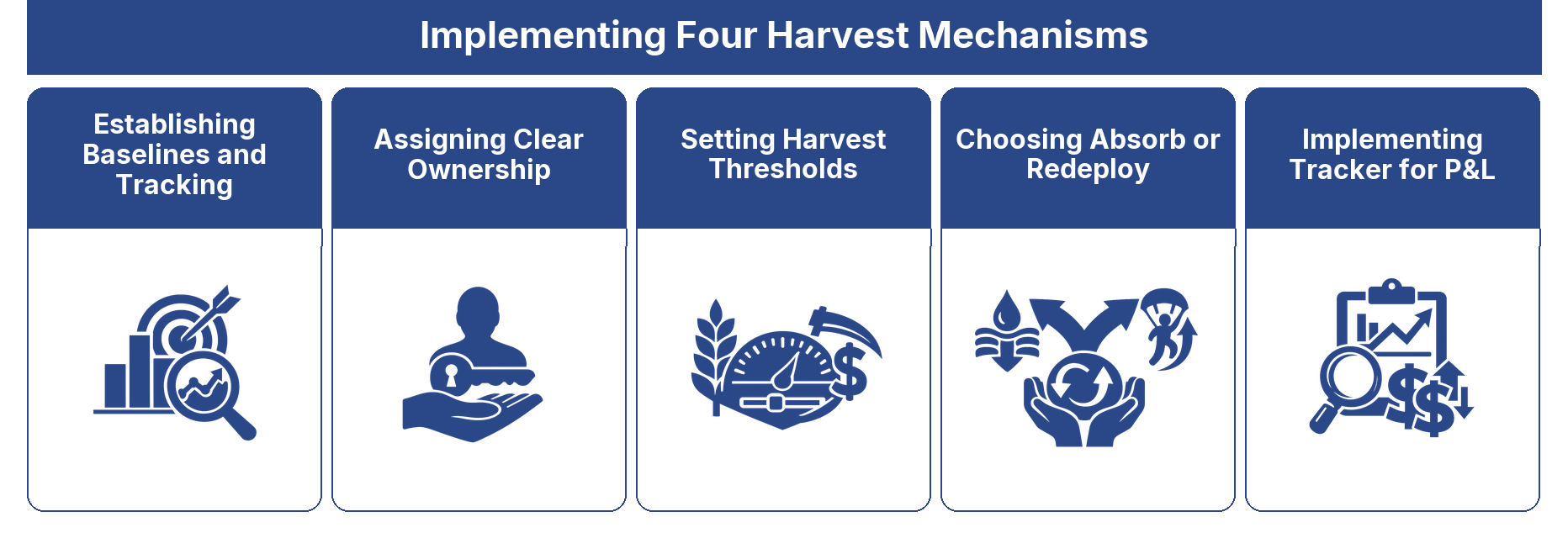
Capacity harvesting begins with a ledger, not a finance estimate. The ledger must distinguish released capacity from avoided future cost, actual recurring expense reduction, and growth or service benefits. Deloitte’s research on harvesting outcomes reinforces the importance of connecting operational outcomes to accountable owners and measurable evidence. The Integration Management Office (IMO) should maintain that connection through one controlled tracker, while functional leaders make the decisions that convert capacity into value.
The four mechanisms are distinct. Organizations can absorb growth without proportional hiring, redeploy released capacity to higher value work, manage attrition and approved backfills, or restructure residual capacity after validation. Vendor and contractor elimination belongs within the selected path as a cost lever, not as a fifth mechanism. The operating controls below determine how each pathway is selected, evidenced, and reflected in profit and loss.
| Mechanism | Decision trigger | Accountable owner | Required evidence | Timing | Financial classification | |—|—|—|—|—|—| | Absorb growth without proportional hiring | Demand rises while service levels remain protected | Business unit leader | Volume, service, and capacity forecasts | Monthly or quarterly | Growth or avoided hiring cost | | Redeploy released capacity to higher value work | Strategic priorities require capability elsewhere | Portfolio or functional leader | Approved role, workload, and output measures | At workforce planning gates | Capacity reallocation and growth benefit | | Manage attrition and approved backfills | Vacancies occur after capacity is validated | Functional leader and finance partner | Vacancy, performance, and backfill approval data | At each vacancy event | Avoided recurring cost if backfill is denied | | Restructure residual capacity after validation | Capacity remains after demand and redeployment decisions | Executive sponsor and human resources leader | Sustained variance, alternatives, and consultation records | After the validation period | Actual recurring expense reduction |
Establishing Baselines and Tracking
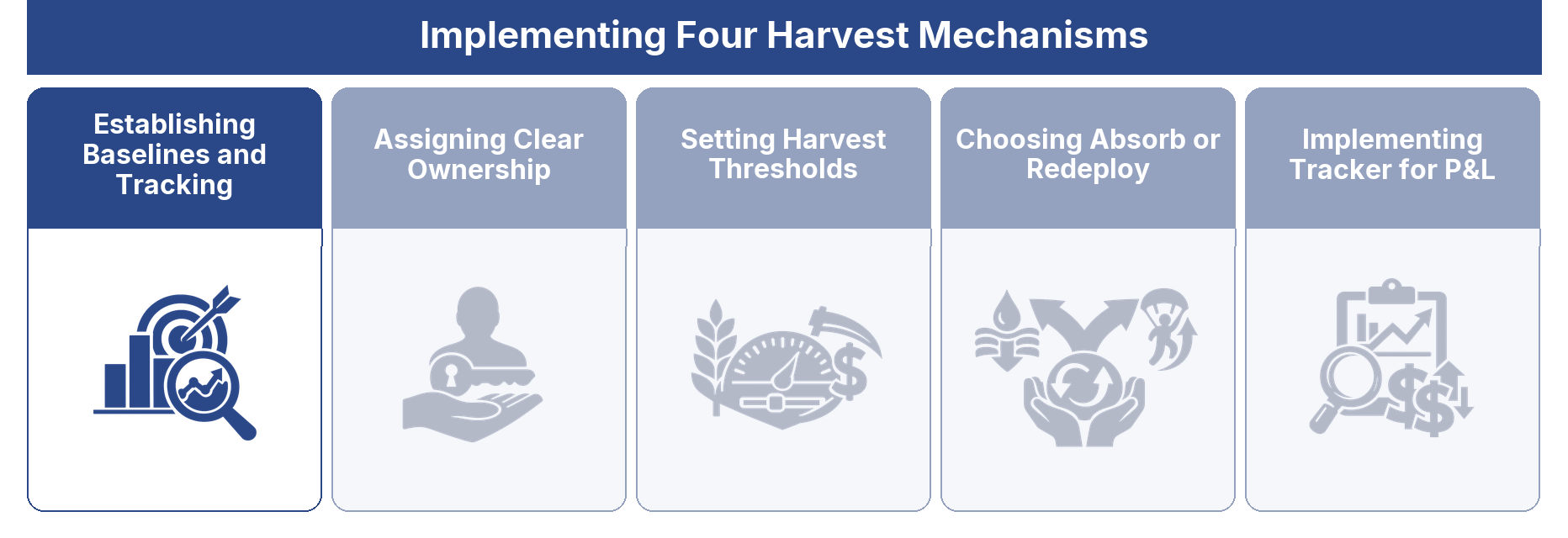
The baseline should capture workload volume, cycle time, quality, staffing, contractor spend, service levels, and recurring cost before any intervention. Gross hours released cannot be treated as value until review and rework are deducted. In the required workflow example, 1,000 gross hours released less 250 hours of review and rework produces 750 net hours. That result belongs in the centralized IMO tracker with an owner, source system, measurement date, and confidence status.
A responsibility matrix for accountability can connect each data field to a decision owner, preventing the tracker from becoming a passive reporting file. The baseline is the reference point, not the benefit claim.
Assigning Clear Ownership
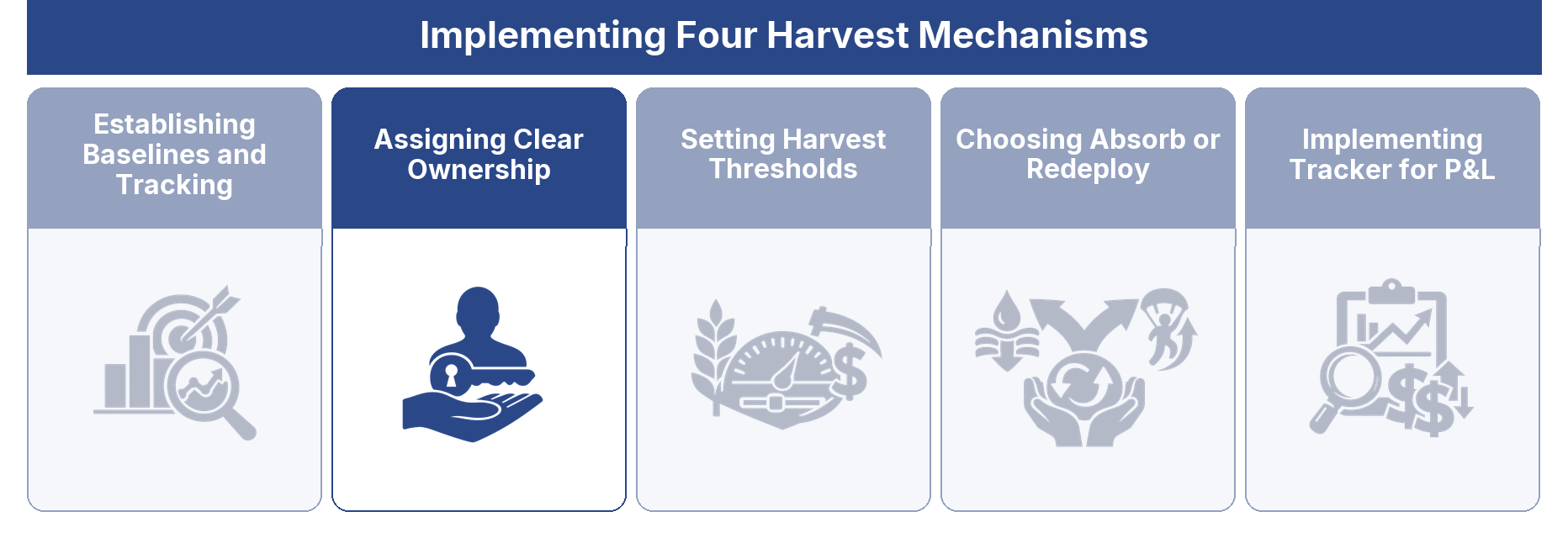
Each pathway requires a named decision right. The operations leader should own service and workload evidence, finance should validate cost treatment, human resources should govern workforce actions, and the executive sponsor should resolve trade offs across functions. The IMO coordinates the cadence and escalates exceptions; it should not quietly absorb accountability that belongs to the business.
In the example, 300 of the 750 net hours could support growth, 250 could support redeployment, 150 could offset attrition and approved backfills, and 50 could enter restructuring review. Those allocations describe capacity decisions, not cash realization. No hours to cash claim exists until an approved cost action is executed.
Setting Harvest Thresholds
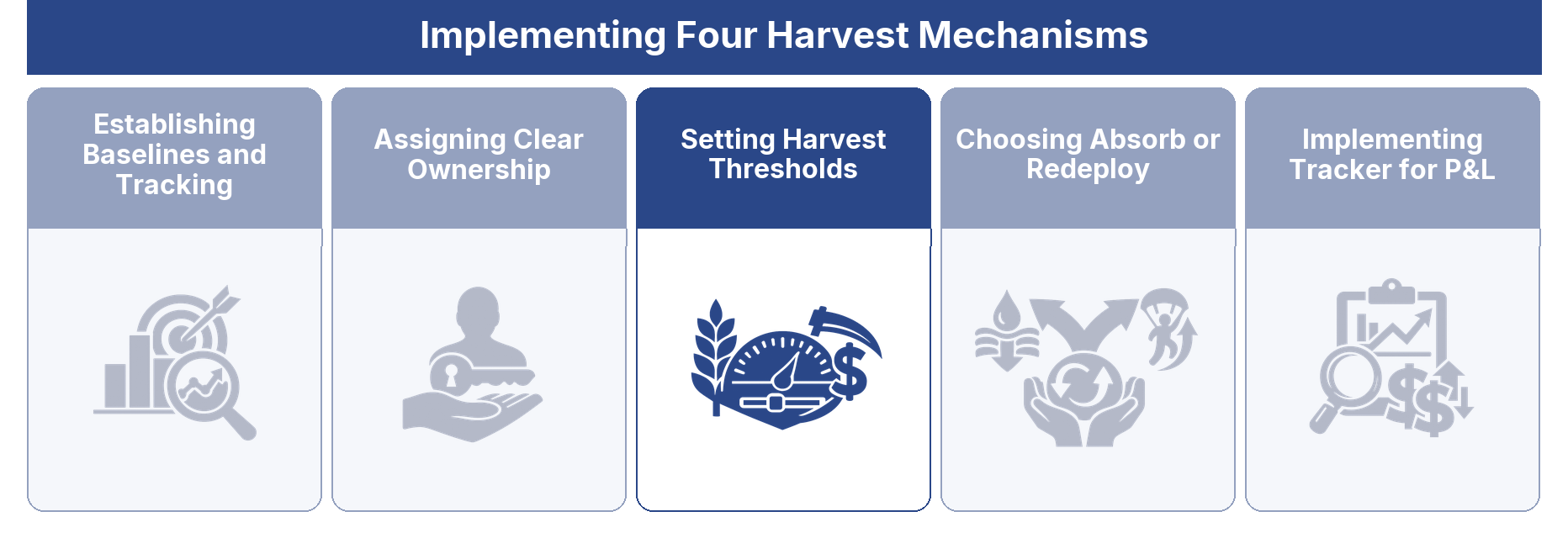
Thresholds convert judgment into repeatable decisions. A business unit may define minimum service performance, quality tolerance, demand persistence, and utilization levels that must hold before capacity moves between pathways. Each threshold should include a measurement period, an escalation rule, and a named approver.
A three month validation window, for example, may be appropriate where demand is seasonal, while a shorter cycle may fit stable transaction work. The duration must reflect operating volatility rather than administrative preference. If quality falls below the agreed threshold, the proposed harvest pauses and the tracker records the variance.
Choosing Absorb or Redeploy
The choice between absorption and redeployment depends on demand, strategic fit, execution risk, and the organization’s appetite for near term flexibility. Absorption is appropriate when growth is credible and existing teams can protect service levels without sustained overload. Redeployment is stronger when another approved priority has measurable demand and requires capabilities already present in the released capacity.
The NICE acquisition of cloud contact center provider inContact, completed on November 14, 2016, provides a relevant context for examining contact center workflow economics, although the public closing release does not establish any specific staffing or AI outcome. In such environments, leaders would need to test volume, quality, response time, and escalation data before selecting a pathway. The mechanism follows the evidence.
Implementing Tracker for P&L
The tracker should link every allocation to a financial classification: capacity available, avoided future cost, actual recurring expense reduction, or growth and service benefit. It should also record decision date, owner, baseline, threshold result, approval, implementation status, and finance confirmation. This structure prevents a redeployment from being reported as a saving or an approved vacancy from being counted as a realized reduction.
The IMO should review the tracker at a fixed governance cadence, with unresolved items escalated through phase gates. Finance closes the loop only when the operating decision appears in the relevant budget, forecast, or ledger. The final artifact is therefore both a capacity register and a decision log, with the next decision made from verified evidence rather than released hours optimism.
Synthesizing Capacity Harvest Across the Series
A post close dashboard can report productivity gains while service levels deteriorate, creating a dangerous decision point: finance sees apparent capacity, operations sees a growing queue, and a hiring freeze is lifted because no one can verify where the released time went. The problem is not whether automation reduced handling time. It is whether the organization absorbed the capacity through demand growth, lost it to review and exception work, or misclassified it as durable excess. NICE’s 2016 acquisition of inContact provides useful context for applying that discipline, but no public evidence establishes specific post close artificial intelligence savings, staffing actions, or capacity decisions from the transaction. The relevant lesson is therefore operational rather than transactional: capacity becomes value only when its destination is documented and tested.
The operating sequence should begin with service protection and absorption. If demand remains persistent and service levels hold across two consecutive reporting cycles, released capacity can support growth without proportional hiring, provided that review effort, escalations, customer protection work, and rework remain visible. Leaders should then test redeployment against capability fit, because moving nominal capacity into higher value work can create a second queue of training, supervision, and quality control demands when skills do not transfer cleanly. Controlled attrition and approved backfills may offer a more credible path than forcing an artificial redeployment decision. Restructuring should remain the final option, considered only after a defined validation period demonstrates durable excess capacity rather than temporary relief.
A capacity ledger should connect the starting workload to the actual disposition of released time, distinguishing productive absorption from work that automation merely shifts into review, exception handling, or escalation. Each movement requires an accountable owner, a measurable outcome, and a decision date, so that finance can distinguish recurring savings from avoided hiring and operations can challenge assumptions before service deteriorates. NICE can be used as a hypothetical context for this test, not as evidence that the transaction produced a particular result. The practical verdict is straightforward: protect service, validate persistence, test capability fit, and restructure only when the evidence survives the operating cycle. Do not let reported productivity gains outrun the decision about where the capacity will go.

Get new articles by email
Insights on M&A, revenue growth, and business transformation, delivered occasionally.