
An AI Value Tracker: Seven Questions to Lock in Redesign Before You Announce Savings
In August 2022, enterprise software company OpenText announced its planned acquisition of Micro Focus and forecast $400 million in cost synergies, including $300 million from Micro Focus’s previously announced cost program and $100 million of additional synergies, as stated in the official acquisition announcement. The disclosure was a forecast, not evidence of realized savings, and it exposed a control challenge that applies equally to artificial intelligence initiatives. Finance leaders had to distinguish inherited commitments from genuinely incremental value before treating any benefit as new. The distinction becomes more difficult when redesigned work, hiring avoidance, redeployed capacity, and cash savings appear in the same plan.
Headline savings can obscure whether the underlying work has changed, whether service and risk guardrails remain intact, and whether the same benefit has been claimed through multiple channels. In fast-moving software organizations and post-merger integrations, weak baselines and unclear ownership turn targets into abstractions that resist audit and reversal. A credible value case therefore requires explicit decisions, evidence, and finance sign-off before savings enter performance reporting. What seven questions should leadership answer to lock in redesign before announcing AI driven savings?
The answer is a CFO-ready tracker that connects each initiative to a baseline, counterfactual, accountable owner, quality guardrail, harvest decision, and recognition rule. Its purpose is not to repeat general AI return on investment commentary, but to make redesigned work and net financial benefit traceable from forecast through commitment and realization. The discipline also prevents double-counting inherited cost programs, redeployed hours, hiring avoidance, and cash savings. Leadership can then convert seven explicit questions into an auditable artifact that governs value capture across growth initiatives and integration workstreams.

Establishing Baseline Metrics for AI Value
A CFO can discover the problem in a single synergy review: the headline benefit appears substantial, yet part of it reflects an inherited cost program, part reflects avoided hiring, and part reflects capacity that has merely moved elsewhere. OpenText’s 2022 acquisition of Micro Focus illustrates the control challenge. OpenText forecast $400 million in cost synergies, including $300 million from Micro Focus’s previously announced cost program and $100 million of additional synergies. The figure was a forecast, not proof of realized savings, but it demonstrates why a baseline must distinguish redesigned work, enabled capability, and cash benefit before management assigns an owner or resizes the organization.
The CFO ready baseline should therefore define not only the current state, but also the counterfactual, the harvest decision, and the evidence required to recognize value. A workflow that reduces handling time does not create a financial benefit until leadership decides whether the released capacity will support growth, reduce overtime, avoid planned hiring, or reduce headcount; the decision must then persist through a defined measurement period, while downstream review confirms that another team has not absorbed the claimed gain through exception handling or remediation. NIST’s repeatable evaluation guidance supports this discipline by treating use cases and metrics as explicit evaluation objects rather than informal claims. The minimum control is consequently clear: no recognition without a documented harvest decision, an accountable owner, stable operating evidence, and finance sign off.
AI adds a further test because first pass automation can release apparent capacity while creating hidden review work. If a support team handles 1,000 cases in a period and an AI workflow reduces initial handling from six minutes to four, the apparent saving is 33 hours; if the system sends 15 percent of cases into an additional three minute review queue, however, 7.5 hours return as exception work, leaving 25.5 hours before training, tooling, oversight, and quality costs. Finance should recognize value only after service levels, accuracy, escalation rates, remediation effort, and customer outcomes remain within agreed thresholds across the measurement period. The tracker should make that decision visible by recording what work changes, which baseline and counterfactual apply, who owns the result, where released capacity will go, and what net benefit survives cost to achieve and attribution checks. Earlier technology enabled GTM alignment makes the same strategic distinction: technology creates value only when it advances a defined business outcome.
The resulting artifact can remain a single tracker, but it should function as an appendix to the operating decision rather than as a checklist inserted ahead of it. Each row needs a benefit ID, a forecast, committed, or realized status, an evidence link, a quality and risk guardrail, a named owner, a harvest decision, and a reversal trigger; the financial bridge should separately show reduced effort, avoided hiring, redeployed capacity, and cash savings so that overlapping programs cannot claim the same gain. OpenText’s disclosure reinforces the point: inherited cost programs, new synergies, and operational savings require separate attribution even when they support one headline target. Do not resize the organization until the redesigned work survives quality, attribution, and persistence tests.
Navigating Growth and Integration Tensions
OpenText’s August 2022 announcement forecasting $400 million in cost synergies from its acquisition of Micro Focus illustrates why savings announcements require attribution controls: the forecast included $300 million from Micro Focus’s previously announced cost program and $100 million of additional synergies. That disclosure did not establish realized savings, and it did not support an artificial intelligence claim. Without a clear baseline, inherited cost actions, hiring avoidance, redeployed hours, and cash savings can be counted twice. AI adds a distinctive complication because variable model quality can release apparent capacity while increasing review, exception handling, remediation, and customer support work. Leadership therefore risks recognizing gross capacity as savings before operating teams have demonstrated that the work has actually disappeared.
Growth creates a related tension because the harvest decision determines whether AI changes the financial thesis or merely shifts capacity between operating needs. A software company that avoids planned hires after automating renewal risk triage may report lower expense, but a company that redeploys the same capacity to improve service coverage may generate more retention and expansion while preserving its growth investment. Those outcomes require different baselines, owners, and evidence. Analysis of 10,897 publicly held U.S. companies found that top quartile companies grew at an inflation adjusted average of 11.8% annually, while the lower three quartiles averaged 0.3% growth, according to research on sustained growth. Organization design must therefore keep pace with the deal thesis, because organization design can determine deal success, while cultural signals require early attention to prevent misalignment.
Leadership should not announce savings until the redesign, attribution, and capacity harvest decisions are documented. The control is a single, auditable tracker owned jointly by the Integration Management Office (IMO), the operating executive, and Finance, with each benefit tied to a unique identifier, current state baseline, counterfactual, owner, and approval path. The tracker should also record model quality, exception rates, remediation hours, customer impact guardrails, and the destination of released capacity, extending the discipline described in structuring diligence for integration. Those fields prevent a common AI failure mode: treating a faster first pass workflow as a net benefit when downstream review consumes the apparent gain. Finance should recognize a committed or realized result only after evidence shows that gross capacity released exceeds implementation cost, retained service capacity, remediation work, and any benefit already embedded in an inherited program.
A clearly labeled hypothetical B2B SaaS workflow row could read: Benefit ID AI 017, automated renewal risk triage; status, forecast; owner, Chief Customer Officer; evidence link, approved workflow log and quality review; finance sign off, pending; reversal trigger, customer escalation rate exceeding the agreed guardrail. The gross to net bridge would show whether the released capacity supports service coverage, avoids hiring, or funds another growth priority, rather than assuming that all available hours become margin. That distinction turns growth and integration from competing mandates into governed decisions. Earlier analysis of people and process alignment reinforces the operating principle: document the baseline, assign the owner, and test the guardrails before counting the benefit. Management is authorized to resize only when the work has changed and the evidence holds.
Implementing the AI Value Tracker Framework
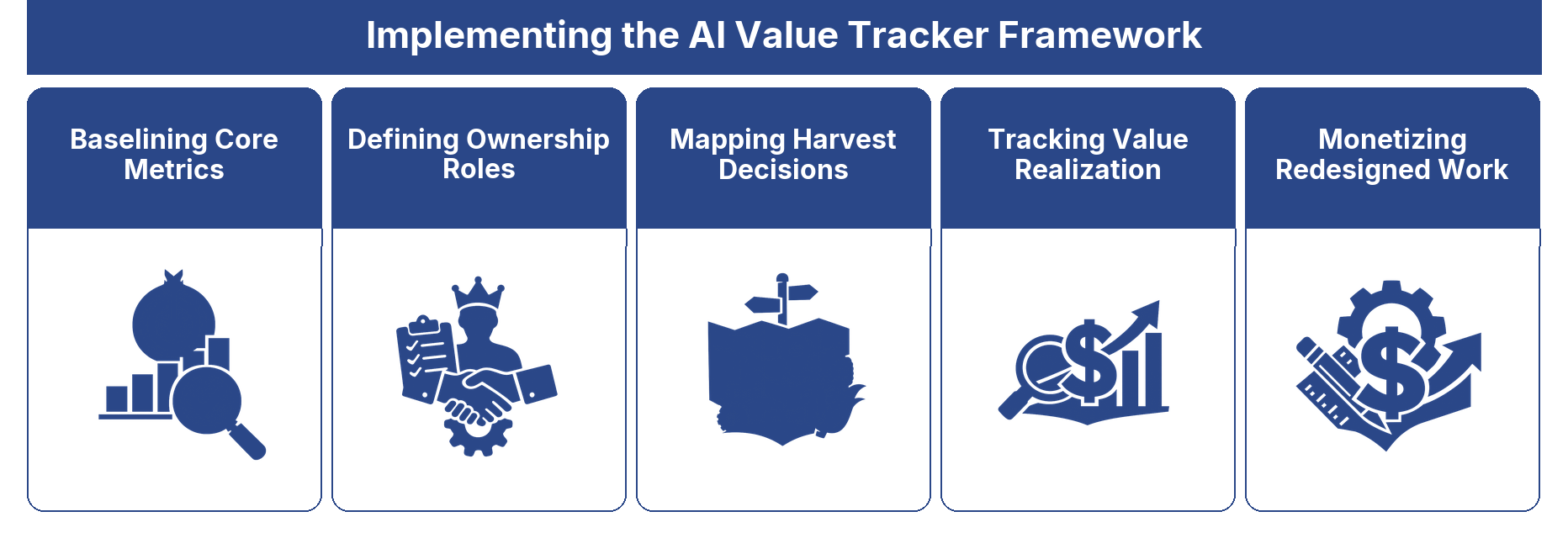
A usable tracker converts an AI redesign from an efficiency promise into an auditable chain of decisions. The sequence begins with a metric baseline, assigns ownership, distinguishes durable harvest decisions from temporary capacity release, measures performance against an agreed reference, and translates validated improvement into margin or cash flow. Research on operating model requirements reinforces the same principle: value depends on how work, decision rights, and accountability are redesigned together.
The tracker should function as a control document, not a dashboard populated after savings have been announced. Earlier continuous improvement disciplines support a recurring review rhythm, while people and process alignment keeps capacity decisions connected to service quality and organizational readiness.
Baselining Core Metrics
The baseline records the current volume, cycle time, labor effort, cost, quality level, service commitment, and demand pattern for the activity being redesigned. It also records the counterfactual, meaning what would likely have occurred without the intervention, because a reduction in work volume may reflect lower demand rather than better productivity. Each measure needs a period, data owner, source system, and inclusion rule.
The tracker should distinguish gross capacity release from net financial benefit. A redesigned workflow may release 10,000 annual hours, yet produce no cash benefit if those hours support growth, remain unfilled, or require expensive controls. BCG’s research on AI enabled engineering excellence supports measuring changes in engineering outcomes, not merely tool adoption.
Defining Ownership Roles
Every initiative needs one accountable owner for the work redesign and one accountable owner for financial recognition. Product owns customer and workflow outcomes; engineering owns system performance, controls, and technical debt; finance owns the benefit logic, attribution, and recognition status; and the Integration Management Office (IMO), when applicable, governs dependencies, decisions, and escalation.
The tracker should identify contributors without diffusing accountability. A named owner approves the baseline, confirms the redesigned process, maintains evidence, and accepts the reversal trigger. Finance should not recognize a benefit because a team reports released hours, and the IMO should not declare success because a milestone closed. Each function must sign the portion it controls.
Mapping Harvest Decisions
The central decision is where validated capacity goes. Options include reducing external spend, avoiding planned hiring, accelerating product delivery, improving customer coverage, or absorbing demand without incremental cost. The tracker must record one primary harvest decision, its timing, its expected financial pathway, and the executive who approved it.
The OpenText announcement regarding its 2022 acquisition of Micro Focus forecast $400 million in cost synergies, comprising $300 million from Micro Focus’s previously announced cost program and $100 million of additional synergies, as stated in the official synergy disclosure. The disclosed figure was a forecast, not evidence of realized savings. It demonstrates why inherited programs require a unique benefit ID, explicit attribution, and protection against double counting.
Tracking Value Realization
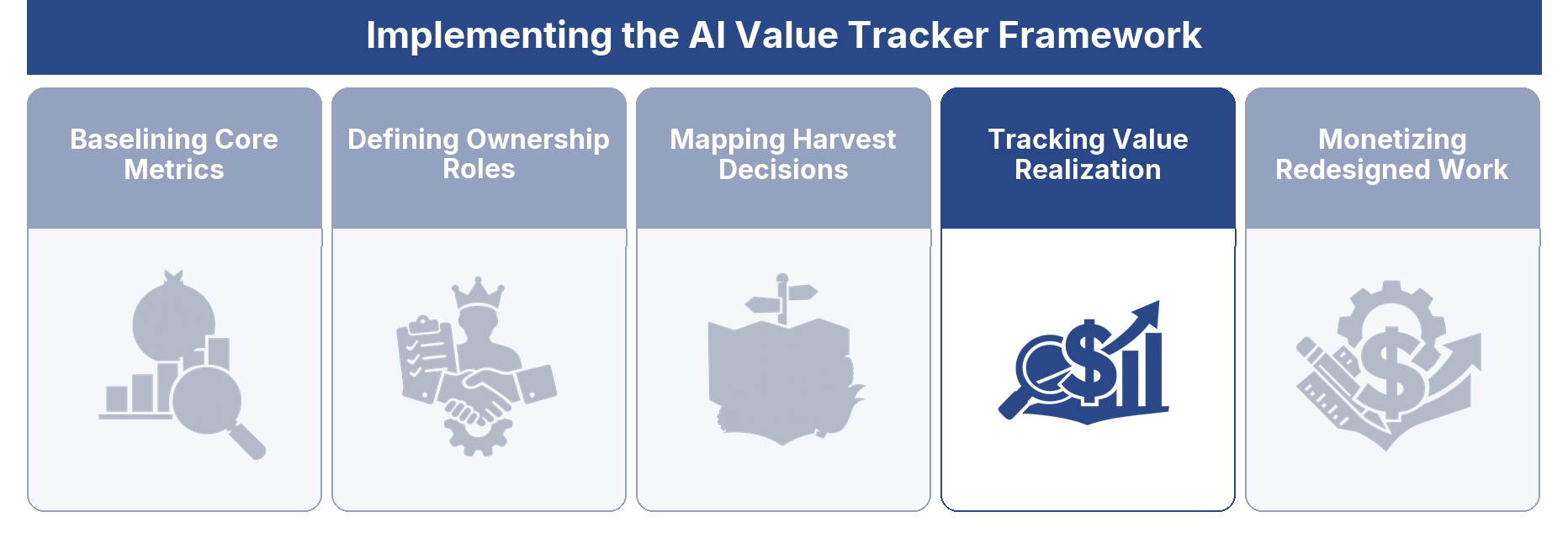
The tracker should use three statuses: forecast, committed, and realized. Forecast means the hypothesis has an owner and model; committed means the decision and funding or staffing action has been approved; realized means evidence shows that the result persisted through the measurement period. Each status requires a date, evidence link, finance sign off, and reversal trigger.
The CFO ready checklist should contain exactly these seven questions:
1. What work changes? 2. What baseline and counterfactual apply? 3. Who owns the decision and result? 4. What quality/risk guardrails must hold? 5. Where will net released capacity go? 6. What net financial benefit survives cost to achieve and attribution checks? 7. What evidence and sign off permit recognition and ongoing sustainment?
A filled hypothetical B2B SaaS workflow example makes the control logic concrete:
| Field | Example | |—|—| | Benefit ID and workflow | AI 017, renewal risk triage | | Status | Committed | | Gross benefit | 1,200 analyst hours annually | | Gross to net bridge | 1,200 hours, less 250 hours of review and control work, less 300 hours already counted in an inherited cost program, equals 650 attributable hours | | Harvest decision | Redeploy 650 hours to renewal coverage, with no hiring avoidance counted | | Evidence and sign off | Ticket volume report, quality audit, Finance approval | | Reversal trigger | Quality score below the agreed threshold for two consecutive periods |
Monetizing Redesigned Work
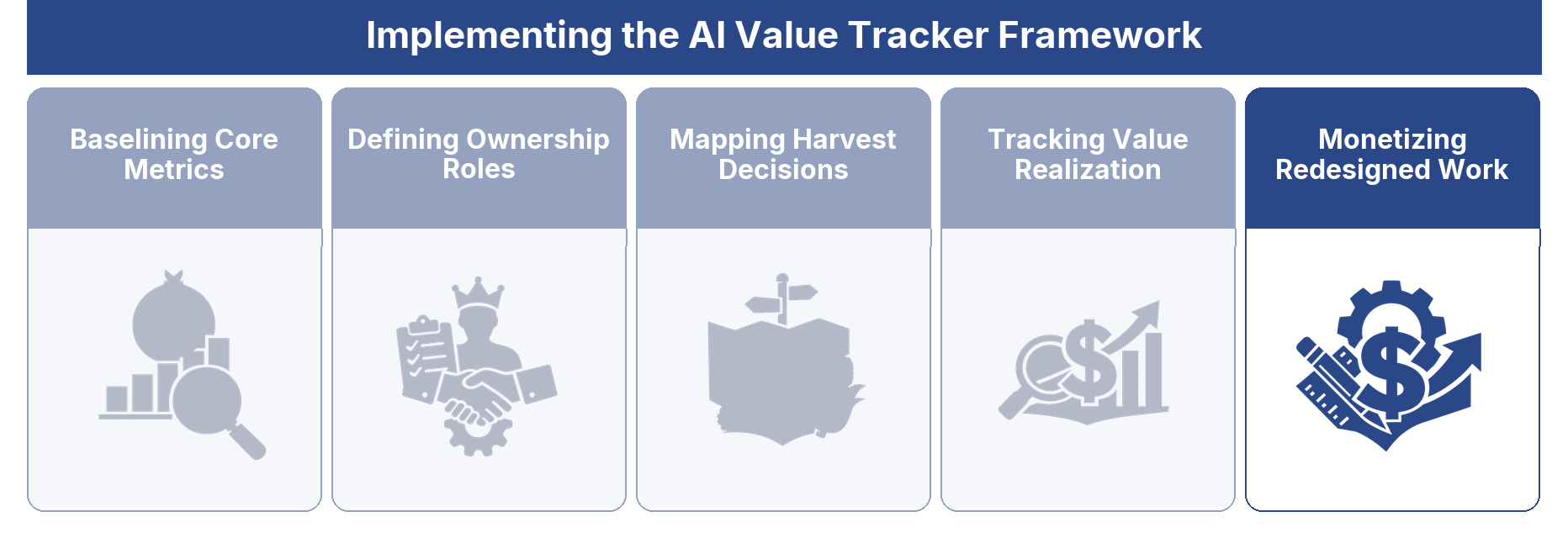
Monetization follows the evidence rather than preceding it. Finance should translate validated outcomes into avoided spend, incremental margin, deferred hiring, or cash improvement only when the operating decision creates that result. Redeployed hours remain capacity value unless management documents how they improve revenue, reduce external cost, or prevent an approved expense.
The final tracker should preserve the gross to net bridge, cost to achieve, attribution notes, evidence link, sign offs, and reversal trigger in one record. The result is a durable audit trail that separates forecast from commitment, commitment from realization, and released capacity from cash savings. The governing decision is simple: recognize only the benefit that survives ownership, quality, attribution, and sustainment checks.
Operationalizing the AI Value Tracker Across Your Portfolio
An AI enabled redesign earns financial credibility only when the operating change, enabling capability, and expected synergy remain connected from decision through recognition. The OpenText forecast for Micro Focus demonstrates why that chain requires attribution discipline: inherited savings and incremental synergies must remain distinct, and a forecast must not be presented as realized benefit or as evidence of AI impact. A CFO ready tracker turns that distinction into operating control by assigning ownership, testing counterfactuals, protecting quality and risk thresholds, and showing where released capacity will go. The result is not another efficiency narrative. It is an auditable record of how value is created, verified, and sustained.
With this in place, executives can take a concrete artifact into Monday morning: a seven question initiative tracker with a unique benefit ID, a filled workflow row, a gross to net bridge, status definitions, evidence links, finance sign off, and a reversal trigger. The disciplined practitioner should establish the baseline and owner before announcing savings, codify the guardrails and attribution rules before counting benefit, instrument evidence collection throughout execution, and operationalize review at each recognition point. Finance and operating leaders can then ratify only the value that survives cost to achieve, double counting, and sustainment tests. The standard is simple: redesign the work, prove the result, and resize only after the evidence earns the decision.

Get new articles by email
Insights on M&A, revenue growth, and business transformation, delivered occasionally.