
Redesign Before You Resize: Establishing an AI Synergy Framework to Capture Value
On March 5, 2021, SAP completed its acquisition of Signavio, adding the company to SAP’s Business Process Intelligence portfolio to complement process transformation. The documented transaction offers a useful analytical starting point for AI-led value creation: process visibility must precede automation, because leaders cannot redesign a workflow that has not been mapped or measured. In B2B SaaS and post-merger environments, the pressure to resize often arrives before the organization understands cycle times, handoffs, service obligations, or the cost of achieving change. That sequence turns a potential redesign into a headcount exercise.
A hypothetical B2B SaaS renewal workflow makes the risk concrete: automating account reviews may reduce manual activity, yet still weaken retention if ownership, escalation paths, and customer service guardrails remain undefined. Without a baseline, an accountable owner, and a harvest milestone, projected savings become assertions rather than investment evidence. How can executives ground AI value in measurable capture before resizing the organization?
Durable value comes from linking workflow boundaries, current performance, change hypotheses, owners, service guardrails, cost-to-achieve, intended benefits, and scale or stop gates in a single operating artifact. That discipline shifts the decision from whether to cut roles to whether redesign has produced credible margin, cycle-time, or revenue improvement. The practical test is whether each proposed action can survive an evidence review before capital, capacity, and organizational scope are changed.

Collecting Baseline Metrics
SAP’s completion of the Signavio acquisition on March 5, 2021, placed Signavio within SAP’s Business Process Intelligence portfolio to complement process transformation, a documented strategic fact that supports an important analytical application: process visibility should precede automation. It does not establish any realized artificial intelligence savings. The same discipline applies to integration work, where baseline benchmarking reveals value levers that staffing plans alone cannot capture, including rework reduction, faster approvals, improved throughput, and earlier revenue conversion.
A useful baseline should measure four outcomes: margin impact, cycle time, throughput, and revenue acceleration. The measures should connect directly to the workflow boundary under review, rather than aggregate activity across an entire function. The NIST perspective on performance measurement reinforces the need to evolve measurement with the operating model, while McKinsey’s discussion of rewiring organizations for AI supports linking technology adoption to redesigned work, not to isolated tool deployment. A baseline therefore records current performance, cost drivers, handoffs, exception rates, and service constraints before any change hypothesis is approved.
Consider a hypothetical B2B Software as a Service renewal workflow. The one page synergy hypothesis charter might record a current renewal cycle time of 18 business days, a 72 percent on time completion rate, three manual approval handoffs, and a defined cost per renewal transaction, provided those figures come from validated operating data. The proposed change could automate account risk summarization and route exceptions earlier, with intended benefits expressed as shorter cycle time, higher throughput, protected gross margin, and faster expansion revenue. The charter should also identify the data owner, process map owner, and metric owner from day one, so accountability does not begin after implementation.
The artifact becomes more valuable when it records the cost to achieve, service guardrail, and scale or stop gate alongside the baseline. A guardrail might prohibit automation from reducing renewal review quality below an agreed threshold, while a stop gate could require sustained improvement across two measurement periods before broader deployment. Prior work on customer feedback loops and linking metrics to growth objectives reinforce the operating principle: metrics must support decisions, not decorate a dashboard. The result is a defensible evidence gate that distinguishes genuine cross functional synergy from activity that merely shifts workload between teams.
Challenging Cut First Mindset
Cut first thinking can produce immediate relief while quietly weakening the capabilities that generate durable value. Research from McKinsey on what worked in cost cutting points toward a more disciplined distinction: structural savings come from changing how work gets done, not simply removing capacity. In an M&A integration, that distinction matters because a headcount target can be reached while cycle times lengthen, service quality declines, and critical knowledge exits with the roles eliminated. The short term P&L improvement is real. So is the capability debt.
Artificial intelligence can intensify the problem when leaders automate an inefficient process instead of redesigning it. Gartner’s research on operating model alignment reinforces the need to connect AI deployment to decision rights, workflows, and accountability. SAP’s acquisition of Signavio, completed on March 5, 2021, placed Signavio within SAP’s Business Process Intelligence portfolio to complement process transformation, according to the official acquisition announcement. That fact does not demonstrate realized AI savings; it provides an analytical application for the principle that process visibility should precede automation.
A usable guardrail is a one page synergy hypothesis charter. The artifact should connect the workflow boundary, current performance, change hypothesis, accountable owner, service guardrail, cost to achieve, intended benefit, and scale or stop gate. A hypothetical B2B SaaS renewal workflow might define the boundary as 90 days before contract expiry through signed renewal, record a current 18 day approval cycle and 7% escalation rate, hypothesize that automated risk summarization plus standardized approval routing can reduce avoidable handoffs, assign ownership to the Chief Revenue Officer and Revenue Operations, and protect a service guardrail requiring human review for discounts above an approved threshold. The charter should also state the implementation cost and stop expansion if cycle time improves while retention or customer experience deteriorates.
This discipline keeps synergy tied to redesigned work rather than workforce subtraction. Earlier technology enabled growth objectives established the importance of metrics that support decisions, while transformation ready culture underscores the capability risk created when change is imposed without stakeholder alignment. Deloitte reports that 75% of surveyed leaders expect to change operating models within 12 to 18 months, yet only about a quarter do so continuously or dynamically, according to its operating model findings. The charter turns that gap into an explicit decision: redesign and test the workflow, or stop before automation converts a flawed process into a faster flawed process.
Designing AI Synergy Framework
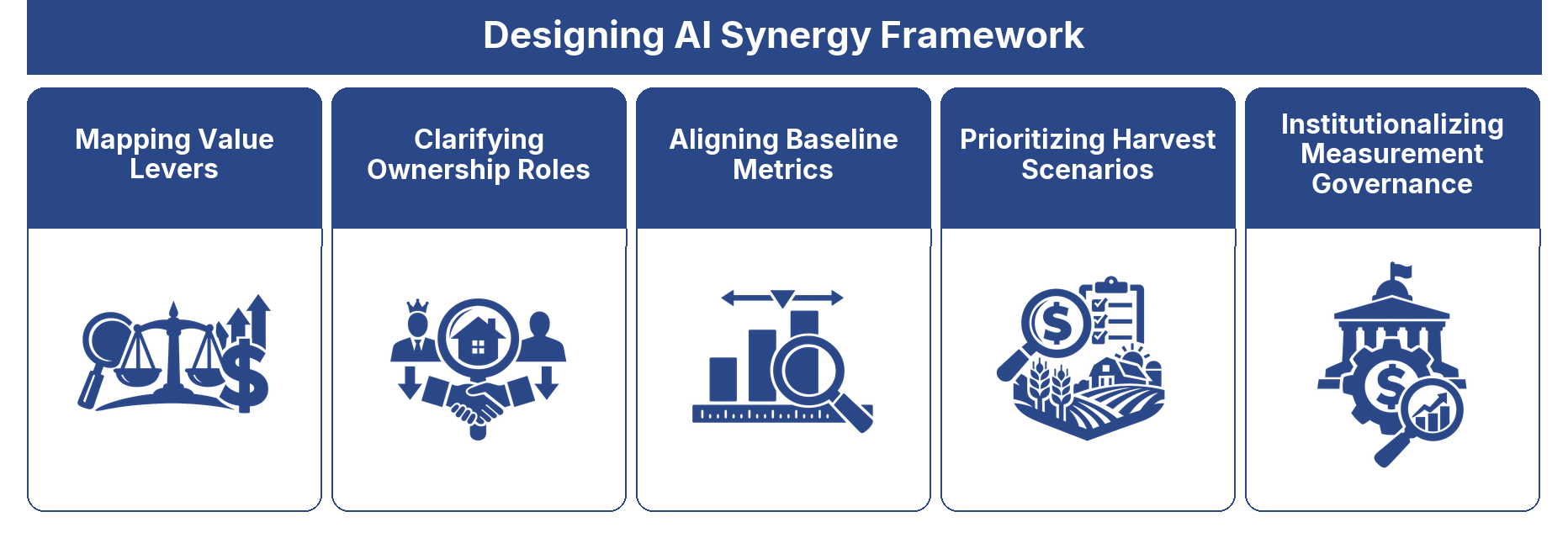
AI synergy rarely fails because an organization lacks potential use cases. It fails because leaders cannot connect a proposed capability to a defined workflow, accountable owner, measurable baseline, and explicit decision about scale. The more consequential failure comes later: teams recognize labor savings before proving that the redesigned process has actually released capacity, improved performance, or created a credible path to redeployment. A usable framework therefore treats synergy as a testable operating hypothesis, with labor reduction recognized only after the workflow has produced measured improvement and cleared its service guardrails.
The distinction matters in post merger integration. SAP completed its acquisition of Signavio on March 5, 2021, adding Signavio to SAP’s Business Process Intelligence portfolio to complement process transformation capabilities. That documented fact does not establish any realized AI savings. It does, however, provide a useful analytical application: process visibility should precede automation, and automation should precede workforce resizing, because leaders cannot claim capacity value until the redesigned workflow has demonstrated what happens to the time released. Prior analysis of transformation possibilities reaches the same operating conclusion from a different angle.
The framework below makes the synergy hypothesis charter the governing mechanism. Supporting artifacts, including a workflow map, ownership register, baseline metric sheet, and scenario comparison, feed the charter rather than becoming a disconnected inventory. Each gate forces a different decision: define the workflow, assign accountability, test the outcome, redeploy capacity, or stop spending. That sequence prevents an Integration Management Office (IMO) from converting an unproven productivity assumption into a committed cost reduction.
Mapping Value Levers
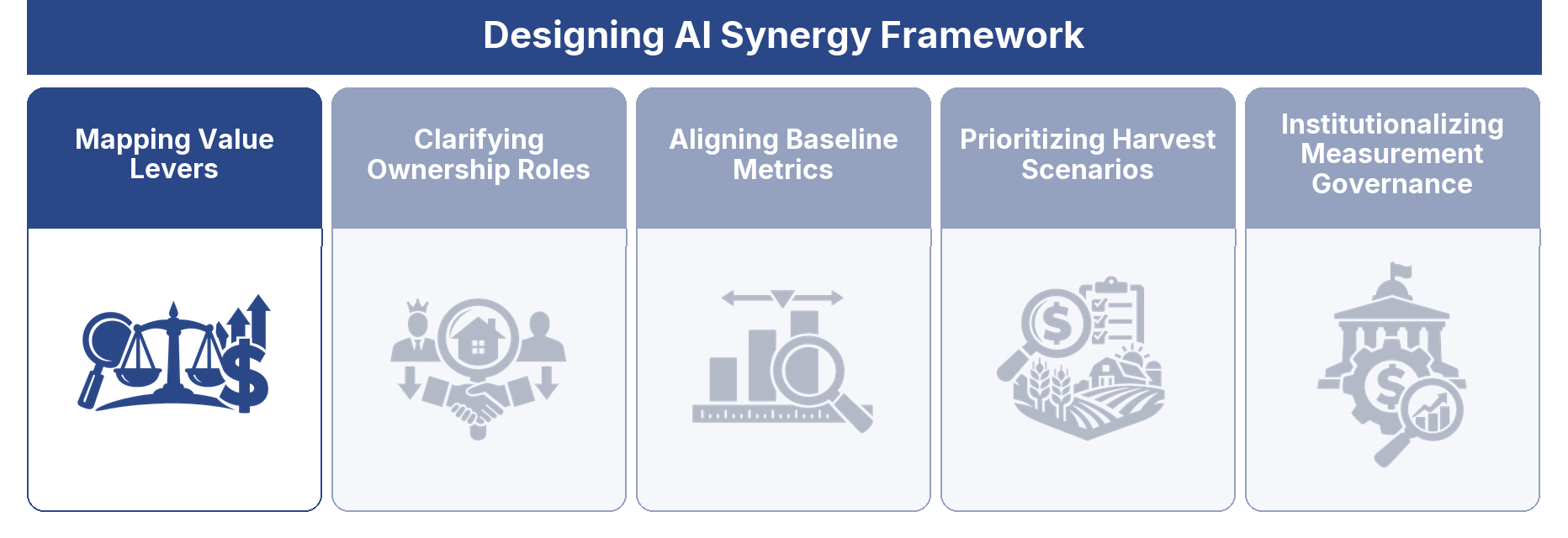
Start by mapping the workflow boundary rather than listing artificial intelligence tools. The map should identify the customer or employee trigger, major handoffs, systems of record, decision points, service guardrails, and sources of delay or rework. It should then connect each potential AI intervention to a value lever, such as cycle time reduction, quality improvement, revenue protection, or employee capacity.
The decisive addition is a capacity disposition: once the intervention works, where does the released time go? It may support higher volumes, shorten response times, improve controls, or be redeployed to a higher value activity. It should not become a labor saving claim by default. McKinsey’s research on AI value and operating models reinforces the importance of aligning technology with how work is actually organized. The charter should record both the change hypothesis and the capacity decision that would validate it.
Clarifying Ownership Roles
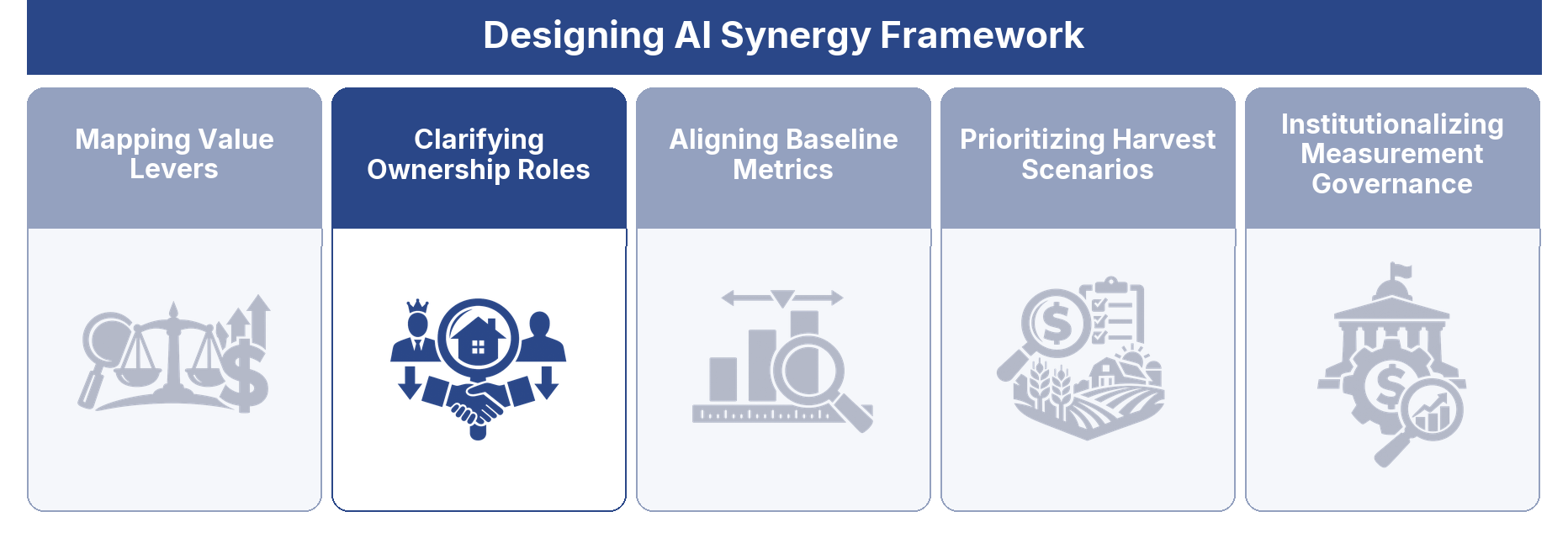
Every hypothesis needs named accountability for data, process, outcome, and capacity redeployment. Data ownership covers access, quality, lineage, and permitted use. Process ownership covers workflow design, controls, and adoption. Outcome ownership covers the business result, while an operational leader must determine whether released capacity is redeployed, absorbed by demand, or genuinely eliminated.
The register should also identify the executive sponsor, technical lead, privacy and security reviewers, and operational approver, without prematurely building the detailed decision rights matrix reserved for later planning. NIST’s AI Risk Management Framework supports this separation by treating governance, measurement, and risk management as continuing responsibilities rather than one time approvals. If no leader owns redeployment, the synergy should remain unrecognized. Ambiguous ownership is itself a risk and belongs in the RAID log.
Aligning Baseline Metrics
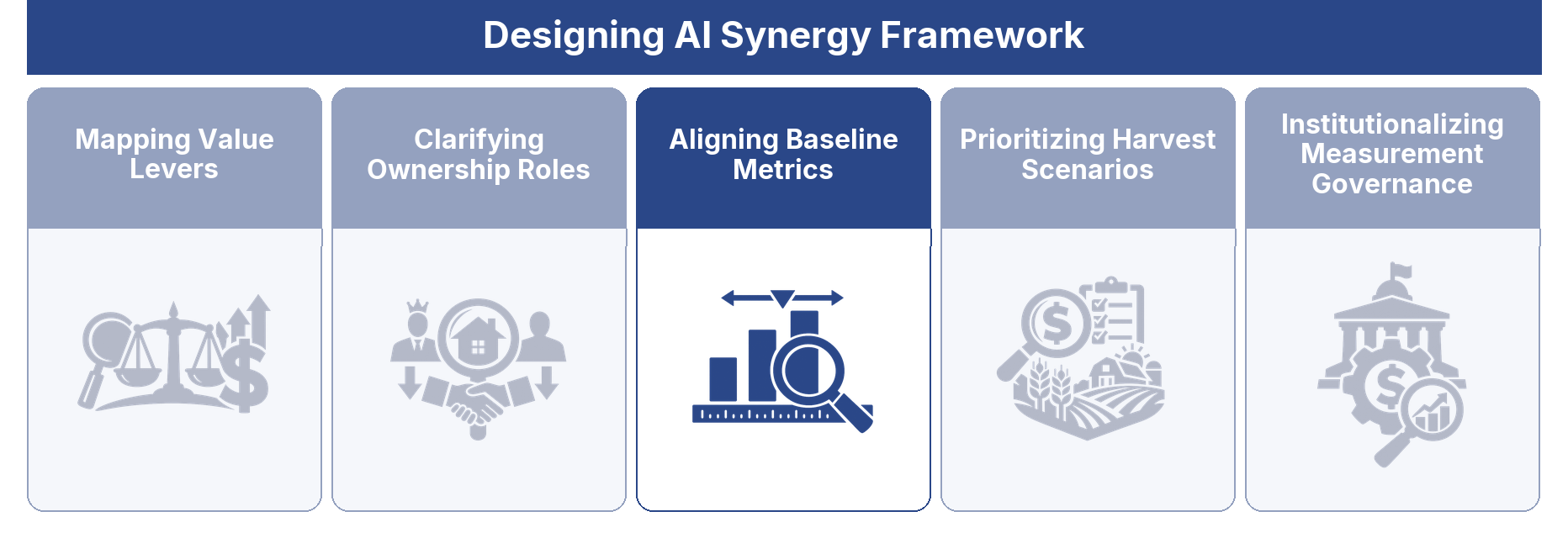
A baseline metric sheet should establish the current workflow before automation begins, but the selected measures must reflect the economic tradeoff rather than merely document activity. Consider a renewal workflow in which AI assistance reduces preparation time while retention declines because account risks receive less human review. Faster renewals do not represent value if the primary commercial outcome deteriorates.
The charter should therefore designate one primary outcome and one or two non negotiable guardrails. For renewals, retained revenue or renewal rate may serve as the primary outcome, while approval accuracy and customer experience remain guardrails. For support, resolution time may lead, but escalation quality and customer satisfaction cannot fall below the agreed threshold. An earlier integration strategy perspective emphasizes the need to connect operational choices to differentiated strategic value. That connection becomes concrete when a failed guardrail blocks scale, regardless of the apparent efficiency gain.
Prioritizing Harvest Scenarios
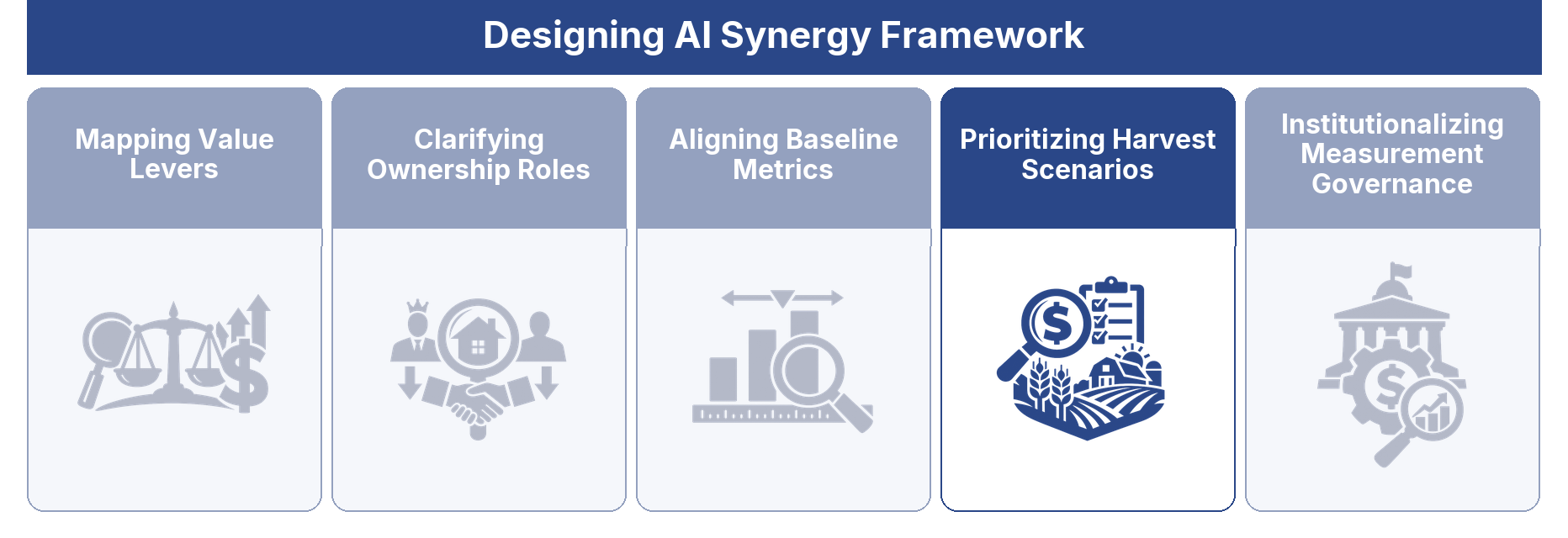
Scenario planning should compare a no change case, a process redesign case, and an AI enabled case using the same baseline, cost to achieve assumptions, service guardrails, and adoption constraints. The comparison should show when evidence should appear, what capacity will be redeployed, and which dependencies could delay realization. A workflow that produces time savings but leaves employees fully occupied with the same work has generated productivity evidence, not labor savings.
Consider a renewal workflow in which managers use AI assisted account summaries to reduce preparation time while preserving approval quality. The synergy hypothesis charter should record the workflow boundary, current preparation time, change hypothesis, renewal operations owner, accuracy and retention guardrails, implementation cost, intended capacity use, and scale or stop gate. If preparation time improves but renewal performance falls, the decision is redesign or containment. If both outcomes improve and managers demonstrably redirect capacity toward additional accounts or higher value risk work, the evidence supports broader deployment.
Institutionalizing Measurement Governance
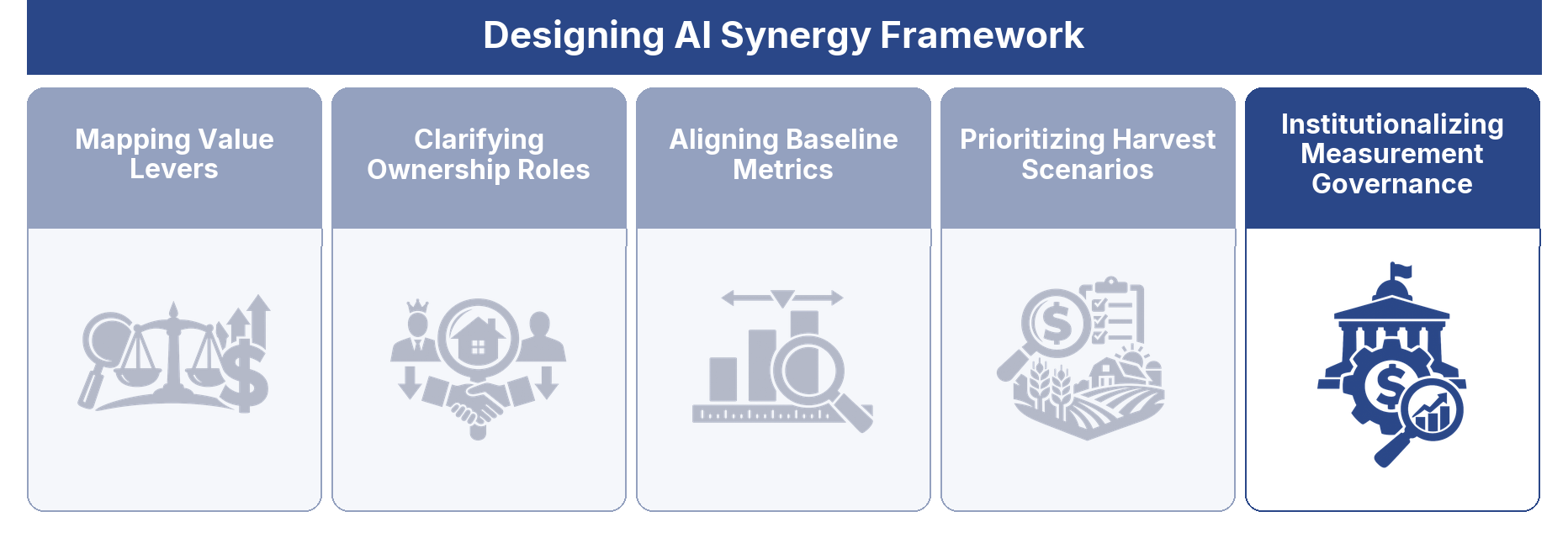
Governance sustains the framework after the initial hypothesis is approved. The IMO should maintain a single inventory linking each synergy to its owner, baseline, data source, risk status, capacity disposition, review cadence, and evidence gate, while a steering committee resolves cross functional dependencies and approves scale decisions. Working sessions should refresh risks and issues rather than allowing stale assumptions to survive into executive reporting.
The durable artifact is a one page synergy hypothesis charter linking workflow boundary, current performance, change hypothesis, owner, service guardrail, cost to achieve, capacity disposition, intended benefit, and scale or stop gate. A failed gate must change the capital allocation decision: funding pauses, the workflow returns to redesign, or the use case is closed. A passed gate does not automatically authorize headcount reduction; executives should approve resizing only after the redesigned workflow has produced measured improvement, cleared its guardrails, and shown where the released capacity will go. That is the difference between a productivity story and realized value.
Synthesizing Synergies into Margin Growth
An executive preparing to remove renewal roles before knowing cycle time, rework, or service exposure is not managing an AI synergy. The decision is premature. Without an operating baseline, a faster workflow can simply release unmeasured capacity, shift work to account teams, or increase customer risk while appearing to reduce cost. SAP’s completion of the Signavio acquisition on March 5, 2021, and Signavio’s placement within SAP’s Business Process Intelligence portfolio, establish the process visibility premise, but they do not demonstrate that the transaction created AI enabled savings or revenue.
The failure sequence is usually predictable: leaders resize first, fail to measure where capacity went, then treat the resulting gap as a false saving. A stronger approach identifies one primary economic outcome, such as cost per completed renewal, while treating retention, quality, and control performance as non negotiable service guardrails. If automation shortens cycle time but increases renewal errors, customer escalations, or control exceptions, the economic case has failed, regardless of the labor reduction. The same test applies to a documented AI hypothesis: the expected benefit must be tied to a measurable workflow change, not to the number of plausible use cases.
The practical decision tool is a concise synergy hypothesis charter that records the workflow boundary, baseline economics, accountable owner, proposed change, cost to achieve, service guardrails, and scale or stop threshold. That charter gives the Monday operating review a decision rather than a catalog of ideas: continue when the primary economic outcome improves without breaching guardrails, redesign when capacity is released but not redeployed, and stop when apparent savings depend on deteriorating customer or control performance. Signavio can therefore support the visibility required to form the hypothesis, while observed operating data must validate the value claim. Instrument the workflow, test the guardrails, and resize only after released capacity is visible in the operating data.

Get new articles by email
Insights on M&A, revenue growth, and business transformation, delivered occasionally.