
Task Level AI Decomposition: Don’t Automate the Org Chart
In August 2022, UiPath, a leading automation software company, announced its acquisition of Re:infer, a technology business that applied natural language processing and machine learning to unstructured communications. The official announcement described a capability for turning communication context into data that could support more actionable workflows. The transaction illustrates a critical boundary for integration leaders: acquiring automation capability does not establish which tasks should be assisted, automated, or retained. In a hypothetical support intake workflow, extracting facts may differ materially from authorizing a customer remedy, even when both sit within the same role.
Role-based planning obscures that distinction because it treats a job as the unit of automation, although actual work varies by input, judgment, consequence, and reversibility. An easy classification task may still require human review when an incorrect result can create financial, regulatory, or customer harm. A usable diagnostic must therefore connect each task to measurable inputs and outputs, an accountable reviewer, and an explicit harvest decision. How can a task level decomposition reveal AI fit and risk, preventing over automation of high consequence tasks?
The practical answer is a task inventory paired with an AI-fit versus consequence matrix, grounded in documented workflow evidence rather than broad labor assumptions. For each task, leaders can record volume, judgment, consequence, reversibility, reviewer, and performance measure before choosing assist, automate, or retain. That discipline converts AI ambition into an artifact that integration teams can govern, test, and revise as operating conditions change.

Surveying Task Driven AI Potential
A role based plan can make an organization appear ready for artificial intelligence while concealing the work that actually creates cost, risk, and customer value. “Support operations” may include extracting facts, classifying topics, routing requests, assessing severity, and authorizing remedies, yet each task carries a different level of judgment and consequence. A task inventory exposes those differences before an Integration Management Office (IMO) commits capital, changes staffing, or redesigns a post merger workflow. Earlier work on technology readiness assessment supports the same discipline: technology choices should follow an evidence based view of capability gaps, not follow the organization chart.
The practical artifact is a worked inventory for a hypothetical B2B Software as a Service (SaaS) support intake process. Each row records the task, input and output, transaction volume, judgment required, consequence of error, reversibility, human reviewer, performance measure, and decision to assist, automate, or retain. For example, extracting account details from an inbound message may have high volume, low judgment, reversible errors, and a measurable cycle time outcome, making it a plausible automation candidate. Assessing severity may have moderate volume and higher judgment, while authorizing a customer remedy carries direct financial and relationship consequences, so the appropriate decision may be AI assistance with mandatory human review.
The inventory becomes more useful when placed on a two axis matrix that compares AI fit with consequence. High fit, low consequence tasks can move toward automation after testing; high fit, high consequence tasks should generally receive decision support rather than autonomous execution; low fit, high consequence tasks should remain human led; and low fit, low consequence tasks may not justify investment. Easy classification does not automatically mean safe automation. A model may identify a billing topic accurately while still requiring review if the classification triggers an entitlement change, regulatory response, or customer remedy.
The boundary between capability and outcome also matters. When UiPath announced its acquisition of Re:infer on August 1, 2022, the company described Re:infer’s NLP and machine learning capability as a way to convert unstructured communications into actionable data. That fact demonstrates a potential capability boundary, not achieved labor savings or integration results. Stanford’s AI Index recorded SWE bench performance rising from 4.4% in 2023 to 71.7% in 2024, but benchmark improvement does not establish business impact in a particular workflow; internal baselines remain essential, as prior data driven segmentation work similarly emphasizes. The required decision is therefore concrete: complete the inventory, score every task on AI fit and consequence, and approve automation only where the measured margin or service effect can be observed.
Revealing Hidden Risk in Automation
A post merger support workflow can expose the difference between model accuracy and integration value. A message reporting a possible security incident may be classified correctly, assigned the right severity, and routed to the right queue, yet still trigger an unauthorized service credit or case closure if downstream rules treat classification as approval. That is the integration failure mechanism: capability is mistaken for synergy, then role reductions or control removals are built around an output that was never authorized to make the final decision. The process mapping discipline required before automation must therefore trace the workflow from message receipt through remedy authorization, identifying where information is extracted, where judgment enters, and where financial, contractual, or reputational exposure begins.
The task decomposition becomes the control point between model performance and permission to act. Fact extraction can convert ticket text into structured fields, and topic classification can route a case to the correct team, but severity assessment may alter response commitments, service continuity, or escalation priority. Remedy authorization should remain human owned until approval limits, evidence requirements, segregation of duties, and audit logging are operating in production. The sequence should map the work, separate decisions by consequence, test reversibility, and only then redesign roles. When UiPath announced its acquisition of Re:infer on August 1, 2022, Re:infer’s documented natural language processing and machine learning capabilities supported the transformation of unstructured communications into actionable data; that capability established an input advantage, not an automatic headcount or control removal opportunity.
The resulting integration rule should be explicit. If an acquired support platform classifies security related messages accurately but passes those labels directly into customer credit or incident closure rules, the acquirer should fund a reviewer queue, exception handling, and monitoring before counting labor savings in the synergy case. Autonomous execution should require two consecutive reporting cycles with no unauthorized actions, all exceptions resolved within the defined service window, stable model performance across priority categories, and documented sign off from security, privacy, legal, and operations owners. Workforce redesign should follow only after those gates hold under live conditions, not after a pilot demonstrates classification accuracy in isolation. High fit, low consequence work, such as extracting a contract number from a standardized request, can move first; high fit, high consequence work should assist execution while requiring human confirmation, and low fit, high consequence work should remain human owned.
The NIST AI Risk Management Framework reinforces the need to measure trustworthy characteristics and track identified risks over time, which translates into named reviewers, performance measures, escalation thresholds, and a dated decision to assist, automate, or retain each task. That discipline also protects the integration thesis from a familiar form of leakage: projected synergy appears in the deal model before the operating evidence exists, while reviewers, controls, and exception capacity disappear from the budget too early. A credible artificial intelligence plan begins below the organization chart. Map the work, protect consequential decisions, prove reversible savings, then resize roles. The integration should move at that pace, or not move at all.
Designing a Task Level AI Diagnostic
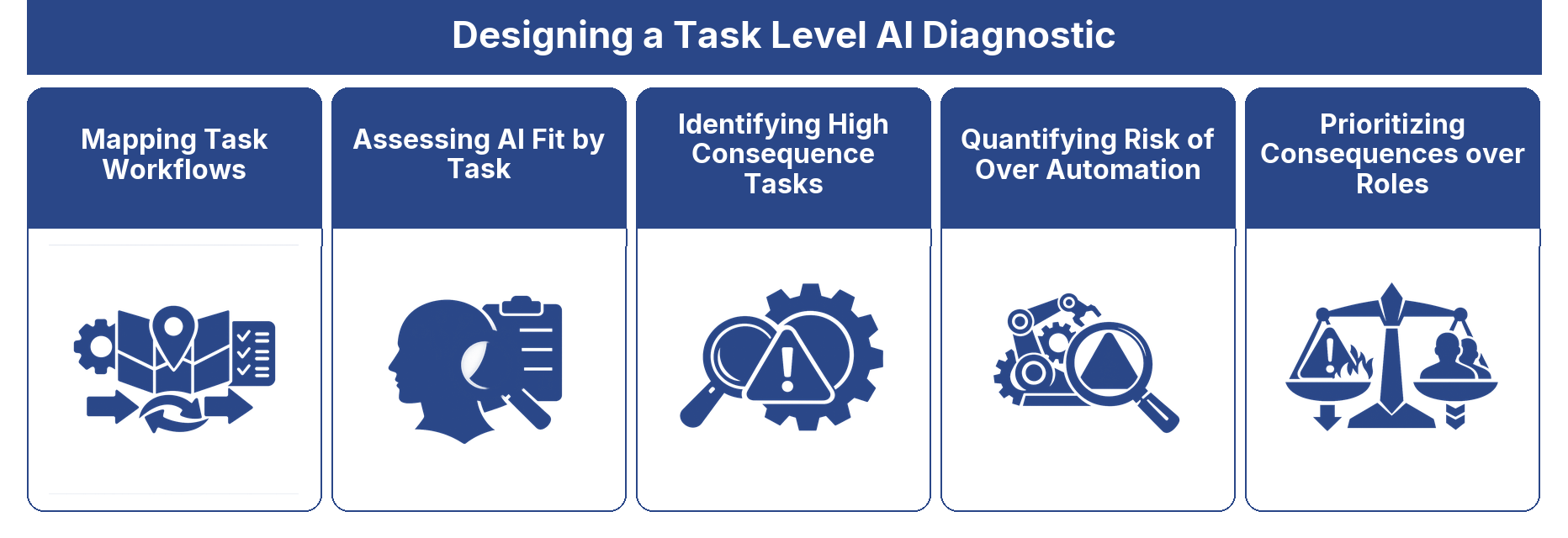
A task level diagnostic begins with an inventory, not an organization chart. The usable artifact is a structured record of what work actually occurs, what information enters and leaves each step, where judgment is required, and what happens when the step fails. That distinction matters because automation potential does not establish permission to automate.
The diagnostic should move through five decisions: map the workflow, assess artificial intelligence (AI) fit, identify high consequence tasks, quantify over automation risk, and prioritize consequences over roles. The result is not a prediction of headcount reduction. It is an explicit decision for each task: assist, automate, or retain.
Mapping Task Workflows
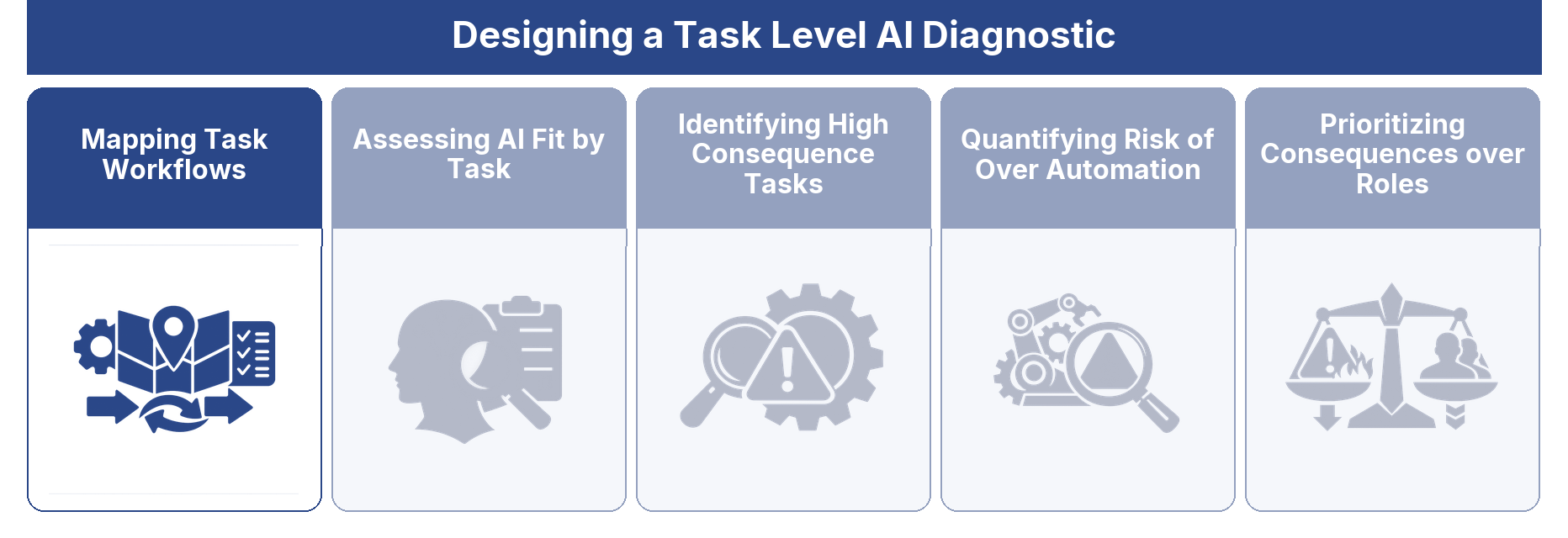
Begin with the workflow as performed, including handoffs, exceptions, approvals, and rework. A hypothetical B2B software support intake workflow might include extracting facts from a customer message, classifying the topic, suggesting a route, assessing severity, and authorizing a customer remedy. Each task should be documented in a consistent inventory with columns for input and output, volume, judgment required, consequence, reversibility, human reviewer, performance measure, and the assist, automate, or retain decision.
The inventory should distinguish an input transformation from a downstream decision. UiPath described its 2022 acquisition of Re:infer as adding technology that applied natural language processing and machine learning to unstructured communications, converting communication context into actionable data in the official acquisition announcement. That fact establishes a capability boundary, not evidence that any particular customer service decision should be automated.
Earlier due diligence structuring guidance reinforces the value of examining process detail rather than relying on broad functional labels. The same discipline applies here: “support” is too broad a unit for an automation decision.
Assessing AI Fit by Task
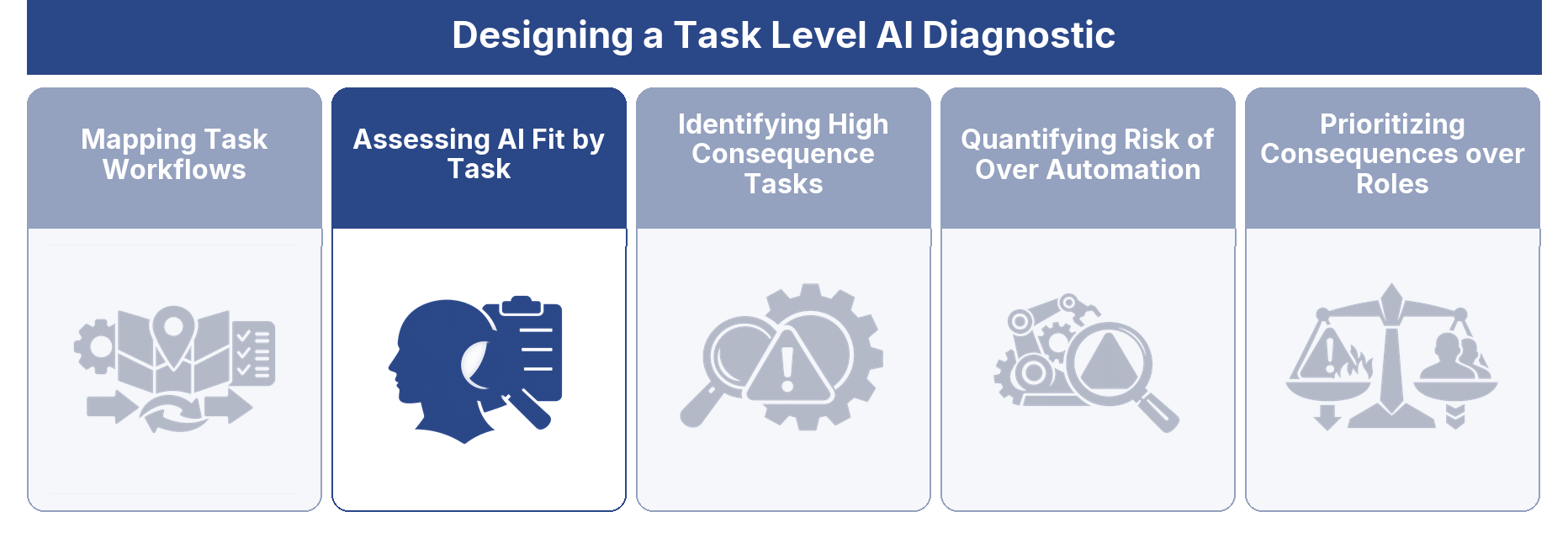
AI fit should be assessed against the task’s data, rules, variability, and required precision. Extracting an account number from a message may offer strong fit when the source format is stable and the output can be validated. Suggesting a route may offer moderate fit because classification can be useful while ambiguity remains. Authorizing a remedy may offer poor fit when the decision depends on contractual interpretation, customer history, or an exception that the training data rarely represents.
The diagnostic should record the evidence supporting each judgment, including sample quality, error patterns, validation method, and the threshold for escalation. Stanford’s benchmark quality assessment framework evaluated 24 AI benchmarks, underscoring that performance claims depend on what a test measures and how well it represents the operating context. A high score on topic classification therefore cannot be treated as proof of safe remedy authorization.
Identifying High Consequence Tasks
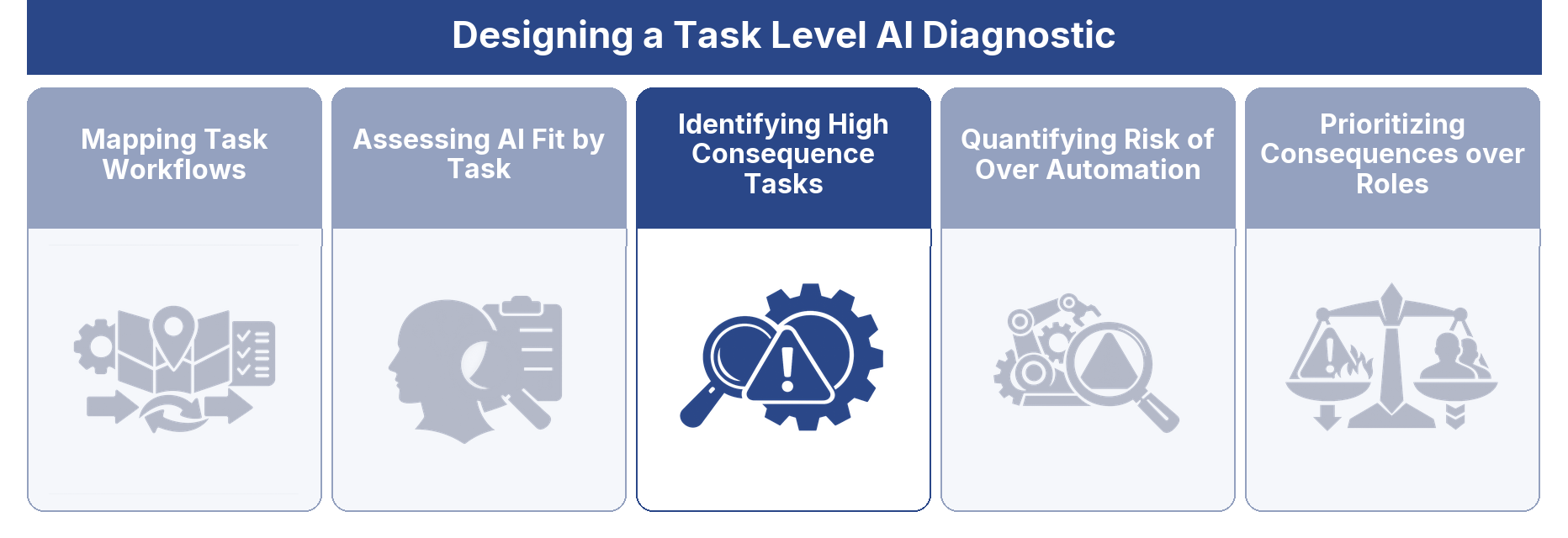
Consequence should be assessed independently from task difficulty. A task can be technically easy and operationally sensitive. Classifying a customer message as billing, technical support, or account administration may require little reasoning, yet an incorrect classification can delay service restoration, expose sensitive information, or route a contractual dispute to the wrong team.
The inventory should identify consequences across customer impact, compliance exposure, financial commitment, data security, and reputational harm. It should also name the accountable reviewer and define the evidence that reviewer must inspect. Continuous improvement through structured analysis provides a useful operating principle: measures should capture patterns and outliers, not merely average throughput. A low average error rate can conceal a small number of severe failures.
Quantifying Risk of Over Automation
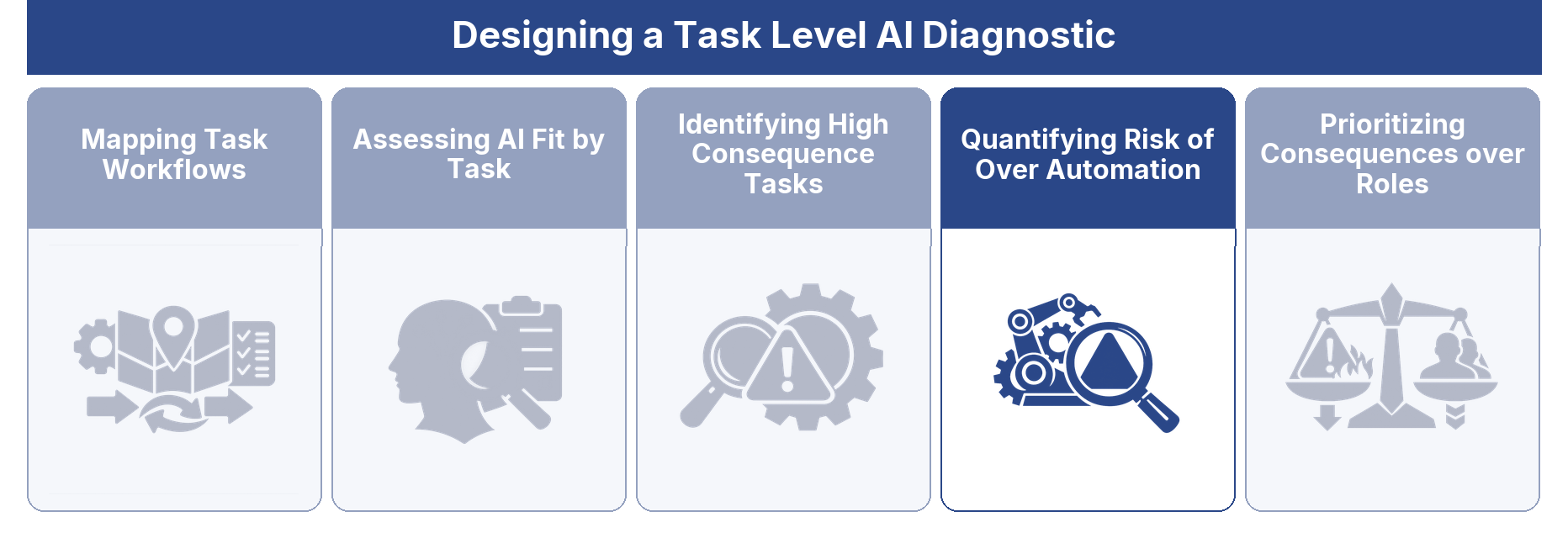
Over automation risk becomes visible when AI fit is placed on one axis and consequence on another. High fit and low consequence tasks, such as extracting standard fields for a draft record, may qualify for automation after validation. High fit and high consequence tasks, such as classifying a message that determines access to a critical service, may warrant AI assistance with mandatory human review. Low fit and high consequence tasks should generally remain with accountable specialists, while low fit and low consequence tasks may justify redesign before investment.
The matrix should include a confidence threshold, escalation rule, sample review rate, and rollback trigger. NIST’s measurement science for AI emphasizes the need for reliable measurement when evaluating AI systems. In practice, that means tracking false positives, false negatives, override rates, cycle time, and severity weighted failures rather than reporting adoption alone.
Prioritizing Consequences over Roles
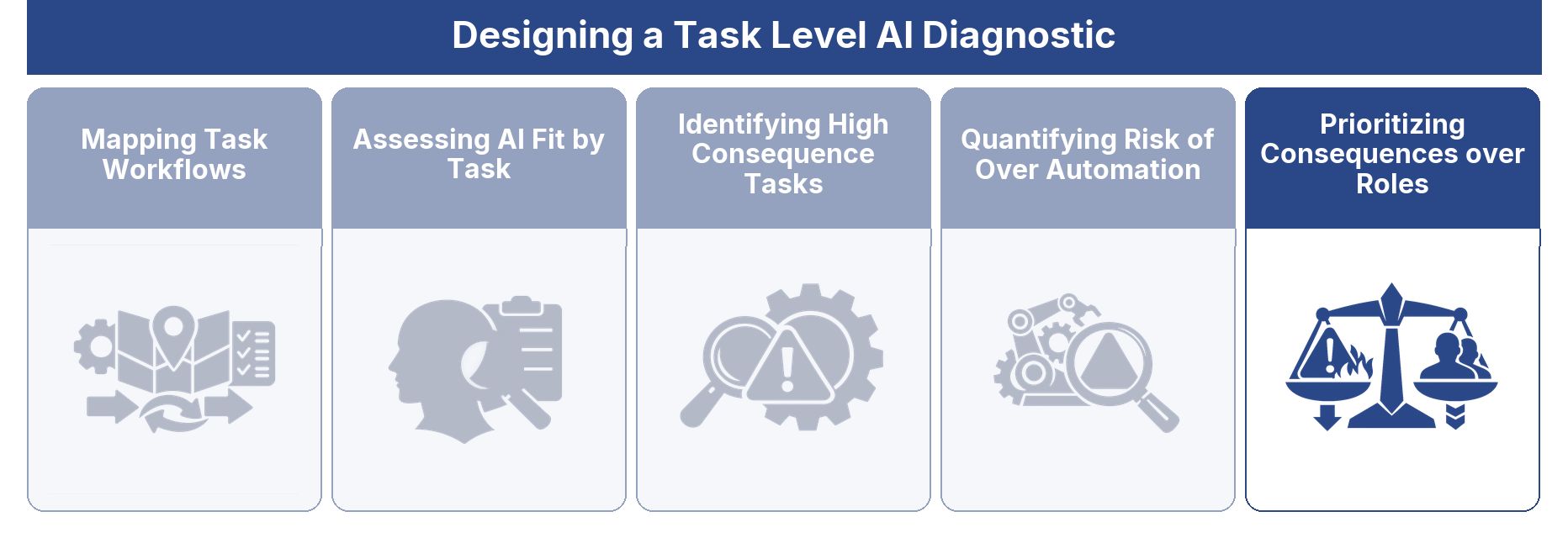
The final diagnostic should rank tasks by consequence, not by the number of people performing them. A role may contain five activities with different automation decisions: extract facts, assist with classification, suggest routing, retain severity assessment, and retain remedy authorization. Resizing the role before separating those tasks risks removing the human control required at the most consequential points.
The completed artifact should contain the task inventory, the two axis AI fit versus consequence matrix, named reviewers, measures, escalation rules, and an explicit decision for every step. That record gives the Integration Management Office (IMO) and functional leaders a common basis for governance, enablement, and redesign. The practical question is no longer whether AI can perform a task, but whether the organization can absorb the consequences when it performs that task incorrectly.
Sustaining Gains via Task Level AI
A credible artificial intelligence plan begins below the organization chart. By decomposing roles into discrete tasks, executives can distinguish repetitive work that may be assisted or automated from judgment heavy activities that should remain human led, especially when errors carry customer, financial, or regulatory consequences. The resulting inventory turns an abstract transformation agenda into an operating decision: what enters each task, what it produces, how often it occurs, who reviews it, and what measure determines whether the design works.
With this in place, the disciplined practitioner can establish a worked task inventory for the support intake workflow, instrument each step with volume and quality measures, and codify an assist, automate, or retain decision for every task. The decision matrix should then separate AI fit from consequence, ensuring that an easy classification task still receives human review when a mistaken output could trigger an irreversible customer remedy. Teams can stand up the inventory in a working session, sequence pilots around reversible tasks, and formalize review thresholds before deployment. The practical test is no longer whether a role appears ready for AI, but whether each task has a defensible owner, measurable outcome, and consequence aware level of automation.

Get new articles by email
Insights on M&A, revenue growth, and business transformation, delivered occasionally.