

The AI Business Case Hides Costs in Plain Sight
In 2021, Salesforce, a leading enterprise SaaS company, acquired Slack for about $27.7 billion to anchor collaboration across its Customer 360 platform, as described in the company’s acquisition announcement. The transaction promised strategic leverage through deeper product integration, broader data flows, and increased platform adoption. It also created a long-term investment obligation extending beyond the purchase price, including systems work, data preparation, governance, training, monitoring, and sustained operational support. For finance leaders, the central challenge was not simply estimating the value of the combined platform, but determining what that value would cost to realize.
AI business cases face the same tension, often presenting attractive returns while treating implementation and operating expenses as peripheral details. Costs accumulate through human review, error and rework, model maintenance, risk controls, and the organizational capacity required to adopt new workflows. When those expenses remain outside the model, reported ROI can overstate value and conceal pressure on existing teams and budgets. How can a comprehensive TCO standard and governance driven cost tracking ensure AI ROI reflects true investment realities?
A disciplined total cost of ownership (TCO) standard makes each cost driver visible and connects spending to measurable outcomes, including adoption, utilization, quality, risk, and realized capacity. Governance then turns cost tracking into an operating discipline, allowing leadership to distinguish capacity creation from redeployment, avoided hiring, and payroll reductions. As AI initiatives expand across SaaS portfolios and M&A integration agendas, investment committees need a complete cost envelope before approving scale, sustainment, and growth.

Assessing Current AI ROI Expectations in Finance
Finance leaders increasingly report AI as a value opportunity, yet the headline return on investment (ROI) often reflects only the visible purchase and deployment decision. Boston Consulting Group’s survey of more than 280 finance executives found that the median reported ROI of 10% falls well below the 20% many organizations target, while nearly one third of respondents reported limited gains. That gap does not necessarily indicate weak technology. It often signals an incomplete denominator.
Most business cases capture software licensing, implementation services, and forecast labor savings, but omit the operating costs that determine whether benefits persist. Data preparation, workflow redesign, employee training, model monitoring, security controls, exception handling, and governance consume both cash and scarce specialist capacity. Deloitte reports that 63% of respondents have already fully deployed and actively use AI in finance, a level of adoption that makes these recurring costs impossible to treat as a pilot stage concern. Earlier analysis of comprehensive TCoA analysis established the same financial discipline for technology enabled transactions: value cannot be assessed credibly until the entire cost envelope is visible.
The problem deepens because organizations rarely apply a consistent definition of Total Cost of Ownership (TCO) across AI initiatives. One team may count cloud consumption and vendor fees, while another includes data remediation, control testing, and the time finance professionals spend validating outputs. A third may classify training as a one time project expense even though model changes, employee turnover, and new use cases create recurring demand. Without standardized categories, portfolio comparisons become unreliable, and governance committees may approve initiatives whose apparent payback depends on costs assigned to another budget.
A rigorous assessment therefore connects each cost driver to a measurable outcome, including adoption, utilization, quality, risk reduction, and realized capacity. That approach distinguishes genuine productivity gains from work merely shifted to reviewers, control functions, or technology teams. It also clarifies whether value comes from avoided hiring, reduced external spend, faster close cycles, or improved decision quality, rather than treating every efficiency claim as equivalent. Prior technology investment cost analysis provides a useful precedent: strategic technology choices require comparison of initial expenditure, operational impact, and scalability. The result is a more credible basis for funding, sequencing, and governance.
Identifying Hidden Costs Obscuring Value
An AI initiative rarely fails because its model license appears on the wrong spreadsheet. The larger problem is that the full cost envelope sits across several budgets, owners, and timelines, allowing data preparation, system integration, training, governance, human review, error correction, monitoring, and ongoing sustainment to remain financially disconnected. Research from McKinsey on embedded product costs describes a similar pattern: costs embedded in operating processes can remain invisible until margin pressure exposes them. AI investments require the same scrutiny.
Data preparation often absorbs more capacity than the initial business case anticipates, particularly when teams must clean inconsistent records, establish access controls, document lineage, and reconcile competing definitions. Integration adds another layer, as application programming interfaces, workflow redesign, security reviews, and legacy system constraints extend delivery timelines. Training and governance create recurring obligations rather than one time expenses, while human review and rework determine whether faster machine output translates into reliable operating performance. Earlier cost visibility in integration reinforces the same discipline: costs become decision useful only when leaders identify them before commitments harden.
Untracked costs do not disappear. They migrate into information technology, operations, compliance, finance, and functional payroll, where each budget may appear defensible while the combined initiative exceeds its approved envelope. Boston Consulting Group reports that transformation value leakage can erode as much as 10% to 20% of anticipated gains through delays, discretionary cost increases, and unplanned reinvestments. More than 85% of executives are leading or planning a transformation, yet most organizations capture only a fraction of the value targeted. The risk is cumulative, not dramatic: a series of modest overruns can consume the capital intended for expansion.
Cost tracking also needs an outcome ledger. Leadership must distinguish payroll reduction from capacity released, faster cycle time from higher throughput, and lower handling effort from improved decision quality. A process that saves 20 minutes per case creates no economic value if employees simply absorb the time without serving more customers or eliminating external spend. Comprehensive TCoA analysis provides a useful precedent for connecting expenditure to realized value, while Harvard Business Review’s discussion of hidden cash costs underscores why apparently efficient decisions can carry material opportunity costs. The five part cost mapping that follows makes those obligations visible before optimism becomes an operating plan.
Mapping the Full Cost Envelope for AI Initiatives
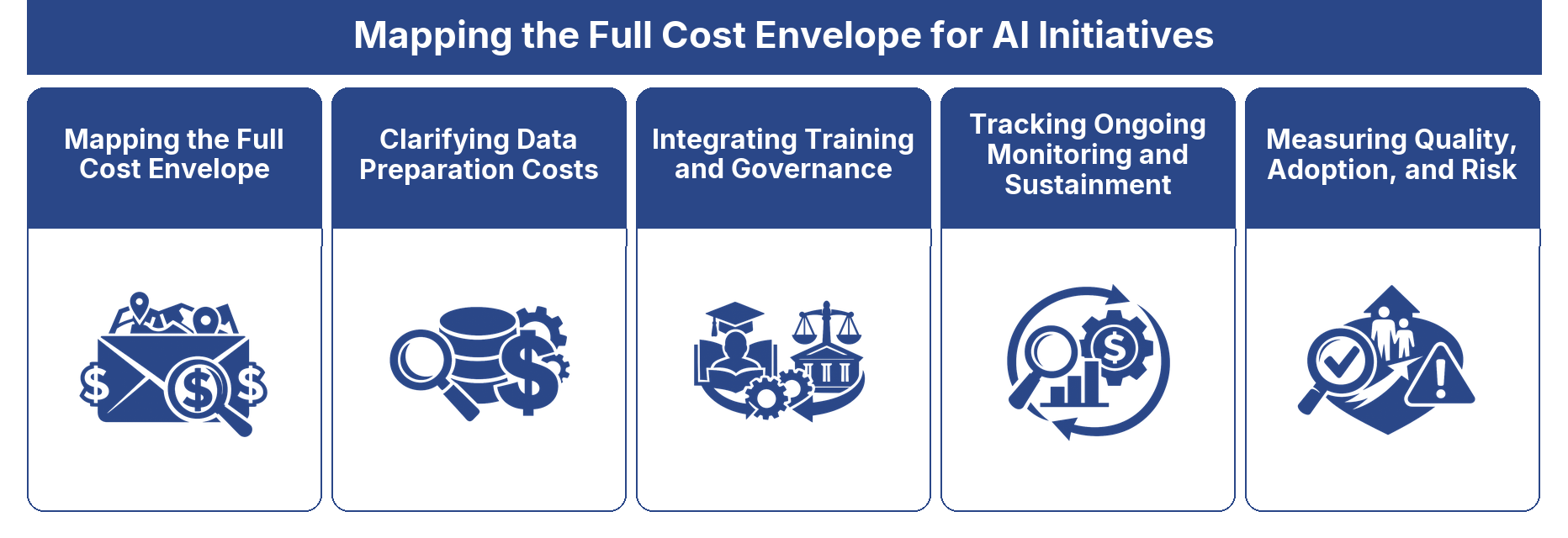
A finance or integration committee can approve an artificial intelligence initiative whose modeled savings depend on reviewers, data remediation, and controls that were never budgeted. The problem is not simply an incomplete technology budget. AI shifts a material share of cost into variable labor: reviewing uncertain outputs, correcting exceptions, monitoring drift, documenting decisions, and managing risk at scale. A low model price can therefore coexist with an uneconomic operating model.
Salesforce’s 2021 acquisition of Slack for approximately $27.7 billion illustrates the broader principle. The strategic rationale depended on embedding collaboration across Customer 360, not merely owning another software product. AI creates the same obligation at the workflow level. If data preparation, human review, workflow redesign, controls, training, and performance management remain outside the investment case, the business is pricing the model while leaving the value creation mechanism unfunded.
The relevant measure is cost per accepted output, not license cost or deployment spend. A standardized AI cost metric supports this broader view of deployment economics. Costs should be organized into three mechanisms: build, run, and prove. Build determines whether the system can reach production, run determines whether it remains economical at scale, and prove determines whether reported benefits justify further funding. An Integration Management Office (IMO) should surface thesis breaking costs first, particularly data remediation, human review, and control requirements, before vendor selection or deployment commitments.
Mapping the Full Cost Envelope
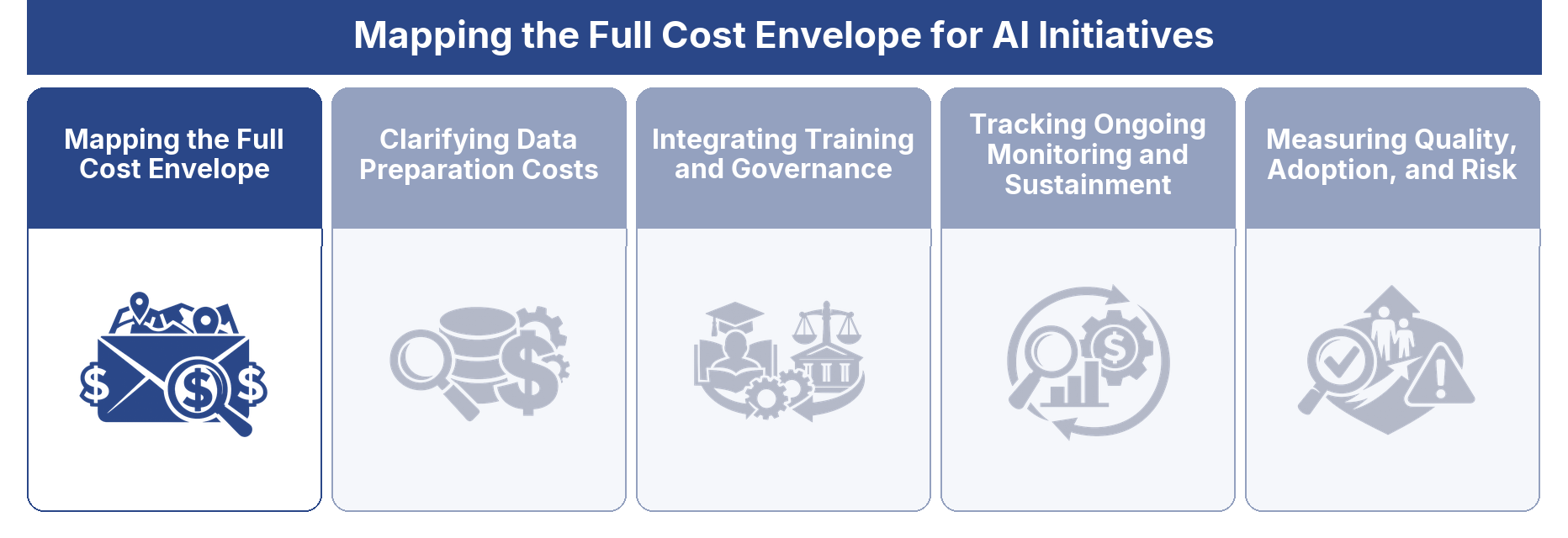
The first approval question is whether the initiative can produce reliable outputs at an economically defensible cost. Build costs include data remediation, workflow redesign, integration, security architecture, compliance design, and internal labor. These costs can invalidate the thesis before deployment, so vendor comparison should follow rather than precede them.
The ledger should separate cash expense, internal capacity, and opportunity cost, then model cost per accepted output under base, high exception, and control intensive scenarios. If lifecycle cost cannot be calculated with defensible assumptions, funding should stop at discovery. The committee should ask which operating design produces an accepted outcome below its economic value, not which model carries the lowest subscription price.
Clarifying Data Preparation Costs
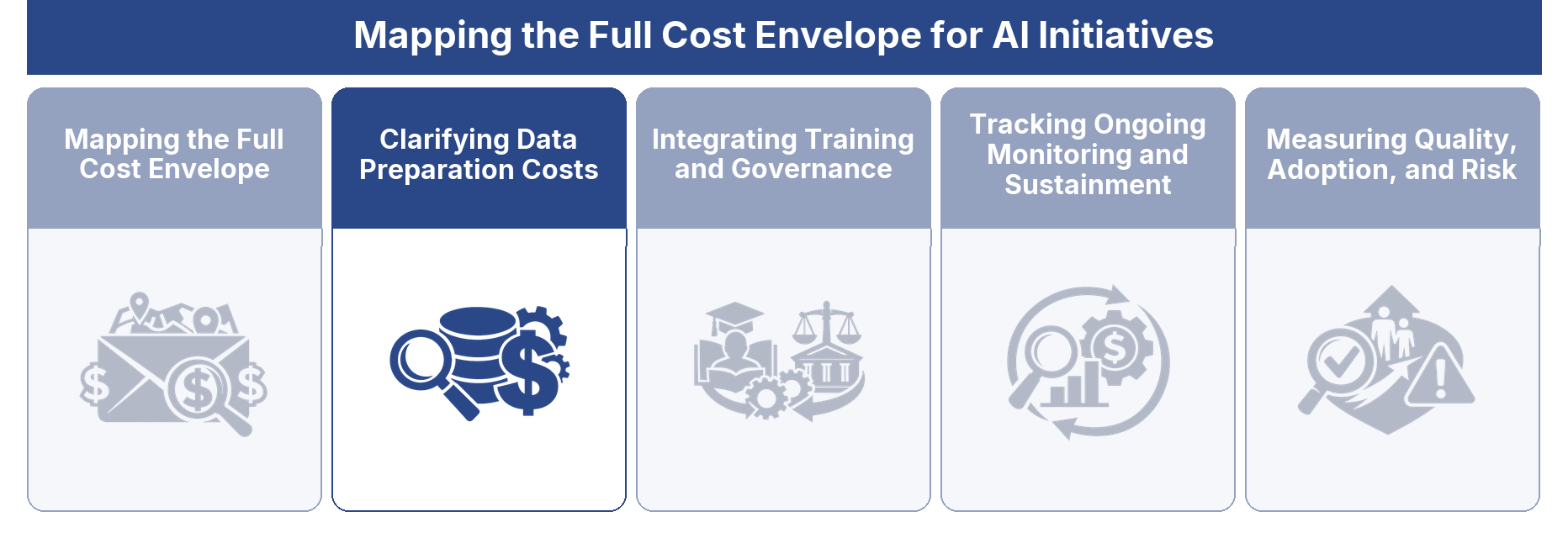
Data preparation deserves priority because remediation becomes harder to reverse after a platform decision. Cleansing, labeling, access controls, lineage, and source system repair determine whether the model can perform reliably, while weak data increases review hours and exception handling after launch. The National Institute of Standards and Technology (NIST) risk management framework supports treating data quality as a lifecycle release condition rather than a one time technical task.
The cost per accepted output should include records processed, human review time, failed outputs, correction effort, and rework. A system that produces 95% accurate answers may still be uneconomic if the remaining 5% require expensive intervention in customer, regulated, or revenue workflows. Data remediation must therefore be priced before model selection. A more capable model cannot rescue an operating case built on continuously defective inputs.
Integrating Training and Governance
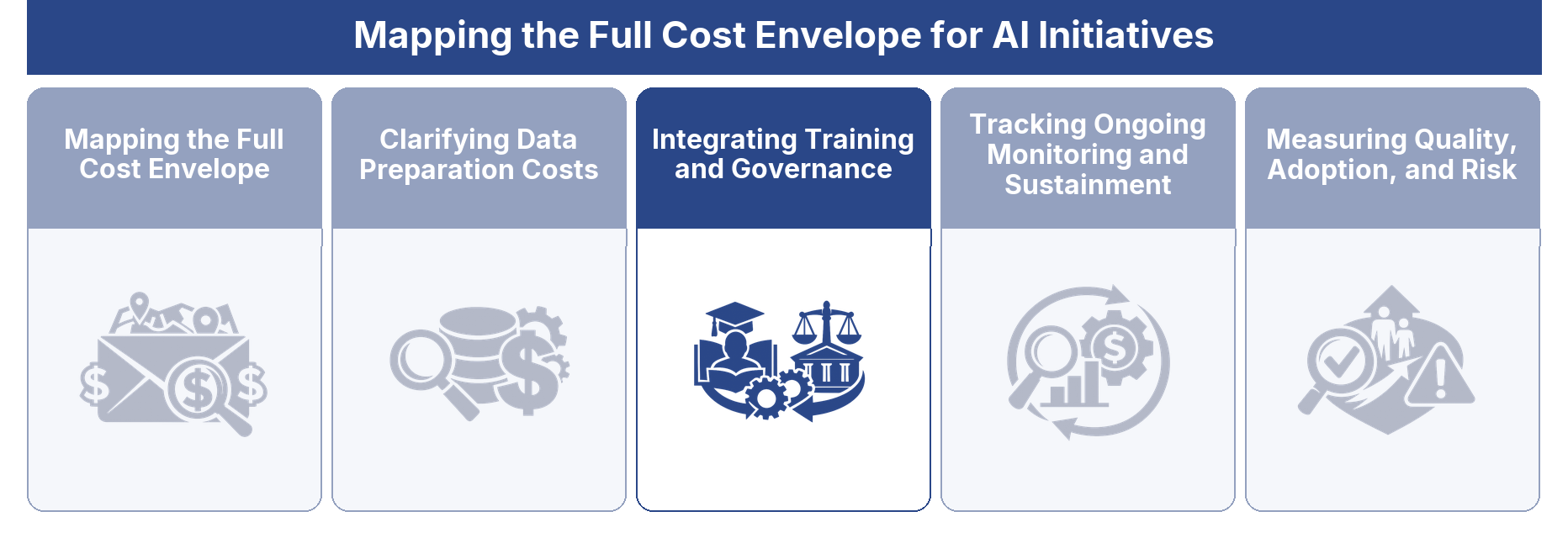
Human review is a variable operating expense, not temporary support. Reviewers, exception managers, process owners, security personnel, and compliance specialists become part of the production system whenever outputs require judgment before acceptance. Their effort should be modeled alongside inference and infrastructure costs.
Training and governance must enter the business case before deployment. Procurement, finance, operations, security, and IT need role specific training, while governance must define approval rights, escalation paths, documentation standards, and acceptable use boundaries. The Stanford AI Index reports adoption reaching 88% of surveyed organizations in 2025, while agent use remained early, signaling broad experimentation without uniform operating maturity. Benefit credit should remain withheld until the trained user population reaches the level assumed in the financial model.
Tracking Ongoing Monitoring and Sustainment
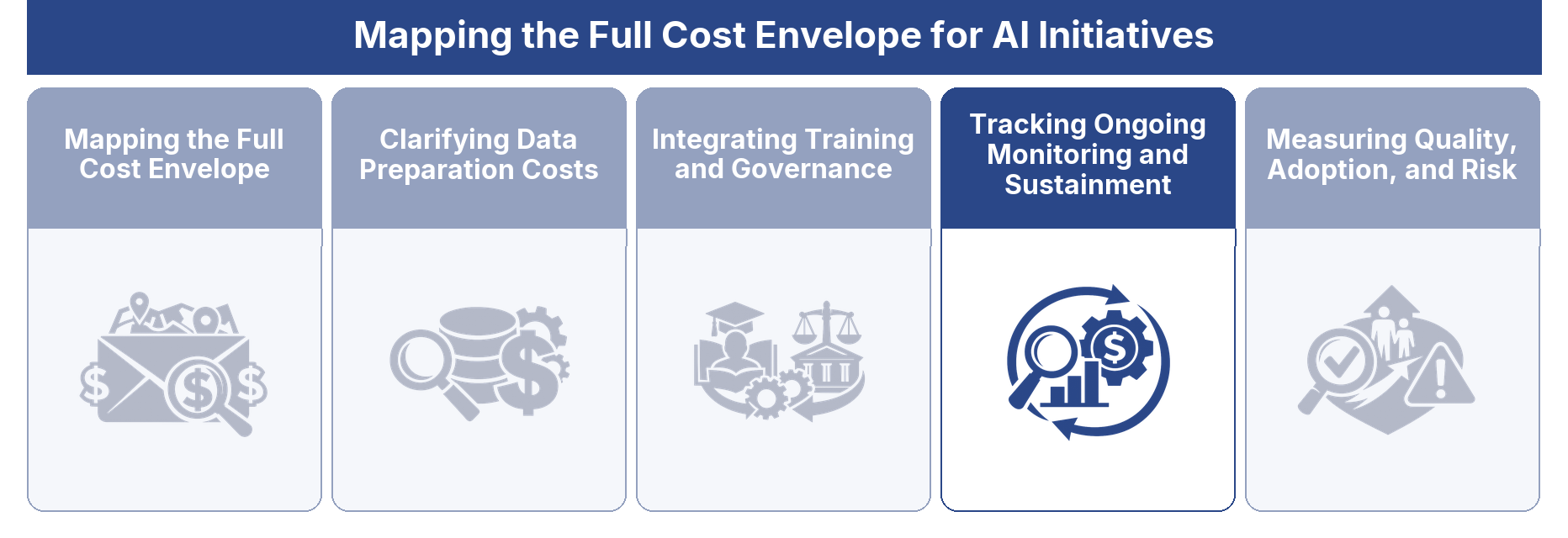
Run costs emerge gradually, after organizational momentum has made retrenchment difficult. Inference volume, cloud consumption, model updates, incident response, retraining, vendor changes, performance drift, and recurring review labor can all change the economics. This variable cost structure makes cost per accepted output more decision useful than deployment spend alone.
Monitoring should track cost per transaction, cost per accepted output, latency, override rates, incident frequency, quality against the approved threshold, and labor required to keep the system usable. NIST’s system lifecycle controls connect ongoing assessment with authorization and control effectiveness. Before deployment, the IMO should establish a redesign trigger, such as sustained cost escalation or material quality decline. If review labor rises faster than output volume, the organization should narrow the use case, redesign the workflow, or stop funding the system.
Measuring Quality, Adoption, and Risk
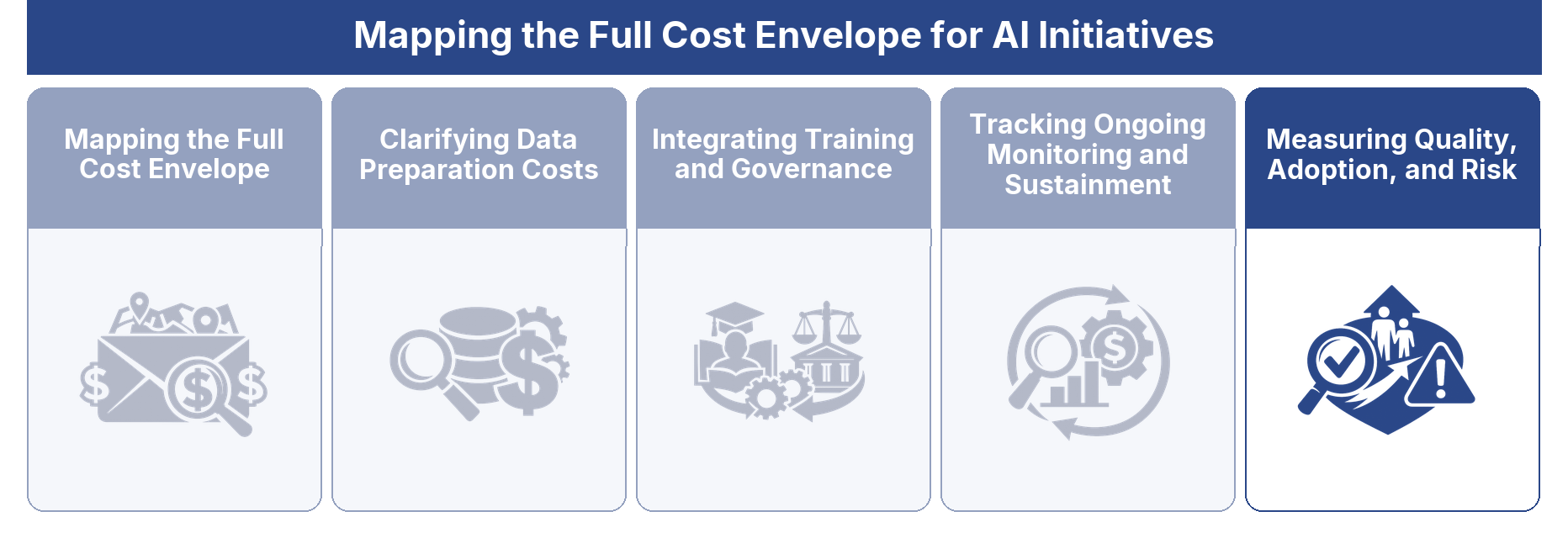
The final mechanism is proving that operating expenditure produces economic value rather than activity. Saving 20 minutes per case creates no measurable benefit if employees simply absorb the time; finance should recognize value only when released capacity supports avoided hiring, higher throughput, lower external spend, or improved service levels.
The Stanford AI Index cites gains ranging from 14% to 15% in customer support, 26% in software development, and 50% in marketing output, but those figures are directional rather than guaranteed returns. A disciplined scorecard should connect benefits to adoption, accepted outputs, cycle time reduction, error severity, customer impact, and regulatory exposure. NIST’s trustworthy AI principles also frame the costs of validity, safety, security, accountability, transparency, explainability, privacy, and fairness.
Scale approval should remain withheld until three conditions hold: adoption reaches the modeled level, cost per accepted output is stable or declining, and released capacity meets the original economic hurdle. If any condition fails, the initiative should be redesigned or stopped before additional volume converts an unresolved cost problem into a structural drain on growth capital.
Summarizing Cohesive AI Cost Realization
Finance leaders can treat artificial intelligence as a value opportunity only when the investment case captures the full economic burden behind the headline return. Model licenses and deployment fees are visible, but data preparation, infrastructure, security, workflow redesign, talent, governance, adoption, and ongoing model operations determine whether projected value survives contact with the business. A complete cost map therefore serves as more than a finance control. It protects capital for growth, exposes fragile assumptions before approval, and gives operating leaders a credible basis for deciding where AI can create durable competitive advantage.
Looking ahead, disciplined practitioners should establish a complete cost map before funding approval, scope one time and recurring commitments across the operating model, and instrument both spending and realized usage from launch. Finance, technology, and business owners should formalize decision rights, codify escalation thresholds, and govern the initiative through measurable checkpoints rather than optimistic forecasts. That operating discipline changes the investment conversation from whether a model can be deployed to whether the organization can capture value at an acceptable cost. The mandate for Monday morning is clear: build the economics first, then deploy the technology against them.

Get new articles by email
Insights on M&A, revenue growth, and business transformation, delivered occasionally.