

Salary Versus Subscription Is a False Comparison
In 2025, ServiceNow, an enterprise software company, agreed to acquire Moveworks for about $2.85 billion to extend agentic artificial intelligence (AI) into front-line employee experiences. The deal’s rationale reached beyond software seats, since redesigned workflows could change how employees allocate productive time. Yet a subscription-led integration model can count licenses while excluding implementation, data preparation, training, governance, review, and rework. The economics can look attractive on paper while operating reality tells a different story.
Salary-based labor is not a fixed proxy for value because fully loaded compensation, productive hours, redeployment, and outcome quality determine automation economics. AI programs also create costs through data acquisition, integration, monitoring, and sustainment, even when subscription prices appear modest. Without governance that tracks capacity creation and payroll effects, ROI can overstate savings and understate risk. Why is salary based labor a misleading baseline for AI ROI, and how should organizations calculate true value with a labor centric TCO?
Shifting from price tags to value metrics makes AI decisions more rigorous by measuring cost per acceptable outcome, not cost per seat. A labor centric total cost of ownership model connects technology spending to workflow redesign, capacity redeployment, and operating performance. In M&A, that discipline protects value creation by exposing hidden cost drift before integration choices harden. Executives can compare build, buy, and integration paths with greater precision.

Framing Labor Economics for AI Decisions
AI decisions often begin with the wrong benchmark: the subscription price per seat. That measure may be easy to compare, but it says little about the labor value a system replaces, augments, or redirects. According to Stanford HAI, employment in AI exposed roles such as software development and customer service has declined by more than 4% this year, a signal that labor market effects are already material, even though the productivity consequences vary by task and workflow. The commercial question is therefore not whether an AI license costs less than an employee, but whether the investment produces an acceptable outcome at a lower fully loaded cost.
Recent transactions show the same pattern at every scale. Salesforce acquired Slack for about $27.7 billion to anchor its collaboration layer across Customer 360. In 2025, Salesforce-Informatica set the template: Salesforce agreed to acquire Informatica for about $8 billion to strengthen the trusted data foundation behind its agentic AI. In 2017, Amazon-Whole Foods set the template: Amazon acquired Whole Foods for about $13.7 billion to combine e-commerce logistics with physical grocery retail.
A credible baseline starts with base pay, benefits, employer taxes, facilities, management overhead, technology support, and the number of productive hours actually available. Gross annual salary is not a labor cost model. If an employee spends part of the day in coordination, rework, training, compliance, and idle capacity, those factors must shape the denominator used to calculate cost per completed task, resolved case, qualified lead, or other accepted outcome. Earlier analysis of technology investment economics established the same discipline: value depends on connecting spending to productivity, revenue, and market position rather than treating adoption as an isolated procurement decision.
AI specific costs then belong inside Total Cost of Ownership (TCO), not in a footnote below the software quote. The model should capture licenses, usage based inference, data preparation, integration, cybersecurity, model monitoring, training, change management, human review, and the cost of redesigning work around the system. It should also account for failure costs, including inaccurate outputs, escalations, regulatory remediation, and reduced throughput during the transition. A 2025 review of AI and jobs reinforces why simple substitution models remain inadequate: labor effects depend on how tasks and occupations change, not merely on whether a tool is available.
This framing changes capital allocation. A system with a higher seat price may create superior economics if it eliminates rework, expands capacity, or allows scarce specialists to focus on higher value activities. Conversely, a low cost tool may destroy value when adoption requires extensive oversight or leaves core bottlenecks untouched. Comprehensive TCoA analysis makes that hidden cost drift visible, giving executives a stronger basis for comparing current workflows with redesigned ones and for setting KPIs around outcomes, capacity, quality, and risk.
Revealing Hidden AI Cost Drivers
An AI subscription rarely represents the full economic commitment. Integration work, data preparation, access controls, model evaluation, workflow redesign, and ongoing monitoring can determine whether the purchase creates capacity or merely adds another layer of technology overhead. Earlier analysis of total acquisition cost applies the same discipline to AI: the visible price is only one line in the value equation. The hidden lines often determine the outcome.
Infrastructure costs can also rise after deployment, particularly as usage expands and workflows become more complex. Research on frontier models found that the amortized cost of training the most compute intensive systems increased at 2.4 times per year since 2016, while server components accounted for 15% to 22% of total costs. Although most enterprises consume models rather than train them, the underlying lesson remains relevant: scale changes the cost base. McKinsey’s analysis of AI inference economics reinforces the need to model recurring compute, data movement, and serving requirements rather than treating the subscription as a fixed expense.
Labor economics create a second layer of complexity. AI may reduce time spent on routine work, but the resulting capacity does not automatically become savings. Employees may redirect that capacity toward higher value activities, managers may need to redesign roles, and payroll may remain unchanged while output improves. The 2026 Stanford AI Index reports that 88% of surveyed organizations had adopted AI in 2025, with reported gains ranging from 14% to 15% in customer support, 26% in software development, and 50% in marketing output. Those gains become real return on investment only when operating leaders define how capacity will be redeployed, measured, and converted into growth, quality, or avoided hiring.
Governance prevents the model from becoming a cost drift mechanism. Errors generate review time, rework consumes capacity, and changing workflows can increase usage without improving outcomes. The NIST AI Risk Management Framework calls for structured management of AI risks across the system lifecycle, while NIST’s research on monitoring deployed AI systems highlights the practical difficulty of detecting performance changes after launch. A disciplined cost model therefore tracks subscription fees, integration effort, data operations, workforce redeployment, error rates, and governance labor together, extending the case for comprehensive TCoA analysis into the operating life of the AI investment.
Operationalizing Labor Centric TCO for AI
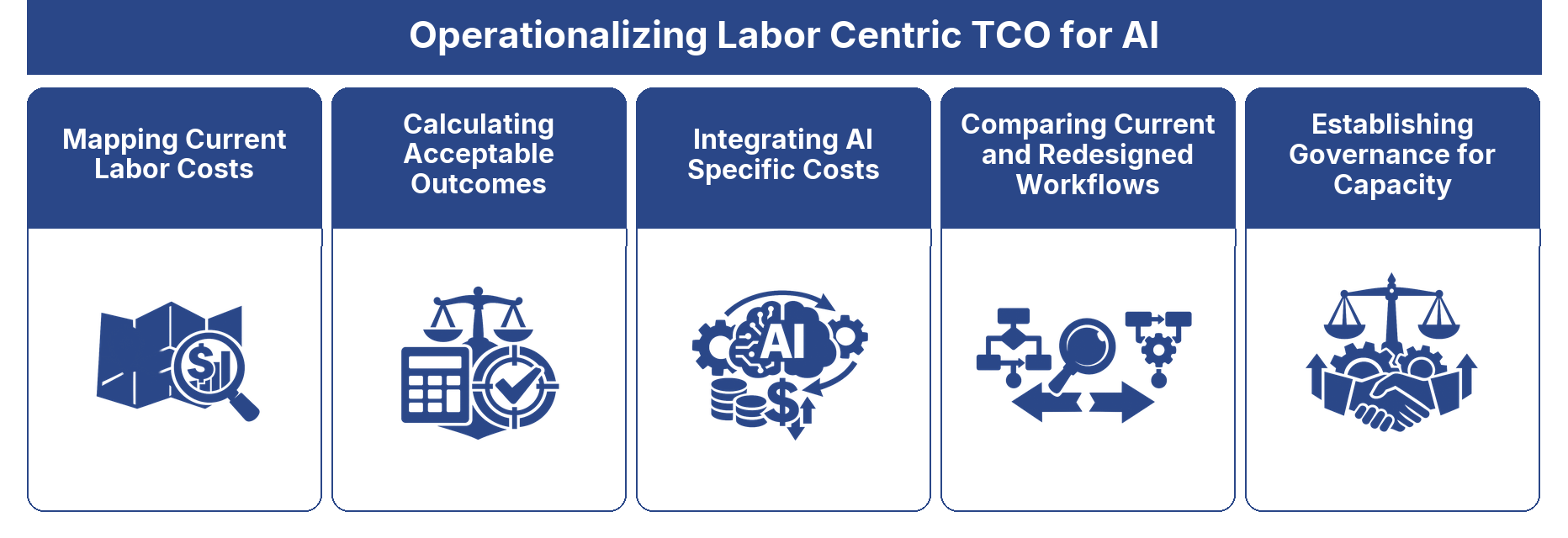
A post acquisition AI program can destroy deal value even when the buyer reports fewer roles and lower unit costs. The failure sequence is usually predictable: the buyer counts eliminated positions, inherits review work and fragmented workflows, then discovers that the synergy case depended on capacity no function was accountable for capturing. Microsoft’s approximately $26 billion acquisition of LinkedIn in 2016 illustrates the strategic alternative: Microsoft preserved LinkedIn’s largely autonomous operating model to protect the network whose value justified the transaction. Labor economics must therefore be modeled around workflow ownership, not headcount reduction.
A labor centric Total Cost of Ownership (TCO) model converts AI ambition into a merger decision by separating three outcomes that are often confused: time released, payroll actually removed, and output or quality actually improved. The sequence is decision specific. Baseline labor before procurement, define the performance threshold in the merger model, price controls and integration, compare the end to end workflows, then assign every recovered hour to an accountable owner. A synergy claim without that final assignment is not a synergy claim.
EY estimates that white collar industries would need to reduce labor costs by nearly 15.8% or increase output by 10.5% by 2031 to earn a market return on projected AI investment. That threshold cannot be evaluated through subscription pricing alone. Earlier technology infrastructure assessment work reinforces the need to connect capability choices with operating requirements.
Mapping Current Labor Costs
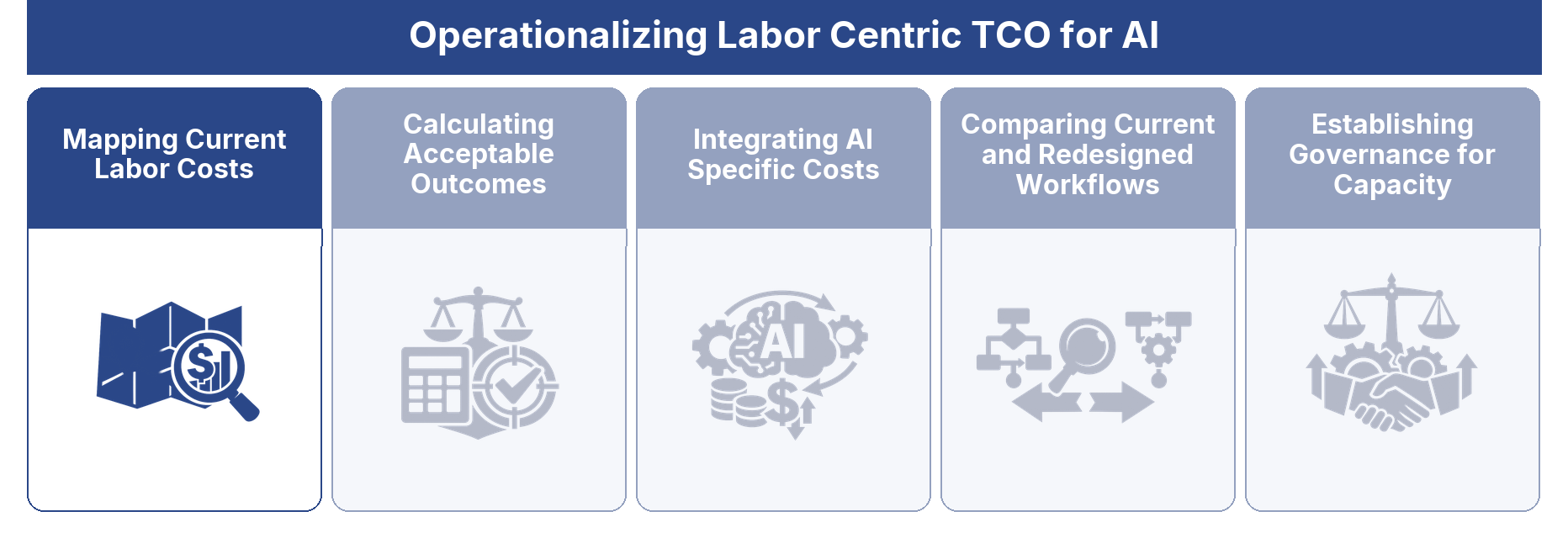
The baseline must capture the full labor system behind a process before procurement begins: employee time, contractor support, management review, rework, escalations, training, and the effort required to move information between systems. A customer service workflow that appears to require 100 agents may also consume supervisory capacity, quality assurance hours, and specialist intervention when cases exceed standard rules. Those costs belong in the merger model because eliminating agent positions without measuring the retained review layer overstates synergy.
Microsoft’s acquisition of LinkedIn for approximately $26 billion shows why workflow and operating model context matter. Microsoft’s decision to keep LinkedIn largely autonomous protected the network, brand, and user relationships that created the strategic rationale, rather than forcing immediate consolidation for an easily reported headcount benefit. Finance leaders should measure task volume, handling time, error rates, escalation frequency, and fully loaded labor cost by workflow. A process map becomes the economic foundation.
McKinsey’s research on AI value curve economics emphasizes that value depends on how AI changes existing work, not simply on model access. The relevant question is not how many roles appear removable, but which activities disappear, which activities remain, and who owns the residual work.
Calculating Acceptable Outcomes
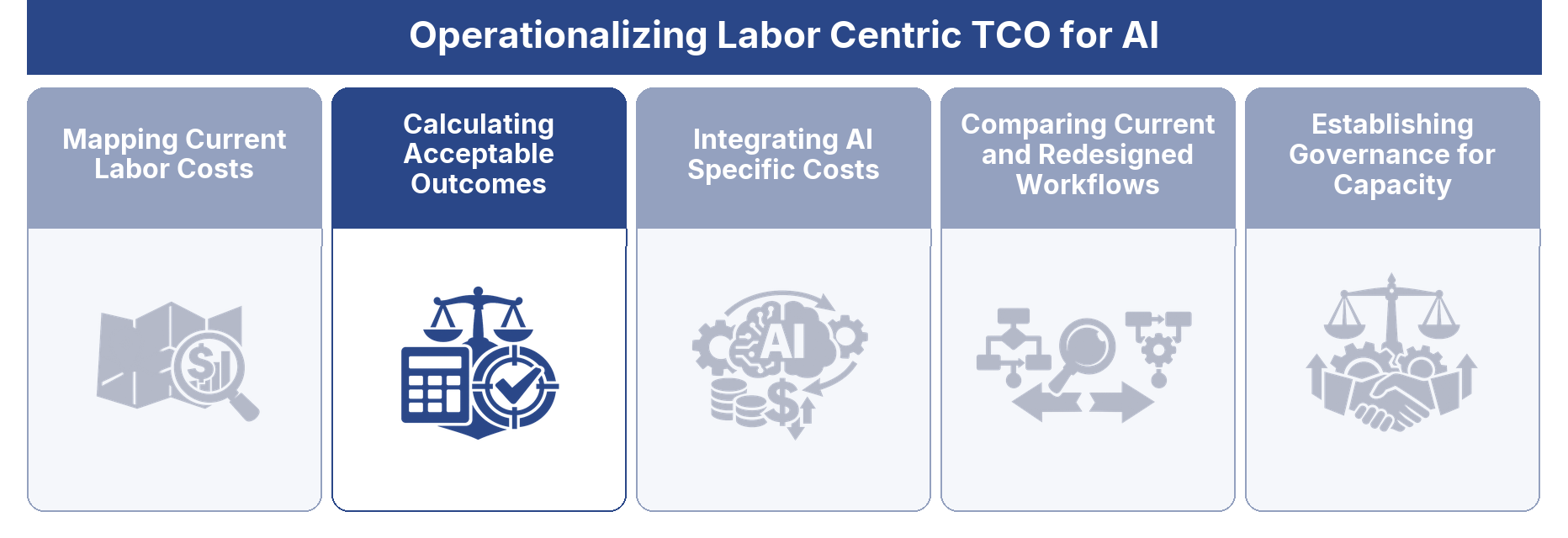
AI should not be approved because a pilot produces a lower unit cost. The business case should define an acceptable outcome across financial return, service performance, and workforce capacity, with each measure tied to the deal thesis. A reduction in handling time that increases errors or customer churn is not value creation, while stable cost paired with materially higher throughput may justify investment if the organization can absorb the demand.
EY estimates that global white collar labor costs will reach $38 trillion in 2031. Its analysis of the labor reduction threshold indicates that required gains cannot come from isolated automation projects. Leadership should therefore set thresholds for payback, accuracy, response time, and redeployment before implementation begins, while the merger model should distinguish hours released from payroll removed. That distinction exposes whether the transaction creates cash savings, capacity for growth, or only theoretical efficiency.
The economic hurdle is consequential. If an AI workflow releases 10,000 hours but no business unit accepts the capacity, the hours have not become a synergy. They remain an unpriced operating option.
Integrating AI Specific Costs
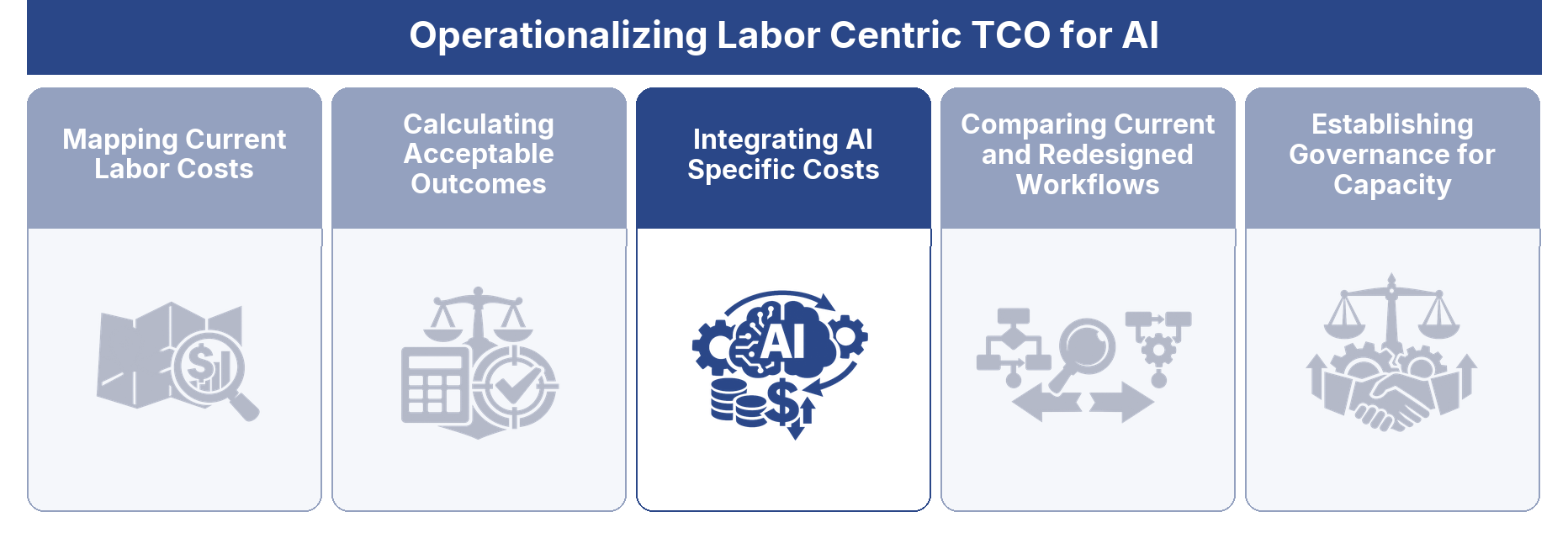
The AI cost stack extends beyond licenses or token charges. It includes data preparation, application programming interface usage, retrieval infrastructure, security reviews, model monitoring, human validation, integration work, change management, and periodic evaluation as models or policies change. Governance labor must be treated as a recurring operating cost, not a one time launch expense, because every control that protects quality also consumes capacity.
Boston Consulting Group’s guidance on generative AI investment choices supports evaluating investment against business value and organizational readiness. The same discipline applies to post merger deployments: every use case should show which costs are fixed, which vary with volume, and which increase as exceptions or review requirements grow. Earlier integration cost management analysis offers a useful parallel, because hidden operating expenses can absorb apparent synergies even when the headline technology price appears modest.
The procurement gate should therefore require a full cost stack, not a software quote. If a buyer cannot price validation, monitoring, integration, and exception handling, the AI case is incomplete before the first contract is signed.
Comparing Current and Redesigned Workflows
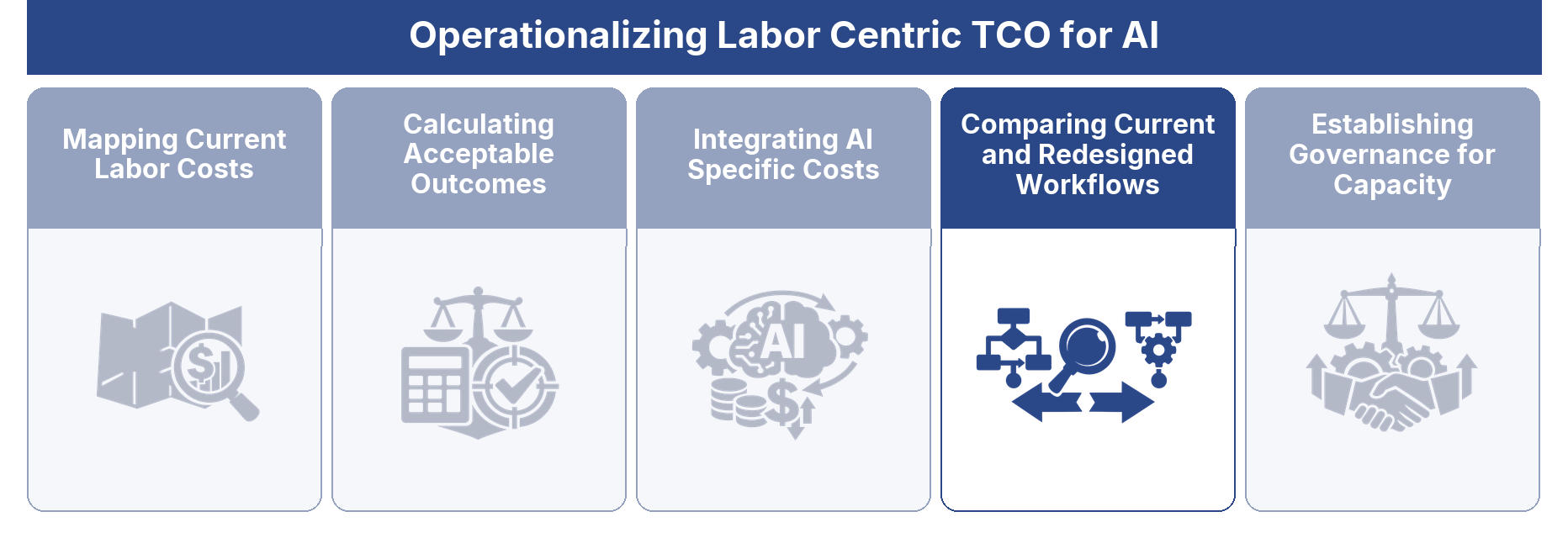
The relevant comparison is not employee cost versus software cost. It is the current workflow versus the redesigned workflow, including every human and technical handoff. The redesigned version should specify which tasks AI performs, where employees review outputs, what triggers escalation, and how exceptions return to the process owner.
Deloitte’s analysis of AI economics and operating models underscores the importance of connecting technology economics with process redesign. A credible comparison measures cycle time, first pass accuracy, backlog, quality assurance effort, and capacity released. It also records whether released capacity becomes payroll reduction, higher throughput, faster service, or additional review work.
If AI eliminates drafting but creates a larger verification queue, the workflow has shifted rather than improved. If the buyer consolidates systems but leaves employees reconciling duplicate data across acquired and legacy platforms, the integration has created a new labor burden. The merger model must price that consequence before management treats automation as synergy realization.
Establishing Governance for Capacity
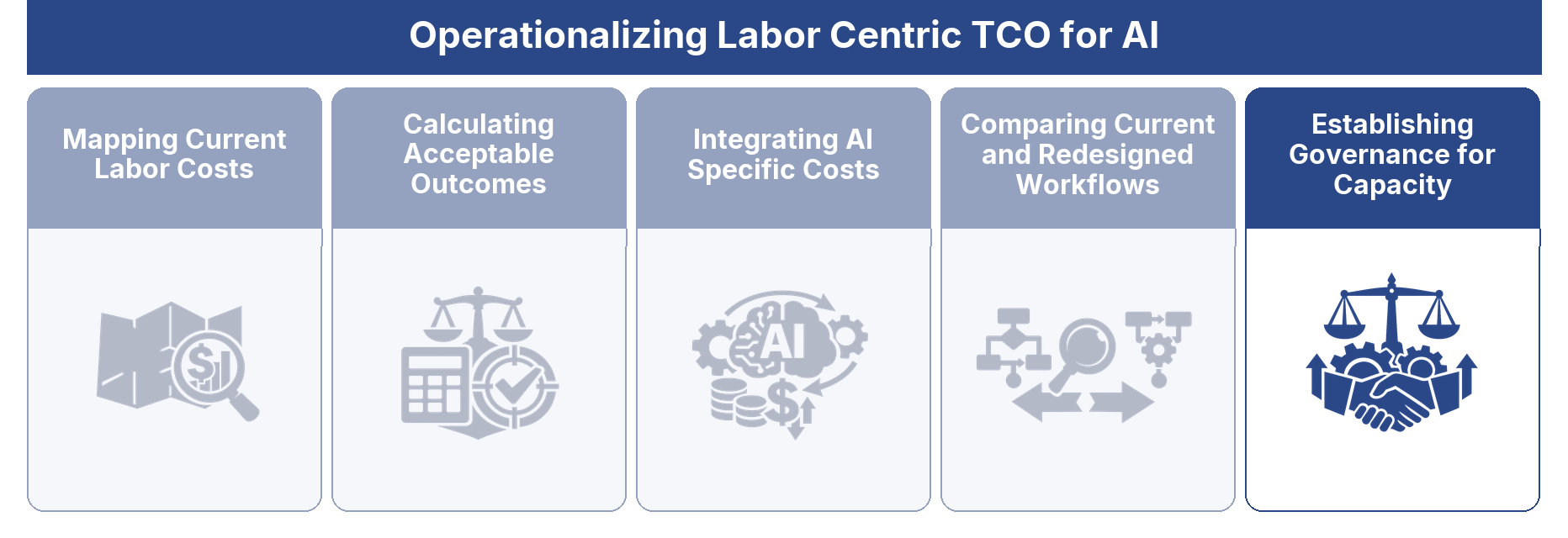
Released labor does not automatically become value. Capacity becomes economically meaningful only when an accountable owner decides where it goes, records the decision, and measures the resulting output or cost change. Without that governance, hours may disappear into lower priority work, managers may absorb additional demand, or employees may spend the savings on quality checks that the original business case ignored.
An Integration Management Office (IMO), transformation office, or designated operating council should maintain a capacity register covering hours released, payroll removed, redeployment decisions, service outcomes, control costs, and realized financial impact. Gartner forecasts worldwide AI spending to rise from $1.76 trillion in 2025 to $2.6 trillion in 2026, increasing the pressure to distinguish productive scale from uncontrolled adoption. Scale without ownership multiplies ambiguity.
Governance should assign responsibility for approving use cases, monitoring performance, funding controls, and deciding where capacity moves. The synergy case fails when no accountable leader owns the recovered hours. The operating rule is simple: assign every recovered hour, price every control, and stop calling unallocated capacity a synergy.
Consolidating Labor Centric ROI Across AI Programs
Salary is a poor benchmark for AI value because automation changes both the cost and the composition of work. The most consequential driver is released capacity: if employees spend less time on a process but no manager assigns the recovered hours to revenue, customer retention, or higher value analysis, the saving remains theoretical. The second driver is control cost, including data preparation, security review, exception handling, and ongoing supervision; omitting these expenses creates an attractive business case that becomes more expensive after launch. The third driver is quality, because rework, customer friction, and escalation can erase nominal labor savings even when adoption appears strong. A labor centric Total Cost of Ownership (TCO) model should rank these drivers in that order rather than treating the subscription fee as the central economic variable.
Consider an AI system that drafts customer service responses. The hours released from drafting do not become financial value when employees simply absorb more queue volume without a defined service target, nor when managers count faster production while error rates increase. Realized value emerges only when the organization redeploys the capacity to a measurable outcome, confirms that utilization remains high, verifies that quality holds, and decides whether the resulting productivity supports slower hiring, reduced overtime, or a smaller external services budget. That sequence converts automation into an operating decision. Without it, the organization records activity but not value creation.
The same discipline shaped the logic behind Microsoft’s largely autonomous integration of LinkedIn after the $26 billion acquisition in 2016: preserving workflow ownership and organizational capacity was part of protecting the strategic thesis, not an administrative detail. AI investments require the same clarity about who owns the workflow, who captures released capacity, and which metric proves that customer outcomes improved. Executives should baseline the work before procurement, price the controls before approval, assign every recovered hour to a defined business outcome, and stop funding use cases that cannot prove conversion from automation into financial value.

Get new articles by email
Insights on M&A, revenue growth, and business transformation, delivered occasionally.