

The Only Savings That Count Are Captured
In 2019, IBM acquired Red Hat for about $34 billion, while deliberately preserving the target’s operational independence and open-source culture. The structure protected the capabilities IBM sought in hybrid cloud, but it also made value capture less visible than a conventional cost program. Integration leaders could not treat every productivity gain, avoided hire, or faster cycle as cash savings without tracing the operational change to a financial outcome. Stakeholders therefore faced a demanding test: preserve autonomy while proving that the investment generated measurable economic value. IBM’s acquisition of Red Hat made a broader lesson concrete: strategic intent creates potential, but only captured benefits support the business case.
Artificial intelligence programs intensify that challenge because reported time savings can remain trapped in dashboards, rather than appearing as reduced labor cost, redeployed capacity, or avoided hiring. Without agreed measures for adoption, utilization, quality, cycle time, and risk, finance teams can overstate returns while operating teams absorb the effort of change. How can finance leaders ensure that only captured, realized savings count toward the AI business case, and what governance is required to sustain them?
Realized value depends on connecting operational improvements to verifiable financial outcomes through defined milestones, accountable owners, and regular status reporting. An Integration Management Office (IMO) can govern that connection, while reinvestment plans preserve momentum after initial savings appear. As AI adoption spreads across business units and deal integration becomes more complex, disciplined measurement becomes a strategic imperative, not an administrative exercise. Durable value emerges when experimentation, execution, and cash realization operate as one managed system.

Framing Realized Savings Landscape
Finance leaders often enter artificial intelligence initiatives with two promises in view: faster insight and lower operating cost. The gap appears after deployment, when minutes saved in analysis do not automatically become payroll reduction, avoided hiring, or additional capacity. Research on AI productivity potential shows why potential alone does not establish value creation: employees must adopt the tools, processes must change, and finance must validate the resulting economic effect. A faster process can produce no cash benefit if headcount, workload, and operating decisions remain unchanged.
McKinsey’s research on procurement value capture makes the broader point: savings require accountable ownership, disciplined measurement, and execution after the opportunity has been identified. The same logic applies to finance automation, but one category is especially vulnerable to misclassification. Released employee time is capacity first, not savings. Finance should recognize a saving only after management documents a consequential decision, such as holding an approved role vacant or removing contractor spend against a defined baseline.
Public reporting provides a useful illustration of the difference between a forecast and a realized result. In 2016, Chubb reported administrative cost savings of $223 million associated with its acquisition of The Chubb Corporation, contributing 0.8 percentage points to the administrative expense ratio. The disclosure connected the claimed benefit to a financial measure rather than to an estimate of effort avoided. That discipline prevents broad efficiency language from being mistaken for cash realization when growth, reinvestment, or one time costs obscure the underlying effect.
A practical value capture framework therefore separates labor shifts, capacity creation, and avoided hiring, while sequencing them rather than treating them as interchangeable outcomes. Capacity creation must be measured first; only then can finance test whether the organization absorbed more workload without hiring or removed external spend. Early reinvestment can conceal an unverified benefit, while adoption reporting can show tool usage without proving that the cost base changed. The six part operating framework, spanning milestones, governance, reinvestment, utilization, quality and cycle time, and risk and compliance, works as a causal chain: establish the baseline, verify the benefit, protect the gain, test sustained use, confirm operating performance, and monitor whether risk weakens the result.
Reversing that order creates false confidence. Earlier work on integration cost management similarly distinguishes projected synergies from benefits that governance can verify. Capacity is not savings until management acts on it.
Clarifying Barriers to Realized Value
Time saved is an operating benefit, not cash. An employee who completes a task in two hours instead of four has created capacity, but return on investment (ROI) remains overstated unless that capacity reduces hiring, increases throughput, or supports measurable revenue and margin improvement. Treating every efficiency gain as immediate savings converts a possibility into a financial result before the business has changed. Prior analysis of integration costs draws the same distinction between projected synergies and benefits that management can verify.
The gap widens when governance ends at implementation. Savings can erode as teams redeploy capacity toward unrelated priorities, managers refill eliminated roles, or suppliers and technology costs absorb the apparent gain. Research from McKinsey on procurement transformation value emphasizes the need to connect transformation initiatives with sustained business outcomes rather than isolated activity measures. Without an Integration Management Office (IMO) or an equivalent owner tracking commitments after launch, the organization may report completed actions while the cost base remains unchanged.
Measurement also becomes difficult when business units define success differently. One unit may report adoption, another may report cycle time, and a third may focus on quality or risk, leaving finance to reconcile incompatible evidence after the fact. Harvard Business Review’s discussion of analytics execution barriers reinforces that technology alone does not resolve weak processes, unclear ownership, or inconsistent decision rights. The practical requirement is an integrated measurement chain: adoption demonstrates use, quality confirms performance, cycle time shows capacity released, and risk controls establish whether the benefit can endure.
That chain should connect operational indicators to financial consequences at the initiative level, while governance tests whether those consequences persist through redeployment and changing demand. The NIST AI Risk Management Framework similarly places governance, measurement, and ongoing risk management at the center of accountable deployment. The six part operating framework therefore treats milestones, governance, reinvestment, utilization, quality and cycle time, and risk and compliance as linked controls, not separate reporting categories. Earlier total cost of acquisition analysis supports the same discipline: value counts only when operational evidence reaches the financial statement.
Operationalizing Value Capture Framework
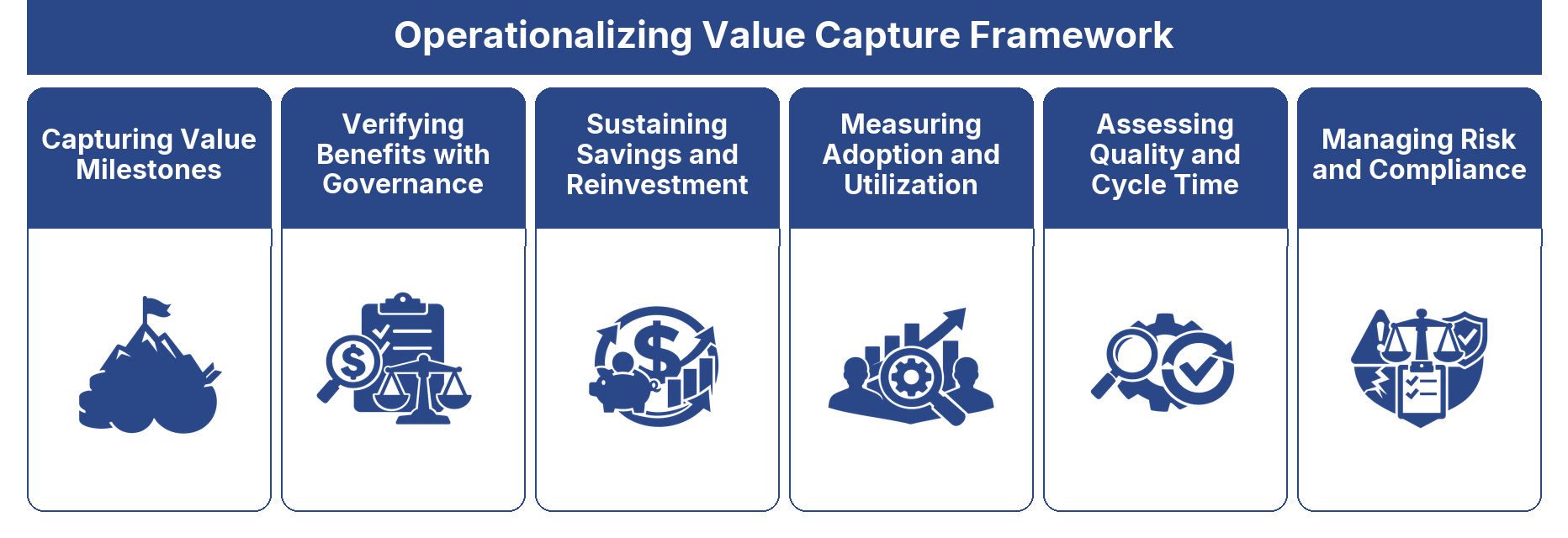
In IBM’s 2019 acquisition of Red Hat for about $34 billion, the value capture dilemma was unusually clear: IBM could not treat Red Hat’s independence as an inefficiency to eliminate because preserving its open source culture was part of the investment thesis. The acquirer therefore had to distinguish between costs that could be removed and operating choices that protected strategic value. The same discipline now applies to artificial intelligence (AI), where reported productivity gains can look attractive long before they affect staffing, contractor spend, service capacity, or the cost base. Value capture begins when financial claims translate into observable changes in behavior, output, and control.
The sequence matters. Teams must establish the baseline and assign ownership before measuring adoption, because usage without a defined starting point cannot prove improvement. They must verify cash or cost impact before authorizing reinvestment, because reinvestment too early can conceal leakage. The six controls below therefore operate as a causal chain: define the benefit, verify the claim, protect the gain, measure whether the capability is used, test whether performance holds, and monitor whether risk or compliance weakens the result.
Capturing Value Milestones
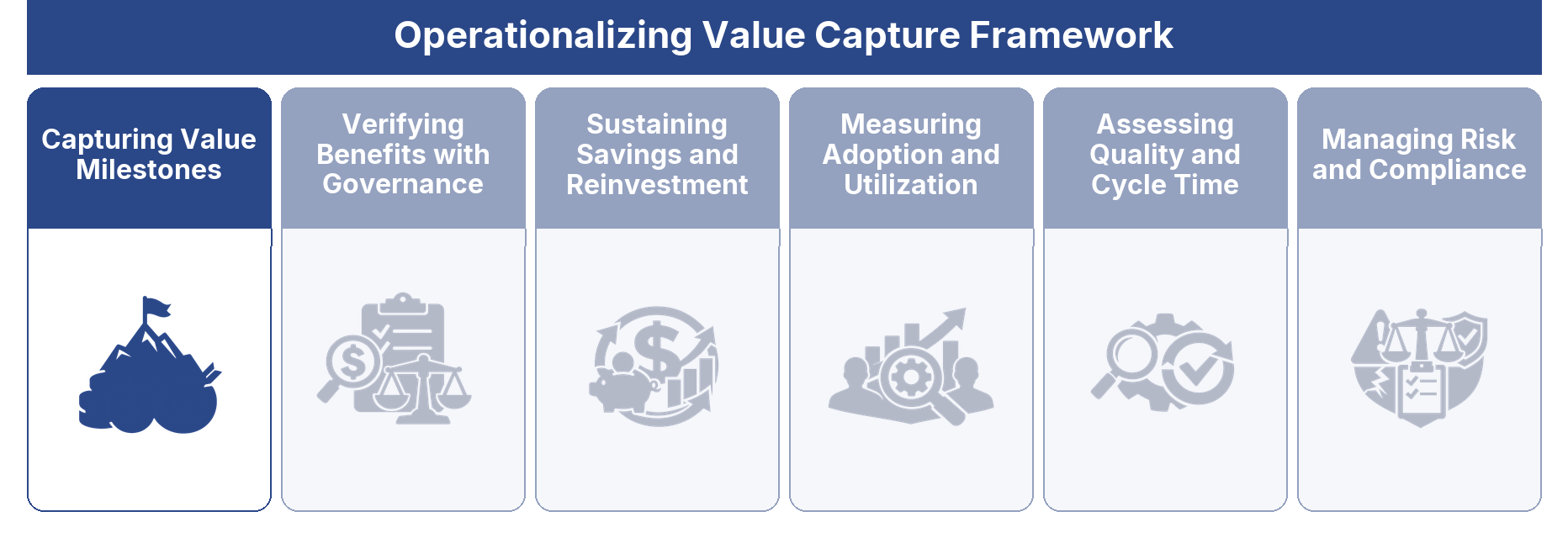
Each value lever needs a milestone that can be observed, dated, and reconciled to a financial owner. “Procurement savings identified” is not a milestone. “Contracted unit costs reduced by 8 percent across the approved supplier base, with invoices reflecting the new rates for two consecutive months” is verifiable. The same standard applies to headcount, infrastructure, pricing, cross sell, working capital, and AI enabled productivity.
Milestones should distinguish implementation from realization. A system migration may be complete while utilization remains low; a renegotiated contract may be signed while legacy purchasing continues. McKinsey’s research on the danger of value erosion from day one makes milestone design a strategic imperative rather than an administrative exercise. Ownership must come first because finance cannot test adoption, quality, or savings against a benefit that has no accountable operator.
Verifying Benefits with Governance
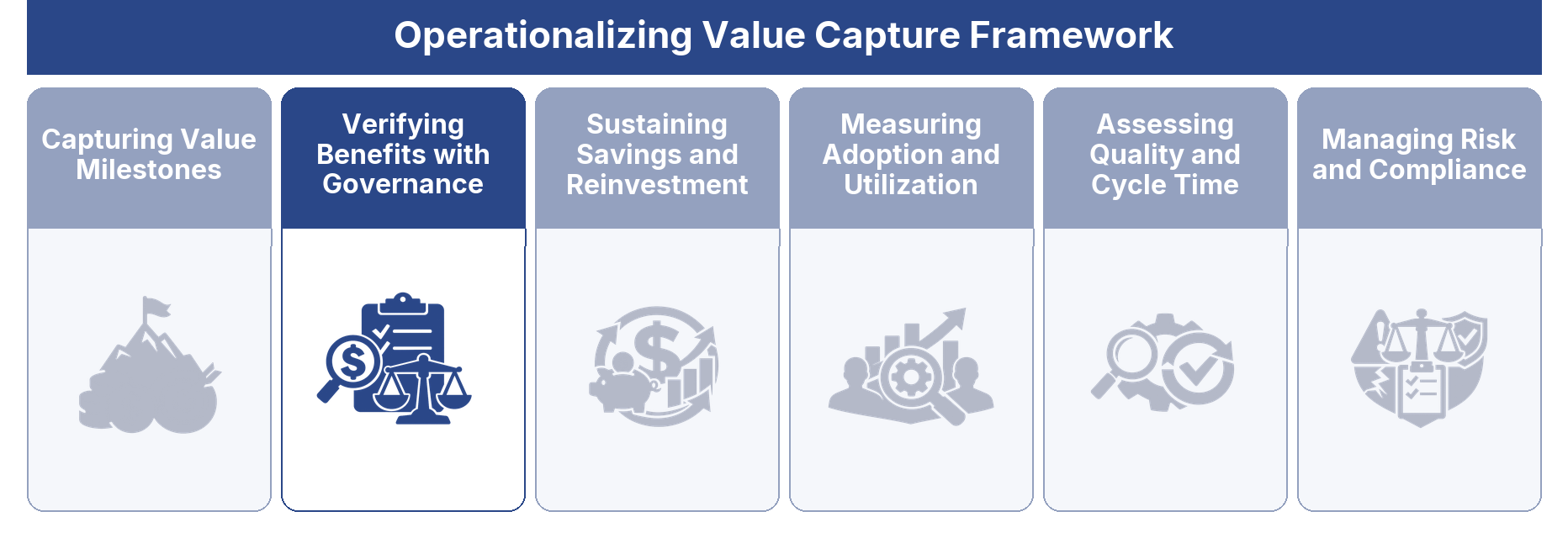
The Integration Management Office (IMO) should operate as the control point for benefit verification, not merely as a meeting coordinator. Each workstream should submit evidence against an agreed baseline, identify dependencies, explain variance, and obtain sign off from the accountable business executive and finance. A monthly benefit review should separate realized savings, forecast savings, one time costs, and benefits still at risk.
This governance model also prevents double counting. A technology team may report license savings while procurement reports the same contract reduction, or a workforce reduction may be credited without accounting for external contractor costs. The IMO should withhold a benefit claim when adoption rises but quality deterioration offsets the reported productivity gain. Harvard Business Review’s treatment of capturing more innovation value reinforces the distinction between creating value and capturing it. The former describes potential; the latter changes a budget, hiring plan, margin profile, or cash outcome.
Sustaining Savings and Reinvestment
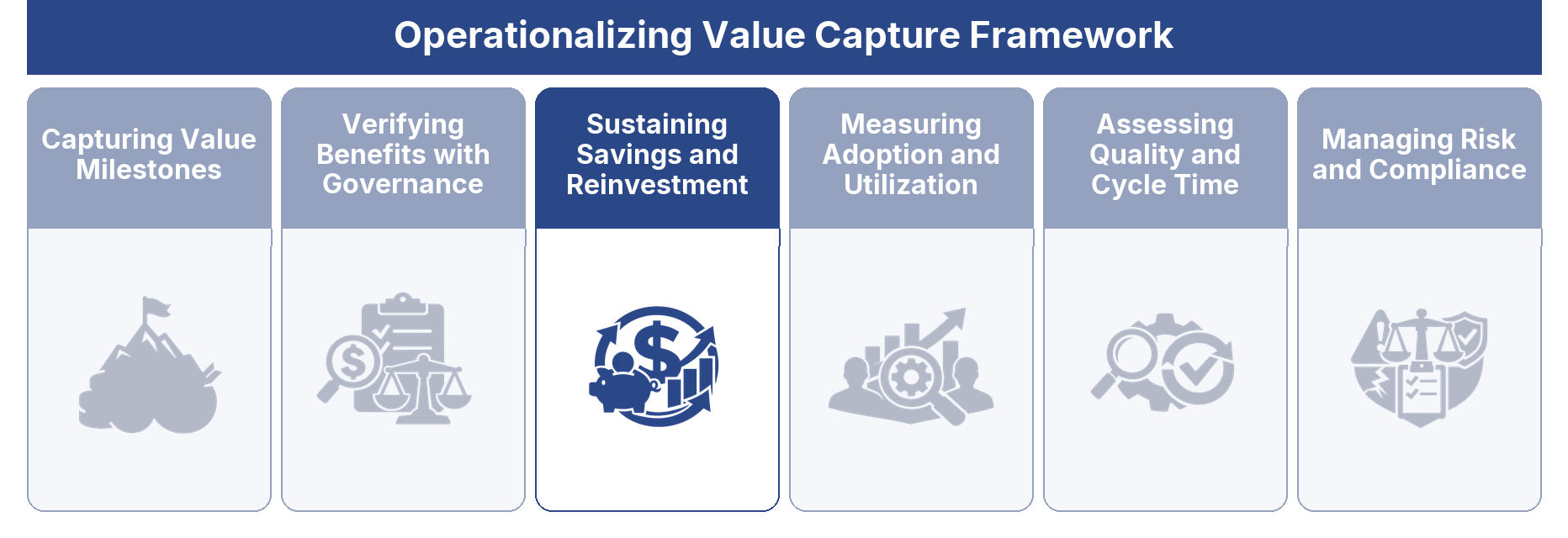
Savings require an owner after the integration team closes the workstream. A sustainment plan should specify the control activity, review frequency, escalation threshold, and responsible operating leader. Procurement savings may require preferred supplier compliance; technology savings may require automated license reclamation; pricing gains may require quarterly discount monitoring.
Reinvestment should follow confirmation, not precede it. If an AI workflow reduces handling time but the organization continues hiring at the previous rate, the benefit remains capacity rather than savings. Finance can convert that capacity into value by holding open roles vacant, absorbing additional workload without adding headcount, removing contractors, or reallocating the budget toward a higher return priority. Only after that decision is documented and reflected in the cost base or hiring plan should the organization treat the benefit as realized. KPMG’s research on increasing supply chain value supports treating operating improvements and reinvestment as connected value levers rather than isolated cost programs.
Measuring Adoption and Utilization
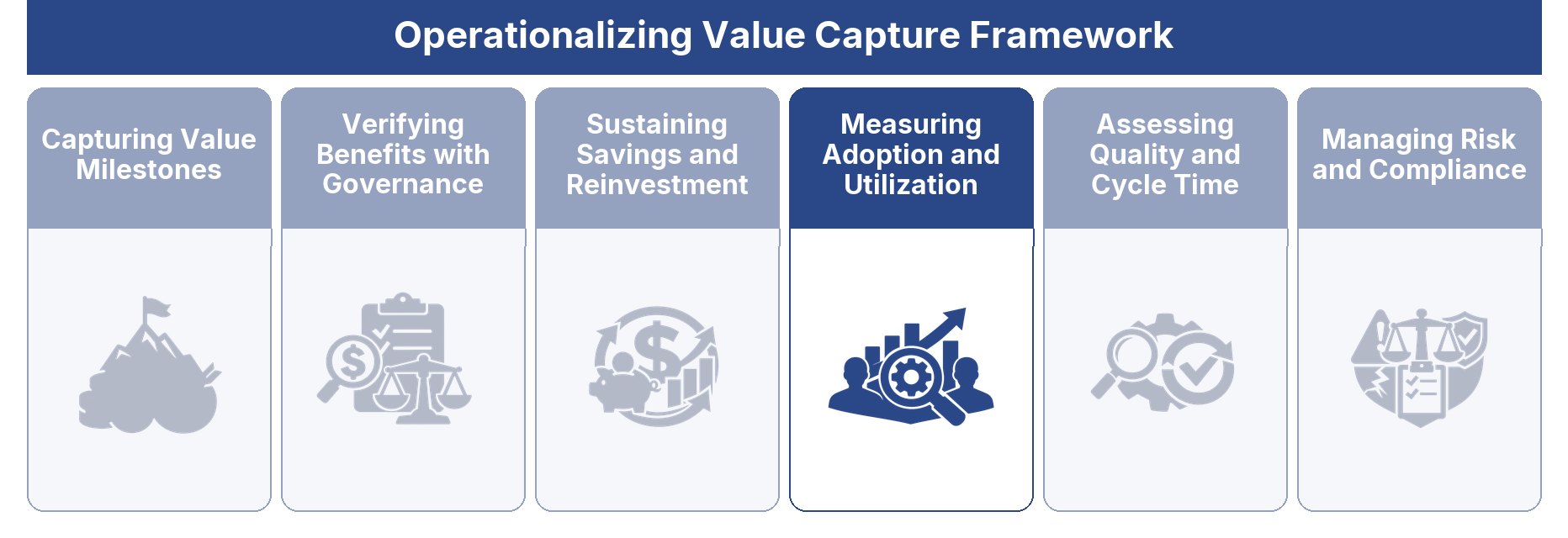
Adoption metrics reveal whether a delivered capability has entered daily operations, but they become useful only after the baseline, owner, and expected behavior are defined. Relevant measures may include active users, transaction volumes, workflow completion rates, feature utilization, exception rates, and training to proficiency intervals. The metric should connect directly to the value hypothesis: if automation is expected to reduce manual effort, utilization must be paired with hours removed from the process, workload absorbed, and verified service levels.
Training completion alone proves little. A stronger test combines attendance, knowledge assessment, observed behavior, and sustained use after 30 or 60 days. Earlier scalable process design similarly treats operational excellence as a repeatable management system, not a technology launch. Low adoption may signal weak usability, poor process design, inadequate incentives, or an incorrect value hypothesis. It should therefore trigger an operating decision, not merely a communications campaign.
Assessing Quality and Cycle Time
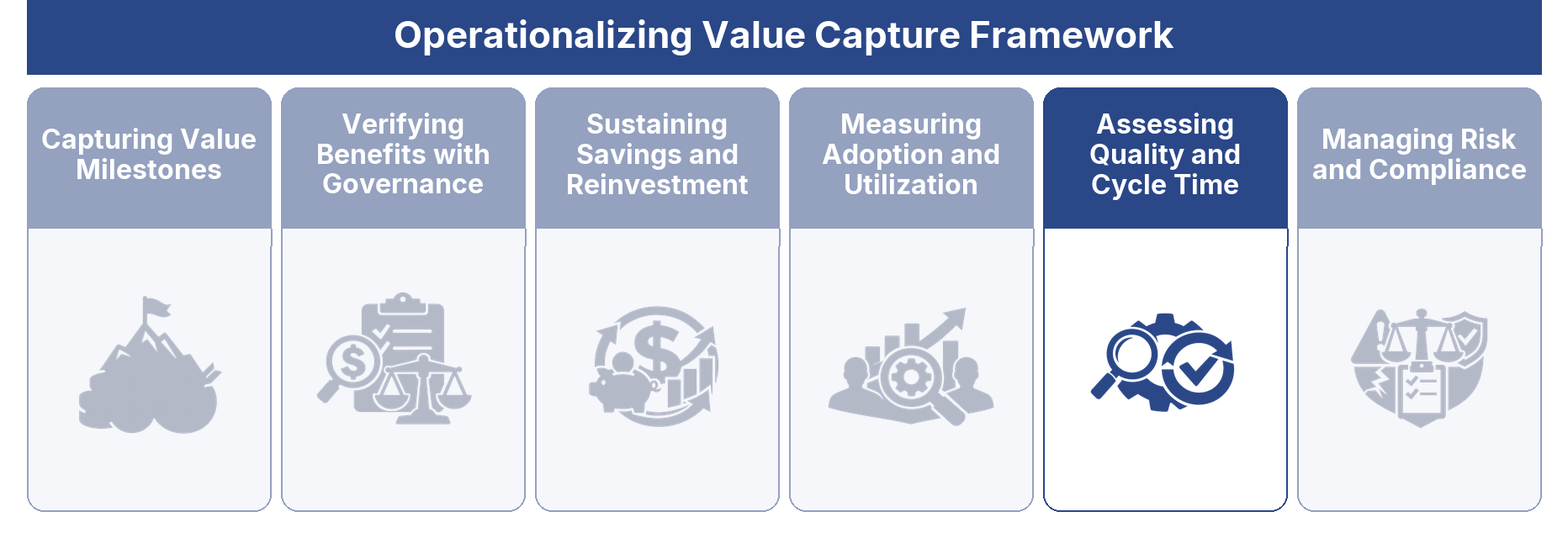
Efficiency gains become fragile when they reduce quality or create downstream rework. Every productivity milestone should pair cycle time improvement with a quality guardrail, such as error rates, customer complaints, first pass yield, service level attainment, or control exceptions. A process that closes tickets 20 percent faster but doubles escalations has not created durable value, regardless of what the productivity dashboard reports.
The IMO should establish a baseline before deployment and review trends after stabilization, rather than relying on a single favorable reporting period. Quality and speed should also be segmented by customer type, geography, product, and channel where performance varies materially. If an AI tool increases throughput for routine cases but lowers accuracy for complex cases, finance should reject the full benefit claim until the mix adjusted result is understood. This is where operational evidence changes resource allocation: a verified improvement can support a hiring freeze or contractor reduction, while an offsetting quality decline may require additional training, controls, or capacity.
Managing Risk and Compliance
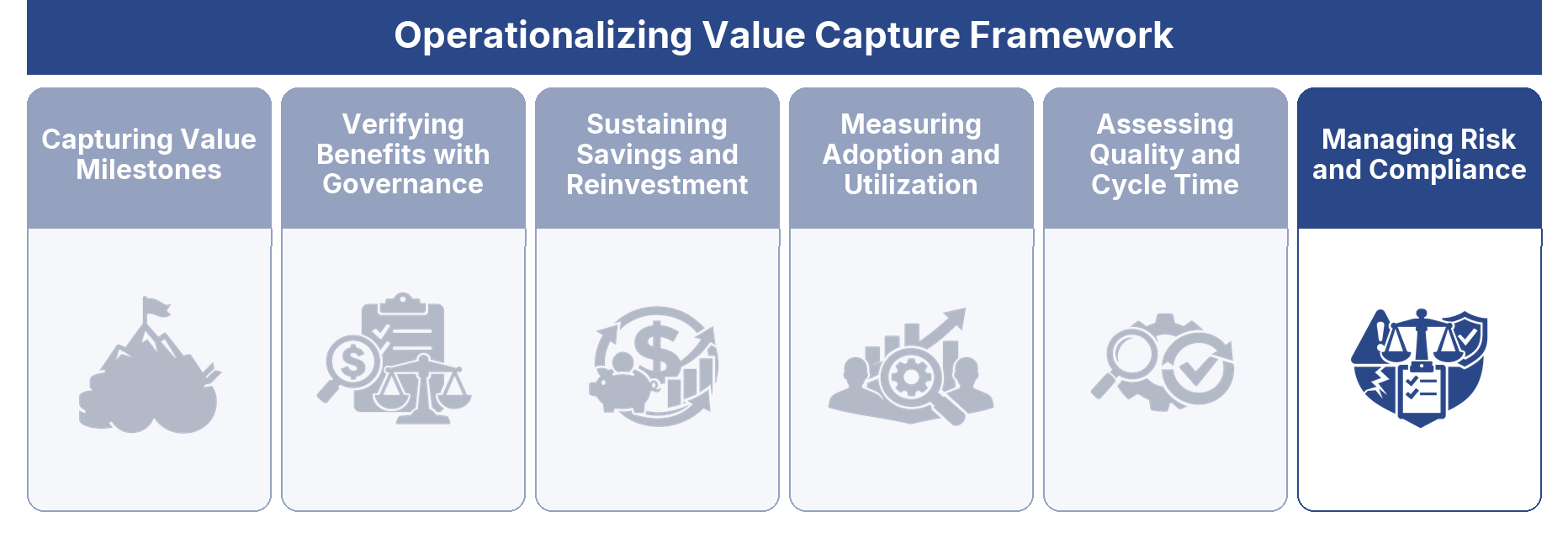
Risk controls protect the value that operating metrics appear to show. The assessment should cover regulatory obligations, data access, segregation of duties, cybersecurity, third party exposure, model behavior where automation is involved, and the control evidence required for audit. The NIST blueprint for coordinated controls illustrates why interdependencies must be mapped rather than managed in functional isolation.
Risk review should continue after go live because new failure modes often emerge through scale, user workarounds, or changing regulation. The IMO can maintain a risk register tied to milestones, assign remediation owners, and require executive escalation when a control gap threatens a committed benefit. A reported saving should remain provisional when the organization cannot demonstrate compliant access, reliable model behavior, or auditable approval. Finance should reject every AI benefit that lacks a named owner, a changed operating decision, and evidence in the cost base or hiring plan.
Synthesizing AI Value Across Series
Artificial intelligence creates financial value only when its promise survives contact with operating reality. Faster analysis can improve decisions, and reduced effort can expand capacity, but neither benefit becomes cash merely because a model produces an impressive estimate. Finance leaders must connect each claim to observable changes in behavior, output, and control, then distinguish released capacity from actual cost removal. That discipline turns an AI business case from an optimistic forecast into an accountable value creation system.
With this in place, disciplined practitioners can establish baseline owners, instrument the workflows affected by AI, and codify the evidence required to validate each benefit. They can operationalize reporting around realized outcomes, govern exceptions through regular reviews, and escalate claims that lack a visible change in spending, throughput, quality, or control. The Monday morning test is practical: identify the first initiative, define the measurable operating change, assign accountability, and establish the cadence that will confirm whether the change persists. AI investment should not be judged by activity, adoption, or time saved alone. It should be judged by the value the organization can prove, capture, and sustain.

Get new articles by email
Insights on M&A, revenue growth, and business transformation, delivered occasionally.