Why has embedding Total Cost of Acquisition analysis into corporate strategy become essential for sustainable M&A success in today’s complex business environment?

When the Fortune 500 technology company announced its $2.8 billion acquisition of a promising B2B SaaS startup in early 2023, industry analysts called it a “textbook strategic move.” The deal had everything going for it: unanimous board approval, an attractive purchase price that seemed reasonable compared to recent transactions, and projected synergies of $400 million spread across three years. Wall Street loved the numbers. The startup’s innovative platform would complement the acquirer’s existing product suite perfectly, or so everyone thought.
Fast-forward eighteen months, and that same company found itself explaining to increasingly frustrated shareholders why it was taking a $1.2 billion write-down on what had looked like such a smart acquisition. The official statement cited “unforeseen integration complexities and higher-than-anticipated operational costs,” which is corporate speak for “we had no idea what we were getting into.” But here’s the thing: this wasn’t a case of poor strategic vision or sloppy due diligence. The problem ran much deeper than that.
What this company lacked, and what’s becoming increasingly obvious across the M&A landscape, was a systematic approach to understanding the Total Cost of Acquisition. They’d focused intensely on negotiating the purchase price and managing the obvious transaction costs, but they’d completely missed the broader financial implications that would ultimately determine whether the deal created or destroyed value.
This scenario plays out with depressing regularity across industries, but it’s particularly painful in the technology sector where integration complexities can spiral out of control faster than anyone anticipates. Companies pour enormous resources into getting the deal done, then discover they’ve underestimated what it actually takes to make the deal work. It’s like buying a house based solely on the listing price, then getting blindsided by the renovation costs, property taxes, and maintenance expenses that turn your dream home into a financial nightmare.
The numbers tell a sobering story about today’s M&A environment. Despite global deal value reaching $3.4 trillion in 2024, a 12% jump from the previous year, the success rates haven’t improved much. Studies consistently show that 70-90% of M&A transactions fail to achieve their intended objectives, which is a pretty dismal track record for an activity that consumes so much executive attention and shareholder capital.
Even more troubling, research by EY that analyzed 229 deals between 2010 and 2022 found integration costs ranging from 1% to 4% of deal value, with Technology, Media, and Telecommunications companies reporting median integration costs exceeding 5.5% of target revenue. When you’re talking about billion-dollar transactions, those percentages represent real money, the kind that can make or break quarterly earnings and send stock prices tumbling.
The Strategic Imperative for Comprehensive TCoA Analysis
The M&A world has gotten significantly more complicated over the past decade, though many organizations haven’t adjusted their approaches accordingly. What worked reasonably well in simpler times, when most technology integrations involved consolidating a few servers and merging some databases, simply doesn’t cut it anymore. Today’s deals involve cloud-native architectures, subscription revenue models, complex data privacy regulations, and integration challenges that traditional cost analysis methodologies weren’t designed to handle.
The financial consequences of getting this wrong extend far beyond any single transaction. When organizations consistently underestimate integration costs and operational adjustments, they create cascading problems that can persist for years. Financial resources get stretched thin, synergy realization gets delayed, and perhaps most damaging of all, confidence in M&A as a viable growth strategy starts to erode. For publicly traded companies, these issues get magnified through market reactions and analyst scrutiny that can outlast the executives who made the original decisions.
Consider what’s happening in the technology sector right now. A decade ago, integrating two software companies might have meant consolidating some data centers and figuring out how to merge customer databases. Today, you might be trying to integrate a company running entirely on serverless computing platforms with another that’s still managing physical servers in their own facilities. The cost implications are enormous, but they’re also completely different from anything most organizations have dealt with before.
Traditional cost analysis models that focus on hardware consolidation and software licensing become almost useless when you’re dealing with consumption-based pricing, auto-scaling infrastructure, and microservices architectures. Companies that rely on historical benchmarks or simplified cost models find themselves woefully unprepared for the realities of modern technology integration, leading to budget overruns that can dwarf the original purchase price.
The rise of private equity as a dominant force in technology M&A has created additional pressure for more sophisticated analysis. PE firms typically demand more rigorous financial analysis and faster value realization than traditional strategic acquirers, which means everyone else has to step up their game just to compete. Organizations that can’t demonstrate sophisticated understanding of total acquisition costs find themselves at serious disadvantages in competitive bidding situations.
There’s also the frequency factor to consider. Many organizations are doing multiple acquisitions per year now, which creates opportunities for systematic capability building that the old transaction-by-transaction approach simply can’t capture. Companies that complete several deals annually can develop institutional knowledge and analytical frameworks that provide real competitive advantages, but only if they’re deliberate about building those capabilities rather than treating each deal as a one-off event.
The regulatory environment adds another layer of complexity that most cost analysis frameworks struggle to handle effectively. Regulatory scrutiny has added 3-6 months to deal timelines while creating entirely new categories of integration costs related to compliance and reporting requirements. Organizations need analytical frameworks that can accommodate these evolving requirements without losing accuracy or efficiency in their assessments.
Institutionalizing TCoA Analysis Across Organizations
Here’s where things get really interesting and frustrating. The primary obstacle facing most organizations isn’t the technical complexity of TCoA analysis itself. The math isn’t that hard, and the analytical tools are readily available. The real challenge lies in embedding comprehensive cost analysis into corporate policies, processes, and culture in ways that actually stick.
Most companies continue treating M&A activities like special projects managed by specialized teams, rather than systematic organizational capabilities that deserve ongoing investment and development. This episodic approach creates several critical vulnerabilities that become more problematic as deal frequency increases.
First, organizations fail to capture and apply lessons learned from previous transactions. Each deal becomes a fresh start rather than building on accumulated knowledge, which means companies keep making the same analytical mistakes and missing the same optimization opportunities. It’s like having a sports team where the players never watch game film or learn from previous matches. They might occasionally stumble into good performance, but they’re not systematically getting better.
Second, the lack of standardized methodologies results in wildly inconsistent quality and reliability of cost analysis across different deals and business units. The corporate development team might use one approach, the business unit leaders might use another, and the external advisors might use yet another. Without consistency, it becomes impossible to benchmark performance or identify areas for improvement.
Third, organizations remain overly dependent on external advisors and consultants, which limits their ability to develop proprietary insights and competitive advantages. While outside expertise can be valuable, companies that can’t perform sophisticated TCoA analysis internally will always be at a disadvantage compared to those that have built these capabilities in-house.
The challenge gets compounded by organizational dynamics that often prioritize speed and deal completion over analytical rigor. In competitive M&A environments, there’s enormous pressure to move quickly, which can lead to shortcuts in cost analysis and integration planning that create significant risks down the road. Everyone knows comprehensive analysis is important, but when you’re competing against other bidders and trying to meet tight deadlines, it’s tempting to cut corners.
The complexity of modern business integration requires coordination across multiple functional areas and organizational levels, making it difficult to ensure consistent application of TCoA principles without formal policies and governance structures. Finance teams, IT departments, HR groups, and business unit leaders all need to be involved, but they often have different priorities and perspectives that can lead to fragmented or incomplete analysis.
Cultural factors play a significant role too. Many organizations have developed cultures that emphasize deal-making success over integration excellence, creating incentive structures that reward getting transactions done rather than ensuring they create long-term value. As highlighted in recent research on effective integration planning and execution, transforming these cultures to support comprehensive TCoA analysis requires sustained leadership commitment and systematic change management efforts that most companies underestimate.
Building Organizational TCoA Capabilities
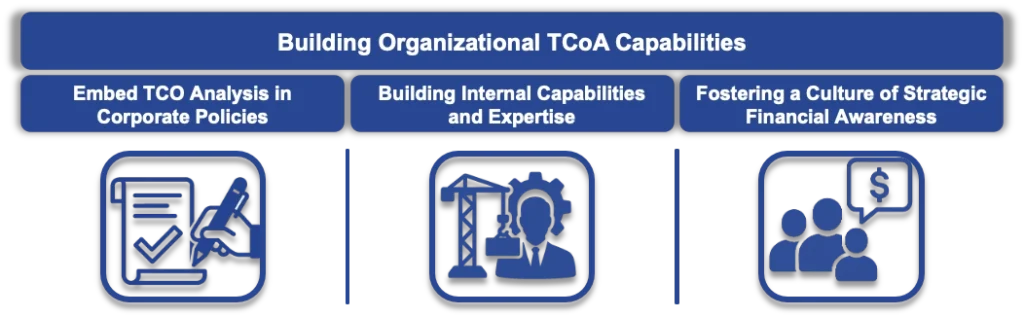
Implementing a robust Total Cost of Ownership (TCO) Analysis framework requires more than just developing a financial model; it necessitates building comprehensive organizational capabilities to ensure its effective and sustained use. This involves establishing clear, well-documented TCO policies that define the analysis scope, methodologies, data requirements, and governance structure. Crucially, it means fostering a TCO-aware culture by providing targeted training to employees across procurement, finance, operations, and IT. These training programs must empower personnel to accurately identify and quantify all direct, indirect, and hidden costs throughout an asset’s lifecycle, transforming TCO from a complex analytical tool into a standard part of the organizational decision-making process.
To fully embed TCO into the organizational DNA, it must be integrated into core corporate processes. This includes mandating its use in business case development, vendor selection, budgeting, and capital expenditure planning. Necessary capabilities extend to securing and maintaining a centralized data repository for historical cost, performance, and lifecycle information, which ensures the accuracy and consistency of future TCO calculations. By focusing on both the procedural (policies, integration) and the human (culture, training) elements, an organization can effectively transform TCO from a one-off project into a powerful, repeatable capability that drives disciplined, long-term strategic investment decisions.
Embed TCO Analysis in Corporate Policies
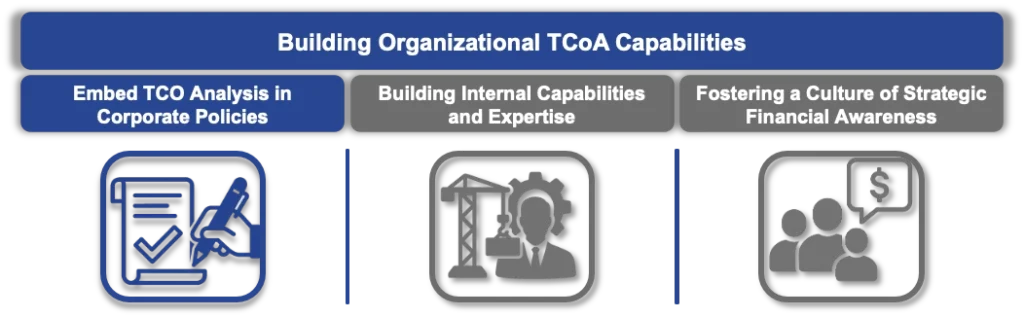
The foundation for effective TCoA institutionalization starts with embedding comprehensive cost analysis into the formal policies, procedures, and governance structures that guide organizational decision-making. This isn’t about creating more bureaucracy; it’s about establishing systematic frameworks that ensure consistent application of TCoA principles across all M&A activities, regardless of deal size or strategic rationale.
Developing formal guidelines represents the critical first step in this transformation. Organizations need comprehensive policies that mandate TCoA analysis for all M&A activities, but these policies have to be more than just checkbox exercises. They need to establish clear methodological standards for assessing integration costs and synergies, define specific roles and responsibilities for analytical activities, and ensure alignment with broader corporate governance and compliance requirements.
The methodological standards must address the full spectrum of acquisition-related costs, from the obvious transaction expenses to the subtle operational adjustments and hidden integration complexities that can derail even well-planned deals. Direct integration costs typically include technology system consolidation, data migration, facility rationalization, and workforce restructuring expenses, but organizations also need to account for indirect costs like management attention, operational disruption, customer retention efforts, and opportunity costs associated with resource reallocation.
What makes this particularly challenging is that many of these costs don’t show up in traditional financial models. How do you quantify the impact of having your best people focused on integration activities instead of growing the core business? What’s the cost of customer confusion during system transitions? How do you account for the competitive opportunities you might miss while you’re distracted by integration challenges? These questions don’t have easy answers, but organizations that ignore them consistently underestimate their total acquisition costs.
Incorporating TCoA considerations into decision-making frameworks ensures that cost analysis actually influences strategic choices rather than merely documenting them after the fact. This requires embedding TCoA analysis into investment evaluation criteria, requiring comprehensive cost assessments in board presentations and approval processes, and utilizing TCoA metrics in strategic planning and resource allocation decisions. The goal is making comprehensive cost analysis an integral part of how organizations evaluate and pursue M&A opportunities, not an afterthought.
Establishing accountability mechanisms provides the governance structure necessary to ensure consistent application of TCoA policies over time. Organizations should assign specific responsibility for TCoA analysis to dedicated roles or committees, monitor adherence to policies through internal audits and reviews, and link performance evaluations to the effective application of TCoA practices. This creates organizational incentives that support analytical rigor and continuous improvement in cost management capabilities.
Building Internal Capabilities and Expertise
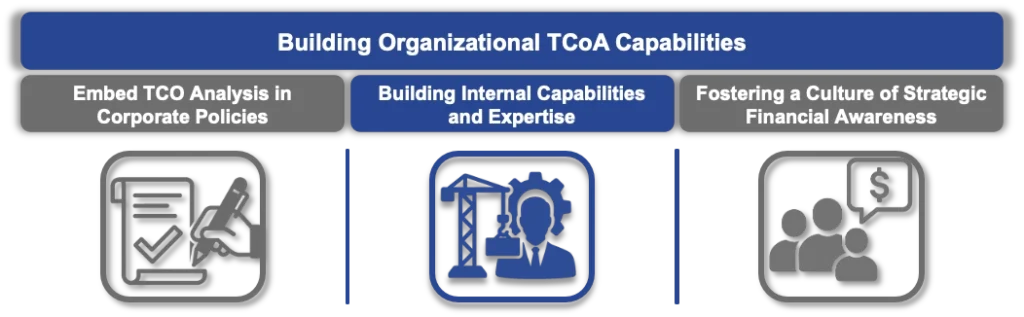
Developing internal TCoA capabilities requires systematic investment in human capital, analytical infrastructure, and institutional knowledge systems. Organizations simply cannot achieve sustainable competitive advantages in M&A by relying primarily on external advisors and consultants. They need to build proprietary capabilities that enable superior analytical performance and faster decision-making.
Training and development programs form the cornerstone of capability-building efforts, but they need to go beyond generic M&A education. Organizations should offer comprehensive training courses and workshops specifically focused on TCoA analysis and integration planning, encourage certifications and continuous learning in relevant areas like finance and project management, and provide ongoing resources and tools to support skill development. These programs must address both technical analytical skills and strategic thinking capabilities, enabling personnel to understand not just how to conduct TCoA analysis, but how to apply insights to create competitive advantages.
The most successful programs combine classroom learning with real-world application, giving participants opportunities to work on actual deals under the guidance of experienced practitioners. This hands-on approach helps people understand the nuances and complexities that don’t come through in textbooks or case studies, while building confidence in applying TCoA methodologies to different types of transactions.
Creating centers of excellence represents a more advanced approach to capability building that can provide significant organizational benefits. These dedicated teams or departments specialize in M&A integration and TCoA analysis, leveraging best practices and lessons learned across the organization while promoting knowledge sharing and collaboration among different teams. Centers of excellence can maintain institutional memory, develop proprietary methodologies, and provide consistent analytical support across various business units and transaction types.
What makes centers of excellence particularly valuable is their ability to accumulate and apply knowledge across multiple transactions. Instead of starting from scratch with each deal, they can draw on previous experiences to identify potential issues, optimize analytical approaches, and accelerate the overall process. They also serve as internal consulting resources that can provide specialized expertise without the cost and coordination challenges of working with external advisors.
Leveraging technology and analytics capabilities enables organizations to handle the complexity and scale of modern TCoA analysis while maintaining accuracy and efficiency. Organizations should invest in software solutions for financial modeling and data analysis, utilize predictive analytics and artificial intelligence to enhance forecasting accuracy, and integrate technology platforms to streamline processes and improve efficiency. These technology investments must be designed to scale with organizational M&A activity while providing the flexibility necessary to accommodate different transaction types and market conditions.
The most sophisticated organizations are starting to use machine learning algorithms to identify patterns in historical integration data that would be impossible to spot manually. They’re building predictive models that can flag potential integration risks months before they become critical issues, and creating automated monitoring systems that provide real-time visibility into integration progress and performance.
Fostering a Culture of Strategic Financial Awareness
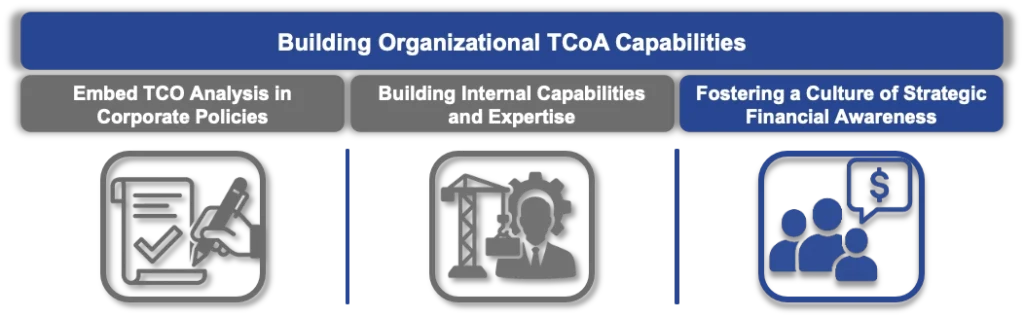
The transformation of organizational TCoA capabilities ultimately depends on creating cultural changes that support analytical excellence and strategic thinking about M&A value creation. This cultural transformation requires sustained leadership commitment and systematic efforts to align organizational incentives with comprehensive cost analysis and long-term value creation.
Promoting organizational buy-in begins with effective communication about the importance of TCoA analysis to all levels of the organization, but it can’t stop there. Leaders need to share specific success stories where comprehensive analysis led to better outcomes, encourage employee engagement and input in refining practices, and demonstrate through their actions, not just their words, that analytical rigor is valued and rewarded. This communication must be ongoing and reinforced through multiple channels to ensure the message reaches all relevant stakeholders.
One of the most effective approaches involves highlighting the competitive advantages that superior TCoA capabilities can create. When people understand that better analysis can lead to winning more deals, achieving better integration outcomes, and creating more value for shareholders, they’re more likely to embrace the additional effort required to do comprehensive cost analysis properly. Research on managing people and processes in M&A integration demonstrates that cultural alignment and employee engagement are critical factors in achieving successful integration outcomes.
Aligning incentives and rewards creates the organizational dynamics necessary to support sustained cultural change. Organizations should recognize and reward teams that effectively implement TCoA analysis, align compensation structures with long-term value creation and strategic goals, and discourage short-term thinking by emphasizing sustainable growth over immediate deal completion. These incentive structures must be carefully designed to avoid unintended consequences while promoting the behaviors and outcomes that support TCoA excellence.
This is trickier than it sounds because traditional M&A incentives often reward deal completion rather than deal performance. Changing these incentive structures requires rethinking how success gets measured and rewarded, which can be challenging for organizations with established cultures and compensation systems.
Continuous improvement and feedback loops ensure that organizational TCoA capabilities evolve and improve over time rather than becoming stagnant or outdated. Organizations should regularly review and update TCoA methodologies based on new insights and market developments, encourage open dialogue about challenges and opportunities in M&A practices, and benchmark against industry standards to remain competitive and innovative. This requires creating systematic processes for capturing and applying lessons learned while maintaining openness to new approaches and methodologies.
Harvard Business Review research on M&A integration success factors emphasizes that organizations achieving superior integration outcomes typically invest heavily in systematic capability building and continuous improvement processes, rather than treating each transaction as an isolated event.
Implications and Future Directions
The institutionalization of comprehensive TCoA analysis represents much more than an operational improvement. It constitutes a fundamental transformation in how organizations approach M&A as a strategic capability. Companies that successfully embed TCoA analysis into their corporate strategies and organizational cultures will develop sustainable competitive advantages that compound across multiple transactions and market cycles.
The evidence supporting this transformation continues to build. Organizations with sophisticated TCoA capabilities consistently demonstrate superior performance across multiple metrics, including deal selection accuracy, integration cost management, synergy realization rates, and overall transaction returns. These performance advantages create virtuous cycles where superior analytical capabilities enable better deal outcomes, which build reputation and access to better opportunities, which provide more chances to refine and improve capabilities.
Looking ahead, several trends will likely accelerate the importance of comprehensive TCoA analysis. The increasing complexity of business integration, driven by technological innovation and regulatory evolution, will make sophisticated cost analysis even more critical for M&A success. The growing emphasis on environmental, social, and governance considerations will create new categories of integration costs and value creation opportunities that require advanced analytical frameworks to assess and manage effectively.
The competitive landscape will also continue evolving in ways that favor organizations with superior TCoA capabilities. As more companies recognize the strategic value of comprehensive cost analysis, the performance gap between leaders and laggards will likely widen, making it increasingly difficult for organizations to compete effectively without sophisticated analytical capabilities.
For senior leaders and executives, the message is clear: organizations that fail to institutionalize comprehensive TCoA analysis will find themselves at systematic disadvantages in an increasingly complex and competitive M&A environment. The companies that recognize this challenge and commit to building world-class TCoA capabilities will position themselves to dominate the next decade of M&A activity while creating sustainable value for all stakeholders.
The transformation requires immediate action and sustained commitment, but the potential rewards (superior deal outcomes, enhanced competitive positioning, and sustainable value creation) more than justify the investment. The question facing organizations today isn’t whether to build comprehensive TCoA capabilities, but how quickly they can develop the analytical excellence that will define M&A leadership in the years ahead.
The post Making the Case: The Necessity of Comprehensive TCoA Analysis in M&A appeared first on JCStrategies.